

Many new runners make the same mistake: they lace up their shoes, hit the pavement hard, and wonder why their knees hurt after a week. The truth is, beginner race preparation requires patience and structure, not just enthusiasm. This guide breaks down everything you need to know about preparing for your first race safely and effectively. You'll discover how to build endurance gradually, avoid common pitfalls, and create a personalized plan that fits your life. Whether you're eyeing a 5K or just want to finish without walking, proper preparation makes all the difference.
Table of Contents
- What Is Beginner Race Preparation And Why Does It Matter?
- Key Components Of Beginner Race Preparation
- Common Beginner Mistakes And How To Avoid Them
- Creating Your Personalized Beginner Race Plan
- Ready To Start Your Beginner Race Journey?
- How Long Should A Beginner Training Plan Be?
- What Is The Best Running Pace For Beginners?
- How Can I Prevent Injuries While Training For My First Race?
- What Should I Eat And Drink On Race Day?
Key takeaways
| Point | Details |
|---|---|
| Run/walk intervals build fitness | Alternating running and walking reduces injury risk while improving endurance for beginners. |
| Consistency beats intensity | Regular easy-paced runs deliver better long-term results than sporadic hard efforts. |
| Proper form prevents injuries | Maintaining good posture and avoiding overstriding protects your body during training. |
| Rest days are essential | Recovery time allows your muscles to adapt and grow stronger between workouts. |
| Personal goals drive motivation | Setting realistic targets based on your fitness level keeps you engaged throughout training. |
What is beginner race preparation and why does it matter?
Beginner race preparation is the process of gradually building your aerobic capacity and running skills to complete your first race safely. It's not about becoming an elite athlete overnight. Instead, it focuses on creating sustainable habits that protect your body while improving your fitness. Beginner training plans span about 12 weeks to give your muscles, joints, and cardiovascular system time to adapt.
The beauty of structured preparation lies in its simplicity. You start where you are, not where you think you should be. Most beginner programs use run/walk intervals, mixing periods of running with walking breaks. This approach lets you build endurance without overwhelming your body. A typical first week might include three sessions of one minute running followed by one minute walking, repeated for 20 minutes total.
Without proper preparation, you risk burnout, injury, or simply hating the experience. Your body needs time to strengthen connective tissues, improve oxygen delivery to muscles, and develop the mental resilience required for race day. Think of it like learning a musical instrument. You wouldn't expect to play a concert after one week of practice. Running works the same way.
The beginner running workflow for first race emphasizes these core principles:
- Start with manageable distances and gradually increase
- Mix running with walking to prevent overexertion
- Allow adequate rest between training sessions
- Focus on consistency rather than speed
- Listen to your body's signals
This foundation protects you from the most common beginner mistakes while building genuine confidence. When race day arrives, you'll know your body can handle the distance because you've trained it systematically. That confidence transforms nervous energy into excitement, making your first race a celebration rather than a survival test.
Key components of beginner race preparation
Every successful beginner training plan includes several essential elements working together. Understanding these components helps you build a balanced approach that develops fitness while minimizing injury risk. Let's break down what matters most.
Run/walk intervals form the foundation
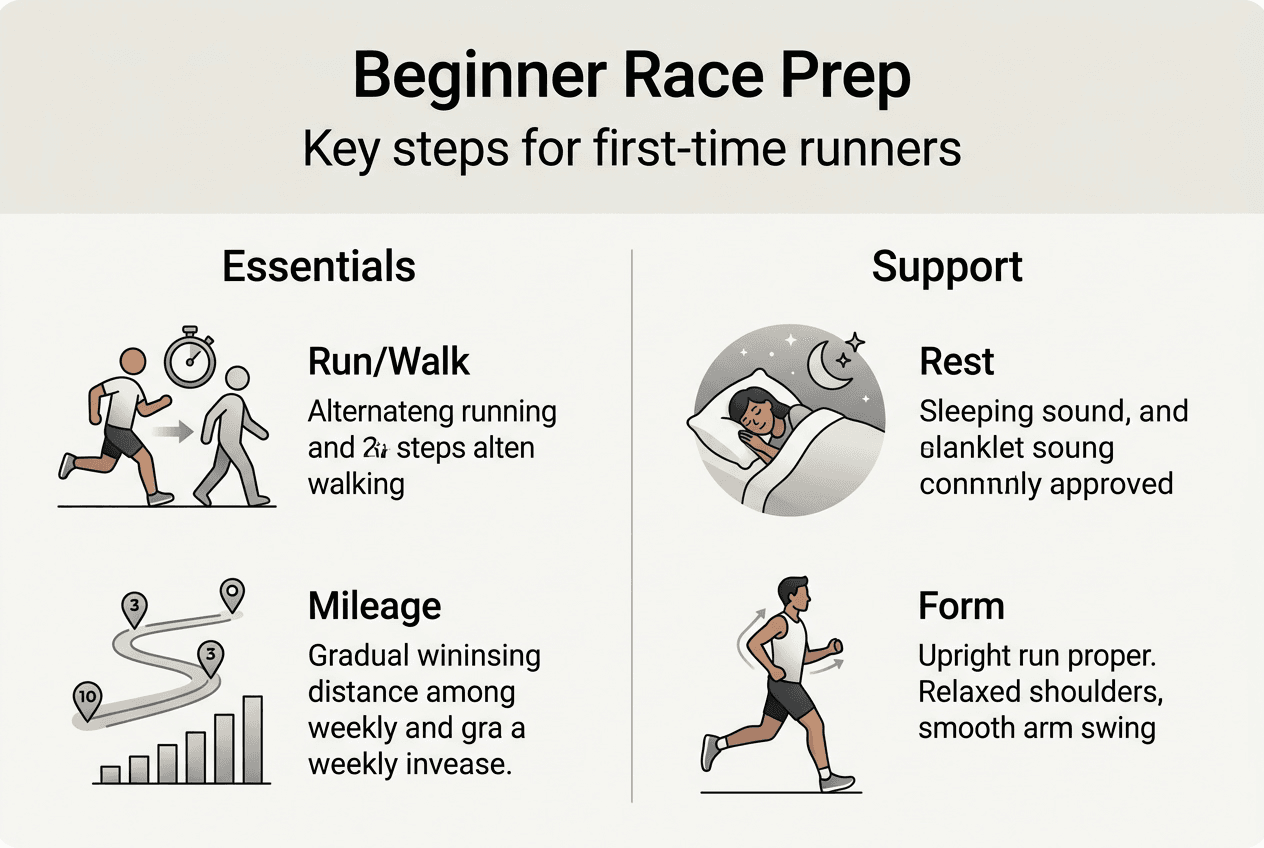
Run/walk intervals minimize injury risk while steadily improving your endurance. Start with a 1:1 ratio, running for one minute and walking for one minute. As weeks progress, gradually increase the running portion. By week four, you might run two minutes and walk one minute. By week eight, you could sustain three or four minutes of running between walk breaks. This progression feels manageable because your body adapts incrementally.

Mileage increases require patience
The 10% rule protects you from doing too much too soon. Never increase your total weekly running volume by more than 10% from one week to the next. If you run six miles this week, aim for no more than 6.6 miles next week. This conservative approach gives your bones, tendons, and muscles time to strengthen. Rushing this process is the fastest route to shin splints, stress fractures, or tendonitis.
Proper running form matters
Good form reduces strain and improves efficiency. Avoid overstriding, which means landing with your foot too far in front of your body. Instead, aim for a cadence of 170-180 steps per minute, taking shorter, quicker steps. Keep your posture upright, shoulders relaxed, and arms swinging naturally at your sides. Your feet should land beneath your hips, not out in front. These adjustments feel awkward initially but become natural with practice.
Hydration and nutrition fuel your training
Hydration before and after runs directly impacts performance and recovery. Drink 17 to 20 ounces of water two hours before running. After your workout, consume 16 to 24 ounces for every pound of body weight lost through sweat. For nutrition, eat a carbohydrate-rich, low-fiber meal one to two hours before running. Oatmeal with banana, toast with peanut butter, or a smoothie work well. Save high-fiber foods for after your run to avoid digestive discomfort.
Rest and recovery build strength
Your body doesn't get stronger during runs. It gets stronger during rest. Schedule at least one or two complete rest days each week. On these days, your muscles repair micro-tears from training, your energy stores replenish, and your nervous system recovers. Cross-training activities like swimming, cycling, or yoga provide active recovery without the impact stress of running. This variety also prevents boredom and works different muscle groups.
Warm-up and cool-down protect your body
Spend five to ten minutes before each run doing dynamic stretches. Leg swings, walking lunges, and high knees prepare your muscles for work. After running, dedicate five minutes to static stretching, holding each stretch for 20 to 30 seconds. Focus on your calves, hamstrings, quadriceps, and hip flexors. These bookend routines reduce stiffness and improve flexibility over time.
Pro Tip: Track your runs in a simple log or app. Note the distance, time, how you felt, and any discomfort. Patterns emerge quickly, helping you identify what works and what needs adjustment.
| Training Element | Beginner Approach | Purpose |
|---|---|---|
| Run/walk ratio | 1:1 initially, progress to 3:1 | Builds endurance safely |
| Weekly mileage increase | Maximum 10% | Prevents overuse injuries |
| Running cadence | 170-180 steps per minute | Improves efficiency, reduces impact |
| Rest days per week | 1-2 complete rest days | Allows muscle recovery |
| Pre-run hydration | 17-20 oz two hours before | Optimizes performance |
Mastering these components transforms random running into purposeful training. Each element supports the others, creating a system that moves you steadily toward race readiness.
Common beginner mistakes and how to avoid them
Even with good intentions, beginners often stumble into predictable traps. Recognizing these pitfalls before they derail your training saves time, pain, and frustration.
Running too fast too soon
Starting too fast leads to early fatigue and increases injury risk dramatically. New runners often push themselves to match what they imagine running should feel like, rather than what their current fitness allows. The solution is simple: use the talk test. You should be able to hold a conversation while running. If you're gasping for air, slow down. About 80% of your weekly miles should feel easy, almost boring. This pace builds your aerobic base without overtaxing your system.
Choosing the wrong shoes
Wrong shoes can cause blisters and contribute to injuries like plantar fasciitis or shin splints. Visit a specialty running store where staff analyze your gait and foot structure. Shoes should feel comfortable immediately, with about a thumb's width of space between your longest toe and the shoe's end. Replace running shoes every 300 to 500 miles, as cushioning breaks down even when the exterior looks fine. Never start training in brand new shoes on race day.
Skipping rest days
More isn't always better. Overtraining syndrome develops when you don't allow adequate recovery between workouts. Symptoms include persistent fatigue, declining performance, mood changes, and increased susceptibility to illness. Your training plan includes rest days for a reason. Honor them. If you feel restless, do gentle yoga or take a leisurely walk. These activities promote blood flow without adding training stress.
Neglecting warm-ups and cool-downs
Jumping straight into running without preparation increases injury risk and reduces performance. Cold muscles are stiff and less responsive. A proper warm-up gradually elevates your heart rate and prepares your body for work. Similarly, stopping abruptly after hard effort can cause blood to pool in your legs, leading to dizziness. A cool-down helps your body transition back to its resting state smoothly.
Ignoring pain signals
Discomfort is normal when building fitness. Pain is not. Learn the difference. General muscle soreness that improves with movement is expected. Sharp, localized pain that worsens with activity signals a problem. Pushing through genuine pain leads to serious injuries that sideline you for weeks or months. When something hurts, rest for a day or two. If pain persists, consult a healthcare provider. Taking two days off now beats taking two months off later.
Comparing yourself to others
Your only competition is yourself. Someone else's pace, distance, or progress has no bearing on your journey. Social media makes this trap especially tempting, but remember that you're seeing highlights, not the full story. Focus on your own improvements. Celebrate running for ten minutes straight when last month you could only manage five. That's real progress, regardless of what anyone else is doing.
Pro Tip: If you miss a scheduled run, don't try to make it up by doubling the next session. Just continue with your plan as written. One missed workout won't derail your preparation, but trying to compensate might.
Understanding running structure for race success helps you avoid these mistakes systematically. Structure provides guardrails that keep you progressing safely while building the discipline needed for long-term running success.
Creating your personalized beginner race plan
Now comes the exciting part: building a training plan tailored to your life, fitness level, and goals. A well-designed 12-week schedule transforms abstract advice into concrete daily actions.
Week 1 through 4: Building the foundation
- Start with three running sessions per week, allowing rest days between each
- Begin with 20 to 25 minutes total, using 1:1 run/walk intervals
- Gradually shift to 2:1 intervals by week four (two minutes running, one minute walking)
- Keep your pace conversational throughout every session
- Add one day of cross-training like cycling or swimming
Week 5 through 8: Increasing endurance
- Extend total session time to 30 to 35 minutes
- Progress to 3:1 or 4:1 run/walk ratios
- Introduce one slightly longer run each week, building to 40 minutes
- Maintain two shorter runs at 25 to 30 minutes
- Continue one cross-training day and one complete rest day
Week 9 through 11: Race-specific preparation
- Practice running continuously for 20 to 30 minutes without walk breaks
- Include one session at your target race pace for 10 to 15 minutes
- Reduce overall volume slightly to allow for higher intensity work
- Simulate race conditions during one weekend run (same time of day, similar terrain)
- Focus on nutrition and hydration strategies you'll use on race day
Week 12: Taper and race week
- Cut your running volume by 40 to 50% to allow full recovery
- Keep intensity easy, with one short session at race pace
- Prioritize sleep, aiming for eight hours per night
- Finalize race day logistics (transportation, gear, nutrition)
- Trust your training and approach race day with confidence
Consistency at lower intensity improves fitness better than sporadic high-intensity efforts. This principle underlies the entire 12-week structure. You're teaching your body to sustain effort comfortably rather than surviving occasional hard workouts.
Pre-race nutrition guidelines
Two to three days before your race, increase carbohydrate intake slightly while reducing fiber and fat. This loads your muscles with glycogen without causing digestive issues. On race morning, eat a familiar breakfast two to three hours before the start. Good options include a bagel with jam, oatmeal with honey, or toast with banana. Drink 16 ounces of water, then sip another 8 ounces 30 minutes before the race begins.
Tracking progress and staying motivated
Celebrate small victories throughout your training. Did you run for five minutes straight without stopping? That's worth acknowledging. Did you complete all three runs this week? Give yourself credit. These incremental wins build momentum and reinforce positive habits. Consider sharing your progress with a friend or joining an online community for accountability and encouragement.
The step-by-step running plan for beginners provides additional structure and guidance as you progress. Different weekly running schedules for beginners accommodate various lifestyles and fitness levels, ensuring you find an approach that works for you.
| Week Range | Run/Walk Ratio | Total Weekly Time | Key Focus |
|---|---|---|---|
| 1-4 | 1:1 to 2:1 | 60-75 minutes | Building base fitness |
| 5-8 | 3:1 to 4:1 | 90-105 minutes | Increasing endurance |
| 9-11 | Continuous running | 90-100 minutes | Race-specific preparation |
| 12 | Continuous running | 45-50 minutes | Taper and recovery |
Your personalized plan isn't set in stone. Life happens. You might need to adjust for illness, work demands, or unexpected events. That's fine. The key is maintaining overall consistency over the 12 weeks, not perfection in every single workout.
Ready to start your beginner race journey?
You've learned the fundamentals of race preparation, from run/walk intervals to avoiding common mistakes. Now it's time to put this knowledge into action. Creating and following a structured plan transforms good intentions into race day reality. Improvio app beginner running takes the guesswork out of training by generating personalized schedules based on your current fitness, available time, and race goals. The platform tracks your progress automatically, adjusts your plan as needed, and provides beginner-specific guidance every step of the way.

Join thousands of beginners who've successfully prepared for their first race with expert guidance and community support. Your running journey starts with a single step, but it succeeds with a solid plan.
How long should a beginner training plan be?
How long should a beginner training plan be?
Most beginner training plans last 12 weeks, giving your body sufficient time to adapt safely to running demands. This duration allows for gradual mileage increases, proper recovery, and building the aerobic base needed for race completion. Shorter plans risk injury from progressing too quickly, while longer plans may lead to burnout or loss of motivation.
What is the best running pace for beginners?
Your ideal pace allows comfortable conversation throughout the run, often called the talk test. About 80% of your training miles should feel easy, even slightly boring. This conversational pace builds aerobic fitness efficiently without overtaxing your cardiovascular system or muscles. Speed develops naturally as your fitness improves over weeks and months.
How can I prevent injuries while training for my first race?
Increase weekly mileage by no more than 10%, use run/walk intervals initially, and invest in properly fitted running shoes. Schedule regular rest days, listen to your body's pain signals, and never push through sharp or worsening discomfort. Proper warm-ups, cool-downs, and cross-training also reduce injury risk significantly.
What should I eat and drink on race day?
Eat a low-fiber, high-carbohydrate breakfast two to three hours before your race starts. Good options include toast with jam, oatmeal with honey, or a bagel with banana. Hydrate with 16 ounces of water, then sip another 8 ounces 30 minutes before the start. Never experiment with new foods on race day; stick with what you've tested during training runs.