

You've logged countless miles, followed training plans religiously, and pushed your body to new limits. Yet on race day, doubt creeps in and your legs feel heavy before the starting gun fires. Psychological preparation can increase time trial performance over 10%, proving that physical fitness alone doesn't guarantee success. Mental training bridges the gap between your potential and actual performance, transforming how you handle discomfort, maintain focus, and execute race strategy. This guide explains what mental training is, why it matters for beginner runners, and how to build psychological resilience through proven techniques.
Table of Contents
- What Is Mental Training For Runners And Why It Matters
- Core Mental Training Techniques For Beginner Runners
- Using Challenging Conditions And Pacing Strategies To Strengthen Mental Resilience
- Applying Mental Training: Practical Steps For Beginner Runners
- Boost Your Running With The Right Training Tools
- Frequently Asked Questions
Key takeaways
| Point | Details |
|---|---|
| Mental training improves results | Psychological preparation can boost race times and reduce how hard running feels |
| Core techniques build resilience | Visualization, positive self-talk, and mindfulness strengthen mental toughness |
| Challenging conditions create growth | Training in hills, heat, or longer distances prepares your mind for race stress |
| Pacing requires mental skill | Negative split strategy integrates mind and body control for better endurance |
| Consistent practice matters most | Daily mental training sessions build neural pathways that enhance race performance |
What is mental training for runners and why it matters
Mental training involves psychological preparation that enhances focus, confidence, and pain management during runs. While physical conditioning builds cardiovascular strength and muscular endurance, mental training shapes how you interpret discomfort, maintain motivation, and execute strategy under pressure. Think of it as programming your mind to support what your body can already do.
The science backs this approach convincingly. Research shows mental training can improve running performance through faster times or reduced perceived effort, even when physical fitness stays constant. Your brain processes fatigue signals and decides whether to slow down or push through, making psychological preparation as crucial as interval workouts.
Beginner runners face common mental barriers that physical training alone can't solve:
- Pre-race anxiety that disrupts sleep and focus
- Negative self-talk during challenging moments
- Difficulty managing discomfort in the final miles
- Inability to maintain pacing strategy under stress
- Loss of motivation during long training cycles
These obstacles explain why two runners with identical fitness levels perform differently on race day. The runner with stronger mental skills maintains composure when fatigue builds, executes pacing strategy despite discomfort, and finishes with energy reserves intact. Mental preparation creates this competitive advantage.
Expert runners consistently credit psychological strength as the difference between achieving personal bests and falling short of goals, even when physical preparation feels complete.
Building mental resilience complements your running form guide for beginners and beginner running workflow for first race by addressing the psychological demands of endurance performance. Physical training teaches your body to run efficiently. Mental training teaches your mind to support that efficiency when conditions get tough.
Core mental training techniques for beginner runners
Practical mental training methods deliver measurable improvements in resilience and performance when applied consistently. These evidence-based techniques help beginner runners build psychological strength through deliberate practice, creating neural pathways that activate automatically during challenging moments.
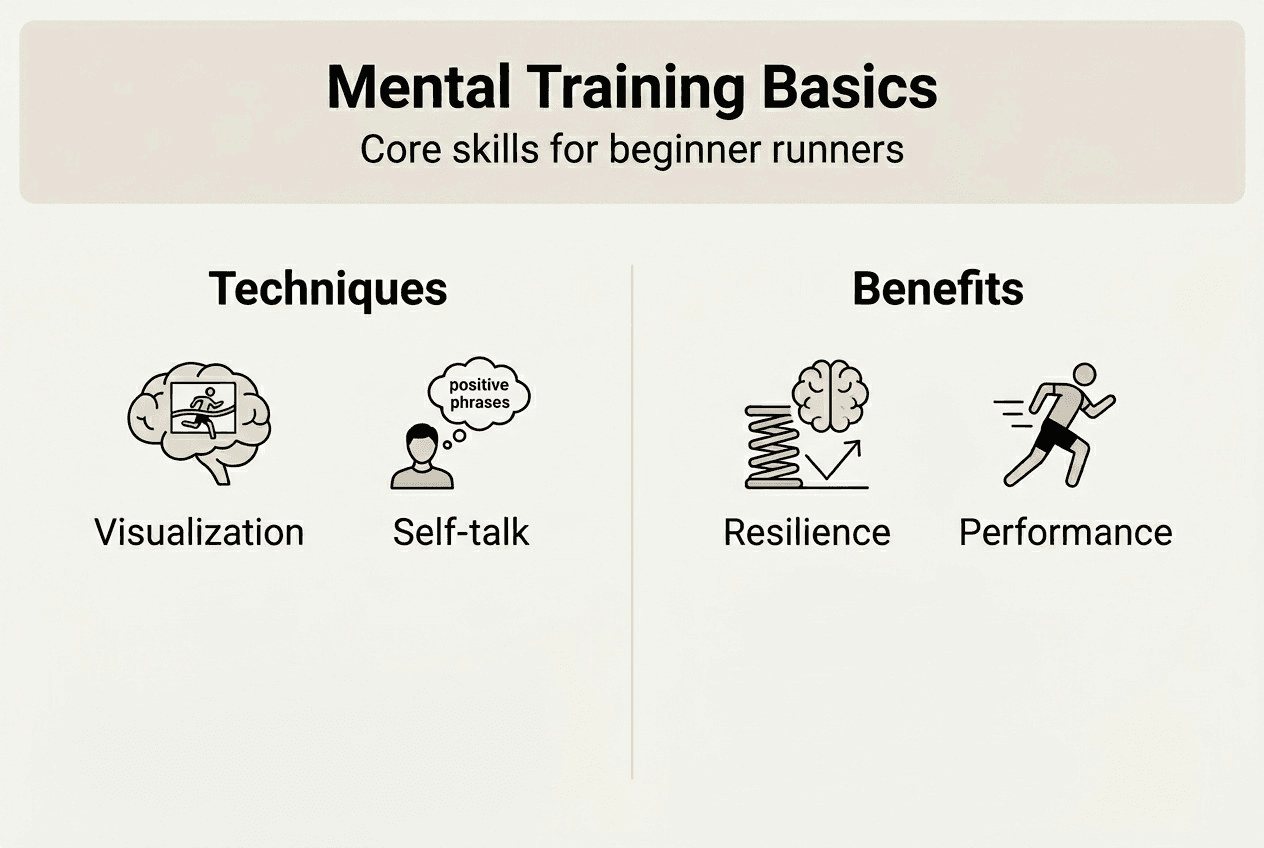
Visualization involves mentally rehearsing race scenarios before they happen. Spend five minutes after easy runs picturing yourself handling tough moments with confidence. Visualization and mental rehearsal create neural pathways that help runners respond confidently to challenging race situations, essentially training your brain to recognize and execute successful patterns. Imagine the final mile of your race, feeling tired but maintaining form and pace. Picture crossing the finish line strong.
Positive self-talk replaces destructive internal dialogue with constructive mantras. Positive self-talk helps overcome negative internal dialogue during tough runs by interrupting the spiral of doubt. When your mind whispers "I can't do this," respond with specific affirmations like "I am strong" or "I've trained for this moment." The key is choosing mantras that feel authentic rather than generic cheerleading.
Mindfulness keeps you anchored in the present moment rather than catastrophizing about future discomfort. Focusing on immediate experiences like breathing rhythm helps prevent overwhelming thoughts about future pain. During runs, direct attention to your foot strike pattern, breathing cadence, or arm swing. This present-moment awareness interrupts anxiety loops and makes discomfort more manageable.
Follow this sequence to build mental skills systematically:
- Practice visualization for five minutes after two easy runs per week
- Choose three personal mantras and repeat them during challenging training moments
- Dedicate one run weekly to mindfulness, focusing entirely on breath and body sensations
- Combine techniques during tempo runs or race simulations
- Review what worked and adjust your mental toolkit based on results
Mental training isn't about eliminating discomfort. It's about changing your relationship with discomfort so it doesn't control your performance.
Pro Tip: Record small victories in a training journal to build confidence. Note moments when mental techniques helped you push through tough miles or maintain composure during challenging conditions.
Integrate these practices with your easy running drills for beginners to create a comprehensive training approach. Mental skills require repetition to become automatic, just like physical movements. The runner who practices visualization weekly will access those neural pathways naturally when race anxiety builds.
Using challenging conditions and pacing strategies to strengthen mental resilience
Deliberately training in tough conditions builds mental toughness by exposing you to race-day stressors in controlled settings. Deliberately seeking challenging training conditions builds confidence in handling race-day challenges, transforming uncertainty into familiarity. When you've successfully completed long runs in heat or conquered hilly routes during training, similar race conditions feel manageable rather than overwhelming.

Different training environments create distinct mental and physical adaptations:
| Training Condition | Mental Resilience Benefit | Physiological Adaptation |
|---|---|---|
| Hill repeats | Teaches persistence through immediate discomfort | Builds leg strength and power |
| Heat training | Develops patience and effort management | Improves thermoregulation and plasma volume |
| Long slow distance | Builds endurance mindset and time management | Enhances aerobic capacity and fat utilization |
| Tempo runs | Strengthens focus under sustained effort | Raises lactate threshold |
Negative split pacing represents the intersection of mental and physical training. This strategy involves running the second half of your race faster than the first half, requiring strategic restraint early and mental toughness late. Negative split pacing is a trainable skill that integrates physiological, cognitive, and behavioral regulation, improving endurance performance through deliberate practice.
The mental challenge of negative splits lies in holding back when you feel fresh and accelerating when fatigue builds. Your brain receives conflicting signals: early in the race, it wants to match the pace of faster runners around you. Late in the race, it amplifies discomfort signals and suggests slowing down. Successful negative split execution requires ignoring both impulses and trusting your predetermined strategy.
Research reveals successful negative splits correlate with improved lactate threshold, VO2 kinetics, running economy, central fatigue resistance, and pacing awareness. These adaptations don't develop through physical training alone. They require mental discipline to execute pacing strategy despite internal pressure to deviate.
Pro Tip: Introduce challenging conditions gradually, starting with one tough element per week. Monitor perceived effort rather than pace alone to avoid burnout while building mental resilience.
Practice negative split pacing during training runs to build confidence in the strategy:
- Start tempo runs at goal pace, then increase speed by 10 seconds per mile in the final third
- Use long runs to practice patient early pacing and strong finishing
- Track split times to verify you're executing the strategy correctly
- Notice how controlled early effort creates energy reserves for later acceleration
Understanding the role of pacing in beginner running helps you appreciate why mental training and pacing strategy work together. Pacing isn't just about physical capacity. It's a psychological skill that improves through deliberate practice and mental preparation.
Applying mental training: practical steps for beginner runners
Integrating mental training into your running routine requires a systematic approach that builds skills progressively. Start with a weekly schedule that balances physical workouts with psychological preparation, creating space for both types of development.
Follow this sequence to develop mental skills alongside physical fitness:
- Week one through four: Practice five-minute visualization sessions after two easy runs weekly, picturing yourself handling race challenges confidently
- Week five through eight: Add positive mantras during one challenging workout per week, repeating affirmations when discomfort builds
- Week nine through twelve: Dedicate one run weekly to mindfulness practice, focusing on breathing rhythm and present-moment awareness
- Week thirteen through sixteen: Introduce one challenging training condition weekly, such as hills or heat, to build mental toughness
- Week seventeen through race day: Practice negative split pacing during tempo runs and race simulations to refine strategy execution
This progression prevents mental fatigue while building psychological resilience systematically. Mental fatigue reduces running speed while positive psychological states improve it, making recovery and balance essential for optimal performance.
Create a sustainable mental training practice through these guidelines:
- Schedule mental training sessions at consistent times to build habit strength
- Keep visualization and mindfulness sessions brief, five to ten minutes maximum
- Practice mental techniques during easy runs first, then progress to harder workouts
- Use race simulations to test mental strategies under realistic conditions
- Adjust your approach based on what works best for your personality and goals
Pro Tip: Record small victories and progress in a training journal to build confidence and maintain motivation. Note specific moments when mental techniques helped you push through challenging miles or maintain composure under pressure.
Avoid common mental training mistakes that undermine progress. Don't practice only physical skills while neglecting psychological preparation. Don't wait until race week to introduce mental training techniques. Don't push through mental fatigue the same way you might push through physical tiredness. Mental skills require fresh cognitive resources to develop effectively.
Balance training load by incorporating rest days that allow both physical and mental recovery. Your brain needs downtime to consolidate new neural pathways created through mental training practice. Overtraining affects psychological resilience just as much as physical performance.
Use mental training especially during tougher runs and race-day simulations to prepare for stress. The goal is making psychological techniques automatic, so they activate naturally when you need them most. A runner who only visualizes success during easy runs may struggle to access those skills when race pressure builds.
Integrate these principles with resources on how to make a training plan and a step-by-step running plan for beginners to create comprehensive preparation. Mental training isn't separate from physical training. It's the psychological foundation that allows you to execute physical preparation successfully on race day.
Boost your running with the right training tools
Mental training works best when supported by structured planning and consistent practice. You've learned powerful psychological techniques, but implementing them alongside physical workouts requires organization and accountability.

Improvio creates personalized training schedules that integrate physical workouts with mental skill development, making it easier to build both types of strength simultaneously. The platform designs beginner-friendly plans based on your current fitness, available time, and race goals, removing guesswork from the training process. You'll know exactly when to practice visualization, which runs to focus on mindfulness, and how to progress challenging conditions safely.
Using supportive running training tools and plans increases finish rates and running confidence by providing structure during the inevitable moments of doubt. Mental resilience grows through consistent practice, and having a clear roadmap makes that consistency achievable even for absolute beginners.
Frequently asked questions
What is mental training for runners?
Mental training involves psychological preparation techniques that enhance focus, confidence, and pain management during running. It includes practices like visualization, positive self-talk, mindfulness, and strategic pacing that complement physical conditioning. These skills help runners handle discomfort, maintain motivation, and execute race strategy under pressure.
How often should I practice mental training techniques?
Short daily sessions or post-easy run practice works best for beginners, typically five to ten minutes per session. Consistency builds neural pathways more effectively than occasional long sessions. Start with two to three sessions weekly and gradually increase frequency as mental skills become more natural and automatic.
Can mental training help if I am not physically strong?
A strong mental game can compensate for lower physical talent by maximizing whatever fitness you possess. Mental resilience improves endurance, focus, and pacing execution, allowing you to perform closer to your physical potential. Many beginner runners discover that psychological preparation unlocks performance gains that seemed impossible through physical training alone.
What is negative split pacing and why is it important?
Negative split pacing means running the second half of your race faster than the first half, requiring strategic restraint early and mental toughness late. This approach is linked to improved endurance and race outcomes through better mental and physiological control. Learning to execute negative splits teaches valuable lessons about effort management and strategic thinking that apply across all race distances. Understanding the role of pacing in beginner running helps you appreciate why this strategy works so effectively.