

You've signed up for your first race and feel ready to lace up and run. Many new runners believe showing up on race day is enough, but the reality is stark: nearly two-thirds of runners without structured preparation suffer injuries before reaching the finish line. A personalized training plan doesn't just reduce injury risk, it builds the fitness, pacing skills, and mental confidence you need to cross that finish line feeling strong. This article reveals why structured training transforms your first race from a painful struggle into a rewarding achievement.
Table of Contents
- Key Takeaways
- How structured training plans reduce injury risk
- Training volume and quality sessions drive better race performance
- Why personalization and proper pacing matter for new runners
- Supporting your first race success with adherence and support
- Boost your first race confidence with a tailored training plan
- FAQ
Key Takeaways
| Point | Details |
|---|---|
| Ten percent rule | Increasing weekly mileage by more than ten percent raises injury risk, so a structured plan progresses mileage gradually. |
| Strength and mobility | Incorporating targeted exercises such as squats, lunges, planks, and hip bridges strengthens hips and core to prevent injuries. |
| Periodization approach | Build, peak, and taper phases sequence stress and recovery to protect beginners from burnout and injury. |
| Planned rest days | Scheduling one complete rest day per week during the build phase supports recovery and injury prevention. |
| Volume and quality | Higher weekly distance and quality sessions are linked to faster race times when combined with appropriate cross training. |
How structured training plans reduce injury risk
Running without a plan feels liberating until pain sidelines your progress. Research shows that plans reduce injury risk by gradual mileage increases (10% rule), incorporating strength, mobility, and periodization with build/peak/taper phases, creating a framework that protects beginners from the most common training mistakes. When you follow structured running schedules for beginners, you're not just logging miles randomly. You're building resilience systematically.
The 10% rule serves as your safety net. Increasing weekly mileage by more than 10% overwhelms your muscles, tendons, and bones before they adapt to new stress. A quality plan maps out these increments week by week, ensuring your body strengthens progressively rather than breaking down. This single principle prevents the shin splints, stress fractures, and tendonitis that derail eager beginners who ramp up too fast.
Strength and mobility exercises form the second pillar of injury prevention. Running alone doesn't prepare your hips, glutes, and core for the repetitive impact of thousands of footstrikes. Training plans incorporate targeted exercises that stabilize your joints and correct muscle imbalances. Squats, lunges, planks, and hip bridges become as important as your running workouts, creating a foundation that keeps you upright and pain-free through race day.
Periodization phases represent the third layer of protection. Your plan divides training into distinct build, peak, and taper phases, each serving a specific purpose. The build phase gradually increases volume while your body adapts. The peak phase adds intensity without excessive mileage. The taper phase reduces training load so you arrive at the start line fresh and strong. This rhythm of stress and recovery prevents the chronic fatigue that leads to injury.
Pro Tip: Schedule one complete rest day per week during your build phase. Your body repairs and strengthens during rest, not while running. Skipping rest days might feel productive, but it's the fastest path to injury.
| Training approach | Injury rate | Common injuries |
|---|---|---|
| Structured plan with gradual progression | 25-30% | Minor muscle soreness, occasional tightness |
| Self-directed training without structure | 65-70% | Shin splints, stress fractures, tendonitis, IT band syndrome |
| Structured plan without strength work | 45-50% | Knee pain, hip issues, muscle strains |
The data reveals a clear pattern. Beginners who combine gradual mileage increases with strength training cut their injury risk by more than half compared to those who simply run more each week. Your first race should celebrate your commitment and progress, not mark the end of running due to preventable injury.
Training volume and quality sessions drive better race performance
Crossing the finish line matters, but finishing strong feels even better. A Boston Marathon training study found that higher weekly distance, quality sessions, and cross-training are associated with faster race times, while reducing session frequency pre-race improves performance. Understanding how volume and intensity work together helps you maximize every training week.
Weekly mileage builds your aerobic engine. Running more miles at easy pace increases capillary density in your muscles, allowing more oxygen delivery to working tissues. Your heart strengthens, pumping more blood per beat. Your body learns to burn fat efficiently, sparing precious glycogen for harder efforts. These adaptations don't happen overnight, which is why training plans for beginner runners gradually build volume over 12 to 16 weeks.

Quality sessions add the speed component that pure volume can't provide. Interval workouts, tempo runs, and hill repeats push your body beyond comfortable paces, improving running economy and VO2max. Your legs learn to turn over faster. Your lungs process oxygen more efficiently. Your mind discovers you're capable of harder efforts than you imagined. These sessions typically comprise 20% of your weekly training, with the remaining 80% at easy conversational pace.
Cross-training offers aerobic benefits without the pounding. Cycling, swimming, and elliptical workouts elevate your heart rate while giving your joints a break from impact stress. This variety prevents overuse injuries while maintaining cardiovascular fitness. Many successful first-time racers incorporate one or two cross-training sessions per week, especially during high-mileage phases when injury risk peaks.
The taper phase might feel counterintuitive, but it's where race-day magic happens. Reducing training volume by 40-60% in the final two weeks allows accumulated fatigue to dissipate while fitness remains. Your glycogen stores fill completely. Minor aches resolve. Mental freshness returns. Runners who taper properly often surprise themselves with performances exceeding their training predictions.
Pro Tip: Don't add new workouts during your taper. Trust the fitness you've built and resist the urge to squeeze in extra sessions. Fresh legs on race day beat tired legs every time.
| Training element | Structured quality training | Unstructured running |
|---|---|---|
| Weekly volume progression | Gradual 10% increases with planned peaks | Random mileage based on daily motivation |
| Hard sessions per week | 1-2 quality workouts (intervals, tempo, hills) | Occasional fast runs without purpose |
| Easy pace discipline | 80% of miles at conversational effort | Most runs at moderate-hard effort |
| Cross-training integration | 1-2 sessions weekly to supplement running | Rarely included or considered |
| Taper execution | Planned 2-week volume reduction | Often skipped or poorly timed |
| Race day readiness | Arrives fresh with peaked fitness | Often overtrained or undertrained |
The contrast is striking. Structured running schedules transform random effort into purposeful progression. Each workout serves a specific physiological goal, building the endurance, speed, and resilience you need to achieve your race day potential.
Why personalization and proper pacing matter for new runners
Generic plans treat all beginners identically, but your fitness level, schedule constraints, and learning pace are unique. Research on novice training strategy shows you should match plans to current fitness and commitment, with novices favoring pyramidal training while including intervals to improve economy and endurance. Personalization turns a good plan into your perfect plan.
Pyramidal training structures your weekly intensity distribution with most miles at easy pace, moderate volume at threshold pace, and smaller amounts at high intensity. This approach suits beginners better than polarized training, which alternates between very easy and very hard with little middle ground. Your body needs time to adapt to running itself before adding extreme intensity variations. Pyramidal progression builds fitness safely while teaching pacing discipline.
The 80/20 rule governs effective easy pace execution. Plans teach you to run easy pace (80/20 rule), strides, and hills early; longer plans benefit true beginners, establishing habits that prevent the common mistake of running every workout too hard. Easy pace feels almost embarrassingly slow at first. You should hold conversations comfortably. Your breathing stays controlled. This restraint builds aerobic capacity without accumulating excessive fatigue.
Strides and hill work appear early in quality plans for good reason. Strides are short 20-30 second bursts at faster pace that improve running form and neuromuscular coordination. Hills build leg strength and power without the injury risk of track intervals. Both elements prepare your body for harder sessions later while adding variety that keeps training interesting. These workouts take just minutes but deliver disproportionate benefits.
Tailoring plan length to your starting fitness prevents frustration and injury. True beginners who rarely exercise need 16 to 20 weeks to build the base fitness required for race day success. Recreational athletes with recent activity can succeed with 12 to 14 weeks. Rushing this timeline invites injury and burnout. Extending it beyond your needs risks losing motivation.
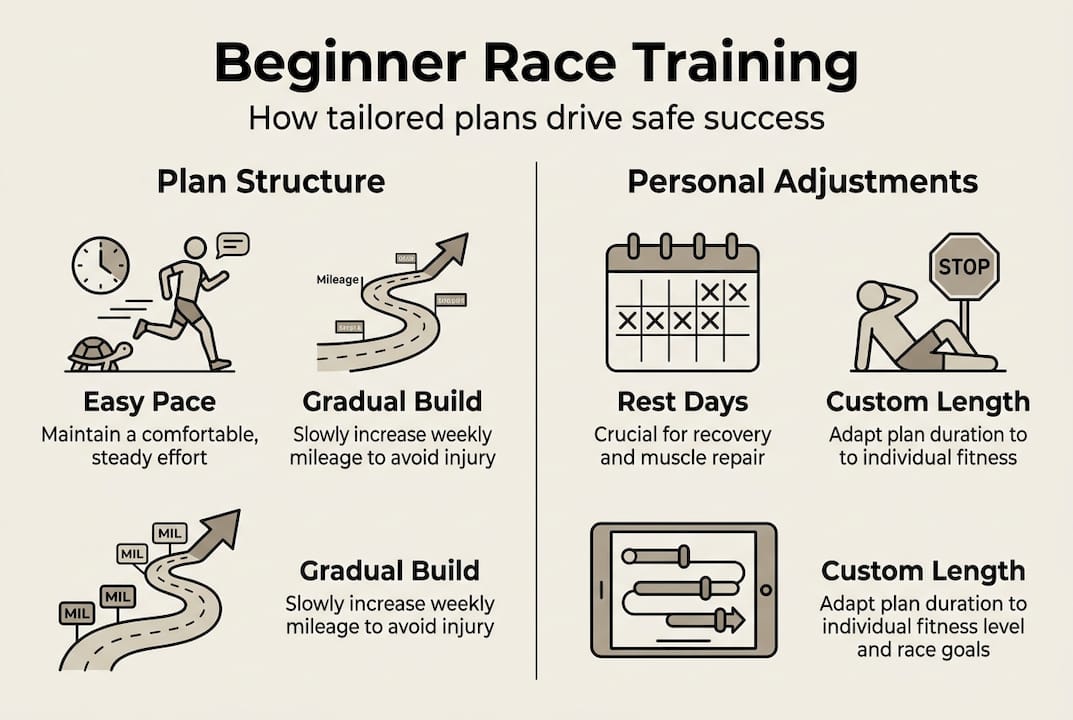
Pro Tip: Test your easy pace in week two by running while holding a conversation with a training partner or talking aloud to yourself. If you can't speak in complete sentences, you're running too fast. Slow down and build your aerobic base properly.
Personalizing your first race training plan:
- Assess your current fitness honestly by noting how far you can run comfortably today without stopping
- Choose a race distance that challenges you without overwhelming your current abilities
- Select a plan length that provides adequate preparation time based on your starting point
- Identify your available training days per week and pick a plan matching that commitment
- Determine your easy pace using the talk test and set all easy runs at this effort
- Schedule quality sessions on days when you have adequate recovery time and mental energy
- Build in flexibility for life events by treating some workouts as optional or movable
- Track your progress weekly to ensure the plan remains challenging but achievable
Running structure for beginners provides the framework, but personalization ensures that structure fits your life. A plan you can actually follow beats a theoretically perfect plan you abandon after three weeks. When you choose a guided running plan for your first race, prioritize one that adapts to your reality rather than forcing you into someone else's template.
Supporting your first race success with adherence and support
The best training plan fails if you don't follow it. Research reveals that structured training improves adherence and performance but fails without personalization and social support, highlighting the human factors that determine whether you reach race day prepared or defeated. Understanding these psychological elements helps you build systems that keep you committed.
Unstructured plans fail because they lack personalization and accountability. When workouts feel arbitrary or disconnected from your goals, skipping them becomes easy. When no one notices your absence, motivation fades. Generic plans can't anticipate your work schedule, family obligations, or energy fluctuations. They provide a framework but no flexibility, leading to guilt when life intervenes and eventual abandonment.
Social support transforms solo suffering into shared experience. Training partners provide accountability on days when motivation runs low. Running groups offer camaraderie and practical advice from those further along the journey. Even virtual communities create connection and encouragement. Sharing your training progress, struggles, and victories makes the process less isolating and more sustainable.
Tracking progress maintains momentum through inevitable plateaus. Logging your runs creates a visual record of consistency and improvement. Watching weekly mileage accumulate builds confidence. Noting pace improvements validates your effort. This data becomes especially valuable during tough weeks when you question whether training is working. Your log proves you're stronger than you were last month.
"Most beginner training programs fail not because the physiology is wrong, but because they ignore the psychology of behavior change. Without personalization, social support, and progress tracking, even scientifically sound plans can't overcome human nature."
Maintaining commitment throughout your training cycle:
- Set specific process goals like completing all scheduled workouts rather than outcome goals like finishing time
- Find a training partner or group that matches your pace and schedule for mutual accountability
- Celebrate weekly milestones to maintain motivation through the long preparation period
- Prepare for setbacks by planning how you'll handle missed workouts or minor injuries
- Connect with the running community through local clubs, online forums, or social media groups
- Reward consistency with non-food treats like new running gear or post-run rituals you enjoy
- Visualize race day success regularly to maintain emotional connection to your goal
- Adjust your plan when necessary rather than abandoning it completely during difficult weeks
Beginner runner motivation for your first race comes from multiple sources, but consistency builds its own momentum. Each completed workout strengthens your identity as a runner. Each week of training proves you're capable of sustained effort. This psychological transformation matters as much as the physical adaptations. By race day, you're not just fitter, you're fundamentally different.
The beginner running workflow for your first race integrates training structure with behavioral strategies that support adherence. Your workflow includes not just what to run, but when to run, how to track progress, who to run with, and how to recover. This comprehensive approach addresses the whole experience of becoming a runner, not just the physiological demands.
Boost your first race confidence with a tailored training plan
You've learned why structured training matters and how personalization maximizes results. Now it's time to put these insights into action with a plan designed specifically for your fitness level, schedule, and race goals. Improvio creates personalized running plans in about 60 seconds, giving you immediate access to the structure and guidance that transform first race anxiety into confidence.
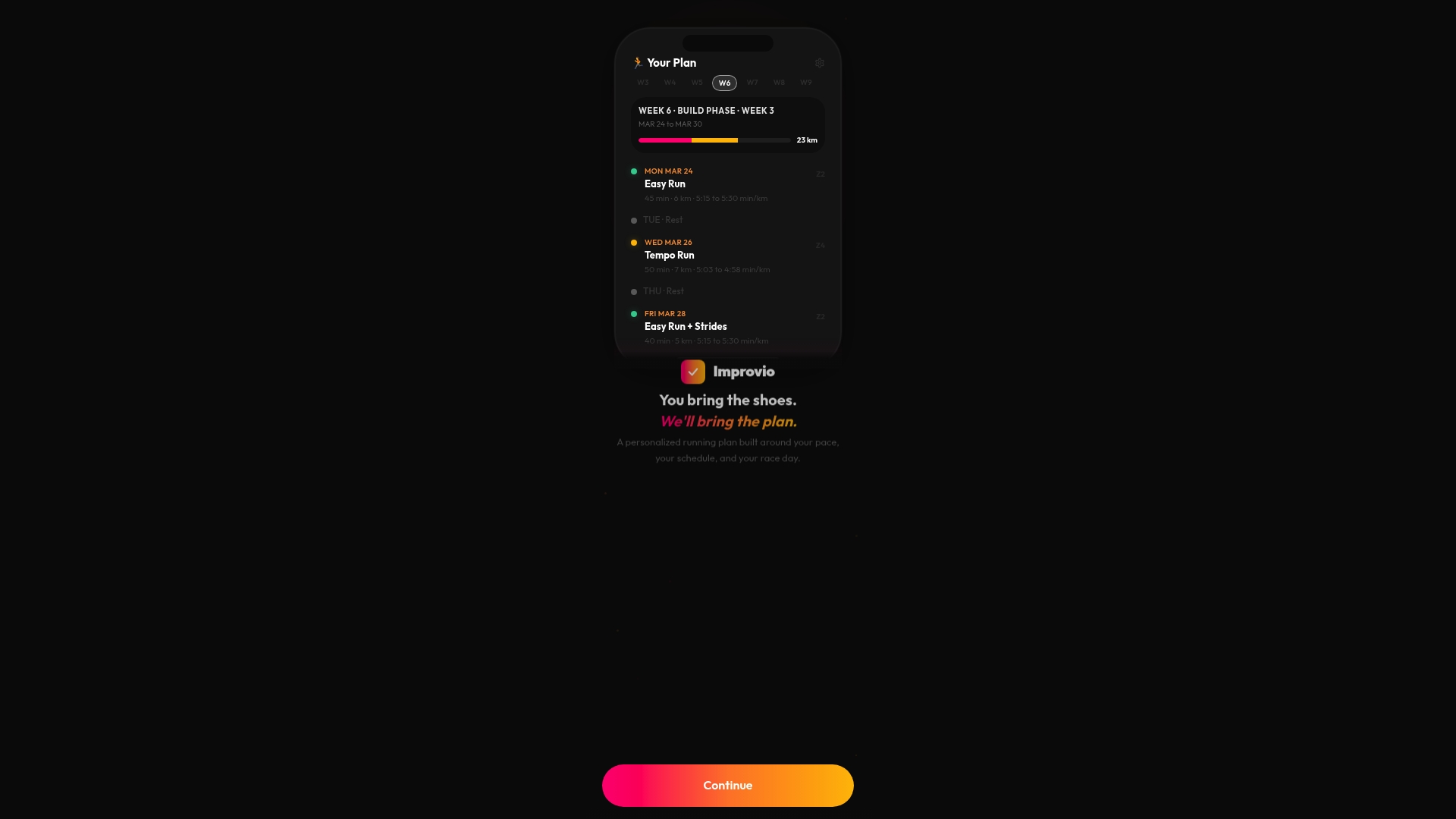
The platform adapts to your current abilities and available training time, building a realistic schedule you can actually follow. You'll receive guided workouts with pacing recommendations, progress tracking to visualize your improvement, and expert advice incorporated throughout to keep you motivated and injury-free. Whether you're preparing for a 5K, 10K, or half marathon, you get a plan that grows with you rather than forcing you into a rigid template.
Key features that support your first race success:
- Customizable training schedules based on your race date, current fitness, and weekly availability
- Pacing guidance for easy runs, quality sessions, and race day execution
- Progress tracking that shows your fitness improvements week by week
- Flexibility to adjust workouts when life interferes without derailing your entire plan
- Expert tips and reminders that keep you on track and injury-free
Start your journey with the running structure for beginners that thousands of first-time racers have used successfully. Your personalized plan awaits, ready to guide you from today's uncertainty to race day confidence. The difference between hoping you'll finish and knowing you will starts with the right training plan.
FAQ
What is the best length for a beginner's first race training plan?
Most effective plans range from 12 to 16 weeks, providing adequate time for safe fitness progression without losing motivation. True beginners who currently do little exercise benefit from longer 16 to 20 week plans that reduce injury risk through more gradual adaptation. Match your plan length to your starting fitness level rather than choosing the shortest option available.
How does a training plan prevent injuries for new runners?
Training plans prevent injuries through gradual weekly mileage increases, typically following the 10% rule to allow tissues time to adapt. Quality plans incorporate strength training and mobility work that stabilize joints and correct muscle imbalances. Periodization phases with planned build, peak, and taper periods ensure adequate recovery between hard training blocks, preventing the chronic fatigue that leads to breakdown.
Can I use a generic training plan or do I need one personalized?
Personalized plans match your current fitness level, weekly schedule, and learning pace for significantly better adherence and results. Generic plans often miss nuanced needs like recovery requirements, schedule constraints, and motivation patterns, leading to frustration and abandonment. While generic plans provide basic structure, guided running plans for your first race that adapt to your specific situation dramatically increase your chances of reaching race day prepared and confident.
How much should I run each week as a beginner training for my first race?
Beginners typically start with 10 to 15 miles per week spread across three to four running days, gradually building to 20 to 30 miles by race week depending on distance. Your weekly volume should increase by no more than 10% each week to prevent injury. Include at least one rest day and consider replacing one run with cross-training to reduce impact stress while maintaining cardiovascular fitness.