

You lace up your shoes, step outside, and start running. No warm-up, no preparation. Just go. Most beginner runners do exactly this, and it's one of the most common mistakes you can make before your first race. A proper warm-up isn't just a nice extra step. It's the foundation of a safe, strong run. Warming up reduces injury risk by 30-50% and directly improves how you perform. In this guide, you'll learn exactly why warming up matters, what happens when you skip it, and how to build a simple routine that works every time.
Table of Contents
- Why warming up matters for beginner runners
- What actually happens if you skip your warm-up?
- Dynamic vs. static stretching: What beginners need to know
- Easy warm-up routines for new runners
- Our take: What most beginners get wrong about warming up
- Ready to take the next step in your running journey?
- Frequently asked questions
Key Takeaways
| Point | Details |
|---|---|
| Warm-up reduces injuries | Warming up cuts the risk of running injuries for beginners by up to half. |
| Boosts performance | Raising muscle temperature with a warm-up measurably improves running speed and endurance. |
| Dynamic over static stretching | Dynamic stretching before runs better prepares muscles while static stretching should be saved for after your workout. |
| Simple routines work best | A 5 to 10-minute walk with dynamic moves is enough to maximize benefits, especially for new runners. |
Why warming up matters for beginner runners
To understand the practical value of warming up, let's look at the science behind what happens in your body and why beginners need it most.
When you're at rest, your muscles are cool and your blood flow is slow. Your heart rate is low. Your joints haven't been asked to do much. The moment you start running without preparing, you're demanding a lot from a body that isn't ready. That sudden stress is where injuries begin.
A warm-up changes all of that. It gradually raises your heart rate, increases circulation, and delivers oxygen-rich blood to your working muscles. It also loosens your joints and improves your flexibility before you need it. These aren't minor benefits. Warming up improves blood flow, flexibility, and heart rate, cutting injury risk by up to 50%.
Here's something that surprises most beginners: temperature actually matters inside your muscles. Every 1°C rise in muscle temperature improves running performance by about 3.5%. That's a measurable boost just from getting your body warm before you run.
"Think of your muscles like cold clay. Cold clay cracks under pressure. Warm clay bends and stretches. Your warm-up is what makes the difference."
Here's a quick look at what warming up actually does for your body:
| Body system | Without warm-up | With warm-up |
|---|---|---|
| Muscles | Stiff, low temperature | Warm, flexible, ready |
| Heart rate | Low, sudden spike | Gradual, controlled rise |
| Blood flow | Restricted | Increased to working muscles |
| Joint mobility | Limited | Improved range of motion |
| Injury risk | High | Reduced by 30-50% |
As a beginner, your body hasn't adapted to the demands of running yet. Your muscles, tendons, and ligaments are still learning. That's exactly why your warm-up matters even more than it does for experienced runners. Pairing a solid warm-up with running plans for beginners gives you the best possible foundation. And once you're warmed up, focusing on proper running form becomes much easier too.
Key benefits of warming up before every run:
- Raises muscle temperature for better performance
- Increases heart rate gradually to reduce cardiovascular stress
- Improves joint range of motion
- Boosts mental focus and readiness
- Reduces the chance of strains, sprains, and fatigue
What actually happens if you skip your warm-up?
Now that you know what happens during a warm-up, let's see what you're risking when you skip it.
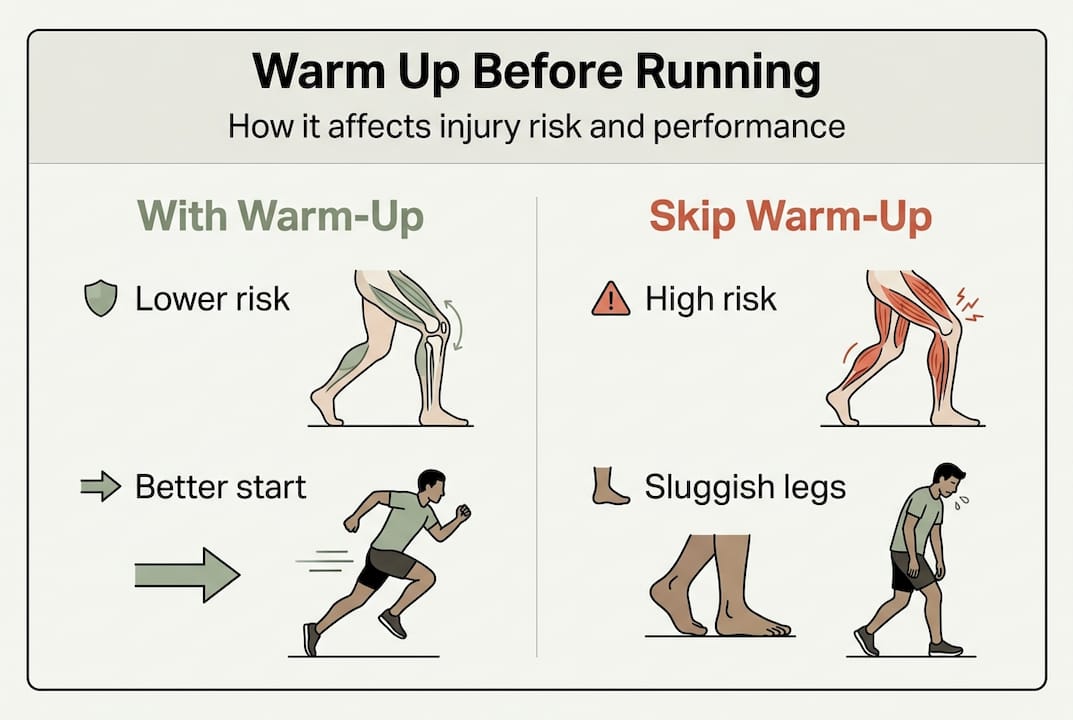
Cold muscles don't absorb shock well. They're less elastic, less responsive, and far more likely to tear or strain under sudden load. When you jump straight into a run, your body hasn't had time to prepare. Your tendons and ligaments are especially vulnerable in those first few minutes.

Skipping your warm-up raises injury risk, particularly if you've been sitting for a while before your run. Think about heading out for a race after a car ride or a morning of sitting at a desk. Without a warm-up, your hips, hamstrings, and calves are tight and unprepared.
Beginners face a bigger challenge here. Experienced runners have built up strength, flexibility, and muscle memory over months or years. You haven't yet. Your body is still adapting to the stress of running, which means the margin for error is smaller. One awkward step on a cold muscle can mean days or weeks off your feet.
Here's how warming up versus skipping it compares on race day:
| Factor | Skipping warm-up | Warming up properly |
|---|---|---|
| Injury risk | High | Reduced by 30-50% |
| First mile feel | Heavy, labored | Smooth, controlled |
| Mental readiness | Low | High |
| Performance | Below your potential | Near your best |
| Recovery after run | Slower | Faster |
Pro Tip: If you only have five minutes before a run, use them to walk briskly and do a few leg swings. Even a short warm-up is far better than none at all.
The performance side matters too. A meta-analysis found warm-ups improve performance in 79% of cases studied, with no evidence of harm. That's a strong case for never skipping it.
Tracking your beginner race milestones is a great way to stay motivated, and hitting those milestones starts with showing up prepared every single time.
Dynamic vs. static stretching: What beginners need to know
One of the most confusing parts for new runners is knowing what kind of stretching actually helps. Let's break down the difference.
There are two main types of stretching: dynamic and static. They serve very different purposes, and using the wrong one at the wrong time can actually hurt your performance.
Dynamic stretching means moving your body through a range of motion repeatedly. Think leg swings, walking lunges, high knees, or arm circles. These movements warm up your muscles while also activating them. They tell your body, "We're about to run. Get ready."
Static stretching means holding a position for 20 to 60 seconds. Think touching your toes and holding, or pulling your heel to your glutes. This is great for improving flexibility and helping your muscles recover. But it belongs after your run, not before.
"Dynamic stretching before a run primes your body for movement. Static stretching after a run helps you recover and stay flexible."
Static stretching before running can reduce strength and power and is not recommended as part of a pre-run routine. Many beginners do the opposite of what works. They stand and hold stretches for a minute before heading out, thinking they're helping. They're actually making their muscles less explosive and more fatigued before the run even starts.
Here's what to do instead:
- Do before running: Leg swings, hip circles, walking lunges, high knees, butt kicks
- Save for after running: Quad stretch, hamstring hold, calf stretch, hip flexor stretch
- Avoid before running: Any stretch held for more than 10 seconds
Learning easy running drills alongside dynamic stretching gives you a complete pre-run toolkit. These drills reinforce good movement patterns and make your warm-up more effective with very little extra time.
Easy warm-up routines for new runners
Now that you know what kind of stretches work, here's a simple, step-by-step warm-up you can use before every run.
You don't need a gym or special equipment. You just need five to ten minutes and a little space. A 10-minute dynamic warm-up is as effective as longer ones, and beginners should start with a brisk walk of three to five minutes followed by dynamic moves and easy strides.
Here's your beginner warm-up routine:
- Brisk walk (3-5 minutes): Start at a comfortable pace and gradually pick up speed. This gets your heart rate moving and blood flowing to your legs.
- Leg swings (10 reps each leg): Hold onto a wall or fence. Swing one leg forward and back in a controlled arc. Switch sides. This opens up your hips.
- High knees (20 reps): March or jog in place, lifting each knee toward your chest. Keep your core tight and your posture tall.
- Butt kicks (20 reps): Jog in place and kick your heels toward your glutes. This activates your hamstrings and gets your legs moving.
- Walking lunges (10 reps each leg): Step forward into a lunge, lower your back knee toward the ground, then step through. This warms up your hips, quads, and glutes.
- Easy strides (2-3 x 20 seconds): Run at an easy, relaxed pace for 20 seconds. Not a sprint. Just a comfortable jog to finish the warm-up and ease into your run.
Pro Tip: Do this routine in the same order every time. Consistency helps your brain recognize that it's time to run, which improves your mental focus before race day.
Dynamic routines enable better performance and injury prevention, and the best part is that this routine takes less than ten minutes. Explore beginner running workouts to pair with your warm-up, and if you're just starting to run for the first time, this routine is the perfect place to begin.
Our take: What most beginners get wrong about warming up
With the essentials in place, here's our take from coaching and observing thousands of beginner runners.
Most beginners either skip the warm-up entirely or spend too long on it and overthink every movement. Both are mistakes. The truth is, a short and focused warm-up done consistently will do more for you than a perfect routine done once in a while.
We've seen it repeatedly. Runners who follow a running workflow that includes a consistent warm-up report that running feels easier and more enjoyable within just a few weeks. Not because they're fitter yet, but because their body is ready when they ask it to perform.
The fear of doing it wrong keeps many beginners from warming up at all. Here's the honest truth: moving is always better than not moving. A two-minute walk and a few leg swings beats standing still every time.
Consistency and movement quality matter far more than the amount of time you spend warming up. The best warm-up is the one you actually do before every single run. Start simple. Stay consistent. Your first race will feel completely different because of it.
Ready to take the next step in your running journey?
A great warm-up is one piece of the puzzle. But getting to race day feeling confident and prepared takes more than just five minutes before each run. It takes a plan built around you.

At Improvio, we build personalized running tools designed specifically for beginners like you. Your pace, your schedule, your race date. Everything is tailored to where you are right now. You can also check out our complete race prep guide to make sure you're covering every base before your first race. Setup takes about 60 seconds and your first plan is free. You bring the shoes. We'll bring the plan.
Frequently asked questions
How long should a beginner's warm-up take before running?
A beginner should warm up for 5 to 10 minutes, starting with brisk walking followed by dynamic movements. A 10-minute dynamic warm-up is just as effective as a longer one.
Is it okay to do static stretching before a run?
No. Static stretching before running can reduce your strength and power output. Stick to dynamic stretching before you run and save static holds for your cool-down.
What is the simplest warm-up routine for new runners?
Start with 3 to 5 minutes of brisk walking, then do leg swings and high knees for about 10 reps each, finishing with a few easy strides. The whole thing takes under 10 minutes.
Does warming up really reduce your injury risk?
Yes. Warming up reduces injury risk by 30 to 50 percent, according to research. That's a significant difference, especially for beginners whose bodies are still adapting to running.