

Starting your running journey without a structured plan often leads to injury, frustration, and abandoned goals. Over 60% of injured male runners increased their weekly distance by more than 30% before getting hurt, and half of female runners experienced similar setbacks. New runners face a critical choice: follow a proven training structure or risk joining these statistics. Structured running plans provide the roadmap you need to build fitness safely, stay motivated through challenging weeks, and cross your first finish line with confidence. This guide explains why running plans are essential for beginner success in 2026.
Table of Contents
- How Structured Running Plans Protect New Runners From Injury
- Periodization And Performance: Why Structured Progression Matters
- Motivation And Accountability: How Plans Keep New Runners On Track
- Personalizing Your Running Plan: Avoiding Common Pitfalls
- Explore Custom Running Plans With Improvio
Key takeaways
| Point | Details |
|---|---|
| Injury prevention | Structured plans limit weekly mileage increases to 30% or less, protecting your body from overload injuries. |
| Performance gains | Periodized training improves VO2max and race times better than random workouts. |
| Motivation boost | Scheduled workouts with clear goals keep you consistent and accountable. |
| Personalization matters | Conservative, adaptive plans outperform aggressive one-size-fits-all schedules. |
| Base building foundation | New runners need 12-20 weeks of gradual progression before race-specific training. |
How structured running plans protect new runners from injury
Injury prevention stands as the most compelling reason to follow a structured running schedule. Your body adapts to running stress gradually, and pushing too hard too soon damages muscles, tendons, and bones before they strengthen. Research shows that runners who increased weekly mileage beyond 30% suffered significantly higher injury rates than those who progressed conservatively.
Structured plans build in three critical safety features. First, they cap weekly mileage increases at manageable levels, typically 10% per week for absolute beginners. Second, they schedule recovery days strategically, giving your musculoskeletal system time to repair and strengthen between hard efforts. Third, they incorporate cross-training and strength work that supports running-specific movements without adding impact stress.
Pro Tip: Track your weekly mileage in a simple spreadsheet or app. If you see a jump larger than 30% from one week to the next, scale back immediately to prevent injury.
Consider these injury prevention strategies every plan should include:
- Alternating easy and hard days to balance stress and recovery
- Run/walk intervals that reduce continuous impact for new runners
- Strength training twice weekly focusing on hips, glutes, and core
- Mobility work addressing ankle, hip, and thoracic spine flexibility
- Deload weeks every 3-4 weeks with reduced volume
The run/walk method deserves special attention for beginners. Starting with intervals like 1 minute running followed by 1 minute walking allows your cardiovascular system to adapt faster than your joints and connective tissue. This mismatch causes many injuries when new runners feel cardiovascularly capable but push their unprepared legs too hard. Structured plans account for this adaptation timeline.
"The biggest mistake new runners make is doing too much too soon. Your heart and lungs adapt in weeks, but your bones and tendons need months."
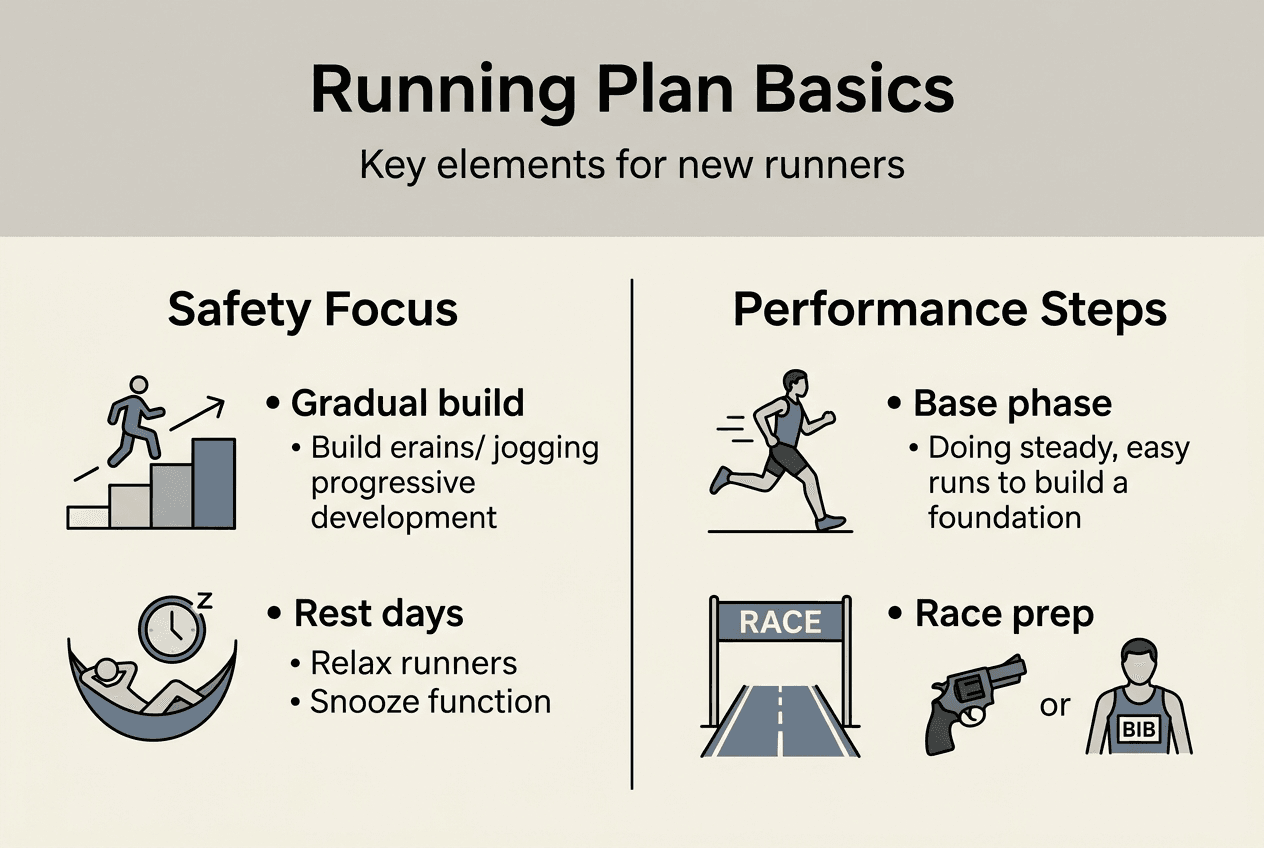
Periodization, the practice of organizing training into distinct phases, ensures you build a solid aerobic base before adding speed work or long runs. Base building phases lasting 8-12 weeks establish the foundation your body needs for harder training later. Without this foundation, you risk stress fractures, tendinitis, and muscle strains that sideline your progress for weeks or months.
Periodization and performance: Why structured progression matters
Periodization transforms random running into systematic fitness development. This training concept divides your preparation into phases, each targeting specific adaptations that build upon previous work. Two main approaches dominate beginner training: linear periodization, which gradually increases intensity while maintaining or slightly reducing volume, and reverse periodization, which builds aerobic capacity first before adding speed.

Research comparing these approaches reveals significant advantages over unstructured training. A study found that both periodized groups showed greater improvements in 5K race times compared to runners following non-periodized programs. The periodized runners improved their VO2max, running economy, and lactate threshold more effectively than those training randomly.
Linear periodization works well for new runners preparing for their first race because it mirrors natural progression. You start with easy base miles, gradually add tempo runs and intervals, then taper before race day. This approach builds confidence as each phase prepares you for the next challenge. Your body adapts systematically, reducing injury risk while maximizing performance gains.
Reverse periodization flips this sequence, emphasizing high-volume easy running before introducing intensity. This method suits runners with limited time who need efficient workouts. The extended aerobic base phase develops mitochondrial density and capillary networks that support faster running later. When intensity arrives in later phases, your aerobic engine can fuel those harder efforts more effectively.
| Periodization Type | Primary Focus | Best For | Key Benefit |
|---|---|---|---|
| Linear | Gradual intensity increase | First-time racers, 5K-10K goals | Builds confidence through progressive challenges |
| Reverse | Extended base building | Runners with inconsistent schedules | Maximizes aerobic development before speed work |
| Non-periodized | Random workout mix | Not recommended for beginners | Higher injury risk, slower progress |
The benefits of structured plans become obvious when you compare periodized versus random training outcomes. Periodized runners typically improve race times by 5-10% more than those training without structure. They also report fewer injuries and higher motivation levels because clear phases provide psychological milestones beyond just race day.
Each training phase serves a specific purpose. Base building develops aerobic capacity and running economy through easy-paced miles. Build phases add tempo runs and hill work to improve lactate threshold. Peak phases incorporate race-pace intervals that sharpen your speed. Taper phases reduce volume while maintaining intensity, allowing your body to absorb training and arrive at the start line fresh. Skipping or rushing any phase compromises the next, creating a house built on a weak foundation.
Motivation and accountability: How plans keep new runners on track
Consistency separates successful first-time racers from those who quit after a few weeks. Structured plans transform abstract goals like "get fit" or "run a 5K" into concrete daily actions. When you know exactly what workout to do each day, decision fatigue disappears. You simply follow the schedule, building momentum through small wins that compound over weeks.
Research on beginner training programs shows that structured plans combining strength and endurance work 6 days per week significantly boost both motivation and race-day fitness. The variety prevents boredom while addressing different fitness components. Easy runs build aerobic base, tempo runs improve lactate threshold, and strength sessions protect against injury while building power.
Pro Tip: Schedule your runs like important appointments. Block the time on your calendar and treat it as non-negotiable as a work meeting or doctor visit.
Structured plans provide psychological benefits that unstructured running cannot match:
- Clear short-term goals for each week keep you focused on immediate progress
- Workout variety prevents the monotony that kills motivation
- Rest days built into the schedule eliminate guilt about taking time off
- Progressive challenges build confidence as you complete harder sessions
- Tangible evidence of improvement when you review completed workouts
The accountability factor amplifies when you share your plan with others or use coaching tools. Many runners print their weekly schedule and check off completed workouts, creating a visual record of commitment. This simple act triggers a psychological response, making you more likely to complete the next session. Missing one workout feels manageable, but seeing multiple blank spaces on your schedule creates urgency to get back on track.
Mixing strength and endurance work prevents the plateaus that frustrate many new runners. Your cardiovascular system adapts quickly to running, often within 4-6 weeks. But continuing to improve requires addressing muscular strength, mobility, and running economy. Plans that integrate strength training twice weekly and easy recovery runs between hard efforts optimize adaptation across all systems.
Consider how a beginner running workflow structures your week. Monday might feature an easy 20-minute run, Tuesday strength training, Wednesday tempo intervals, Thursday rest or cross-training, Friday easy run, Saturday long run, and Sunday complete rest. This rhythm becomes automatic, removing the daily question of "should I run today?" You already know the answer because your plan tells you.
The motivation to follow a training plan grows stronger as race day approaches. Each completed long run proves you can handle the distance. Each tempo session shows you can sustain faster paces. These confidence builders matter more than physical fitness alone. Many runners possess the fitness to complete their goal race but lack the mental certainty that they can do it. Structured training provides both physical preparation and psychological proof.
Personalizing your running plan: Avoiding common pitfalls
Off-the-shelf training plans fail many beginners because they assume average fitness, recovery capacity, and time availability. A plan designed for someone running 15 miles per week will overwhelm someone currently running zero miles. Similarly, a plan requiring 6 days per week won't work for someone who can realistically commit to 3-4 days. Recognizing when a plan doesn't fit your situation prevents frustration and injury.
Signs your running plan is too aggressive include persistent fatigue that doesn't improve with rest, multiple missed workouts each week because the schedule feels overwhelming, recurring minor aches that never fully heal, and dreading runs instead of looking forward to them. These red flags indicate your body cannot handle the training load or the plan doesn't match your lifestyle.
Research confirms that static plans increase injury risk compared to adaptive approaches that adjust based on your progress and recovery. Coaching feedback and personalization consistently outperform one-size-fits-all schedules. The best plans evolve with you, increasing intensity when you adapt well and scaling back when you show signs of overtraining.
Follow these five steps to personalize your running plan for safer, more effective training:
- Assess your current fitness honestly by tracking how far you can run comfortably today
- Choose a plan that starts below your current capacity, not at your limit
- Add an extra week to each phase if you're over 40 or have previous injuries
- Replace one run per week with cross-training if you have joint concerns
- Schedule workouts around your actual available time, not ideal scenarios
Data shows the relationship between mileage progression and injury risk clearly:
| Weekly Mileage Increase | Injury Risk Level | Recommended Action |
|---|---|---|
| 0-10% | Low | Safe progression for most runners |
| 10-30% | Moderate | Acceptable occasionally, not sustainable |
| 30-50% | High | Scale back immediately |
| Over 50% | Very High | High probability of injury within 2-4 weeks |
The base building phase deserves special attention for beginners. Most successful step-by-step running plans dedicate 12-20 weeks to establishing aerobic fitness before adding significant speed work or racing. This timeline feels long to eager beginners, but rushing it guarantees problems later. Your aerobic system, including capillary networks and mitochondrial density, needs months to develop fully.
Run/walk protocols offer the most conservative entry point for absolute beginners. Starting with 1 minute running and 2 minutes walking, then gradually shifting the ratio toward more running over 8-12 weeks, allows adaptation without overwhelming your system. Many runners skip this approach because it feels too easy, then suffer injuries that force them back to square one.
Integrating rest and strength days based on your individual recovery capacity matters more than following a generic schedule. Some runners recover quickly and handle 4-5 run days per week easily. Others need 48 hours between runs to avoid cumulative fatigue. Pay attention to morning heart rate, sleep quality, and mood as recovery indicators. If these markers worsen over consecutive weeks, add more rest days regardless of what your plan prescribes.
Proper running form also influences how much training volume you can handle safely. Runners with efficient form distribute impact forces better, reducing injury risk at higher mileages. If you struggle with recurring injuries despite conservative mileage progression, consider working with a coach to assess and improve your running mechanics before increasing training load.
Explore custom running plans with Improvio
Ready to start your running journey with a plan designed specifically for your fitness level and goals? Creating a personalized training schedule no longer requires expensive coaching or guesswork. Improvio builds adaptive running plans in under 60 seconds, tailoring every workout to your current pace, available training days, and target race date.

The platform handles everything from conservative base building through race-specific preparation, adjusting your schedule as you progress. Whether you're preparing for your first 5K or building toward a half marathon, personalized plans reduce injury risk while keeping you motivated through structured progression. Track your completed workouts, receive coaching feedback, and adjust your plan when life gets busy. Explore personalized running plans that adapt to your unique situation and set yourself up for first race success.
FAQ
What is a running plan and why do I need one?
A running plan is a structured schedule that gradually builds your fitness and prepares you for races safely over weeks or months. It prevents injury by controlling how quickly you increase mileage and intensity. Plans also keep you motivated by providing clear daily workouts and measurable progress toward your goal. Without structure, most new runners either do too much too soon and get injured or lose motivation and quit.
How often should beginners run per week?
Beginners typically run 3-4 times per week, balancing run days with rest and strength training sessions. This frequency allows adequate recovery between runs while building consistency. Some plans include 5 run days for more experienced beginners, but starting with fewer days reduces injury risk. Consistency over months matters more than high weekly volume when you're building your initial running base.
What are the risks of skipping a structured running plan?
Skipping structured plans often leads to overuse injuries from increasing mileage too quickly without adequate recovery. You may also experience motivation loss when random training produces inconsistent results. Race day performance typically suffers because unstructured training doesn't build the specific fitness adaptations needed for your goal distance. Many runners who skip plans either get injured within the first month or quit from lack of progress and direction.
Can I create my own running plan?
You can create your own plan if you understand periodization principles and start conservatively with gradual progression. However, most beginners lack the experience to design effective training phases and recovery schedules. Using online plan generators or working with a coach improves both safety and success rates significantly. If you choose to create your own plan, start with base building for at least 8 weeks before adding intensity, and never increase weekly mileage by more than 10%.