

Starting your running journey feels exciting and overwhelming at the same time. You lace up your shoes, step outside, and suddenly wonder: how far should I go? How fast? How often? You're not alone. Most first-time runners face this exact confusion. The good news is that structured programs like C25K have helped millions of beginners go from zero to race-ready in just 9 weeks. This guide walks you through four clear milestones that build your fitness, protect you from injury, and get you to that finish line with confidence.
Table of Contents
- Understanding beginner training milestones
- Milestone 1: Starting with structured run/walk intervals
- Milestone 2: Building your aerobic base with weekly consistency
- Milestone 3: Improving running mechanics and introducing drills
- Milestone 4: Preparing for your first race with personalized adjustments
- Unlock your personalized running plan today
- Frequently asked questions
Key Takeaways
| Point | Details |
|---|---|
| Start with run/walk intervals | Run/walk intervals are the safest launchpad for beginners and help reduce injury risk dramatically. |
| Build weekly consistency | Consistent, easy-paced running builds your aerobic base and sets you up for race success. |
| Focus on proper mechanics | Learning basic running form and introducing drills boosts efficiency and minimizes injuries early on. |
| Personalize for your needs | Adapt your plan, repeat weeks as needed, and consult a doctor to assure safe and steady progress. |
| Use digital tools for tracking | Apps and digital solutions make milestone tracking easy and help you optimize your running journey. |
Understanding beginner training milestones
A training milestone is a stepwise checkpoint that marks real progress in your running journey. Think of milestones as signposts on a road trip. They tell you how far you've come and how far you still need to go. For new runners, these checkpoints are everything.
Here's what beginner milestones typically look like:
- Completing your first 20-minute run without stopping
- Running a full mile at a comfortable pace
- Finishing three consistent runs in a single week
- Running for 30 minutes straight for the first time
Milestones do two powerful things. First, they boost your confidence. Every small win tells your brain that you can do this. Second, they protect your body. Jumping too far too fast is the number one reason new runners get hurt. Understanding why running plans matter is the first step toward building a sustainable habit.
"Base building minimizes injury risk through slow, steady progression. Novice runners face up to 79% annual injury risk, but careful milestone tracking can reduce that rate by nearly 20%."
Structured milestones aren't just motivational tools. They're evidence-based checkpoints that keep your body adapting safely over time.
Milestone 1: Starting with structured run/walk intervals
The run/walk interval is the safest and most proven entry point for absolute beginners. The idea is simple: alternate between running and walking, gradually increasing your run time and decreasing your walk breaks over several weeks.
The C25K program follows this exact approach across 9 weeks and 3 sessions per week. Here's how the progression works:
- Weeks 1-2: Run 60 seconds, walk 90 seconds. Repeat for 20 minutes.
- Weeks 3-4: Run 3 minutes, walk 90 seconds. Repeat for 20 minutes.
- Weeks 5-6: Run 5-8 minutes, walk 3 minutes. Repeat for 20-25 minutes.
- Weeks 7-8: Run 20-25 minutes continuously.
- Week 9: Run 30 minutes without stopping.
This structure works because it gives your muscles, joints, and cardiovascular system time to adapt. Run/walk intervals reduce injury risk by 65% according to ACSM research, making this approach far safer than jumping straight into continuous running.
If a week feels too hard, repeat it. There's no shame in that. Your step-by-step running plan should flex around your body, not the other way around. A solid beginner running schedule always builds in room for adjustment.
Pro Tip: Use a free app like the NHS C25K app for real-time audio coaching. It tells you exactly when to run and when to walk, so you can focus on your breathing and form instead of watching a timer.
Milestone 2: Building your aerobic base with weekly consistency
Once you can run and walk comfortably for 20 to 30 minutes, your next milestone is consistency. Running three times a week, every week, is what builds your aerobic base. That's the foundation everything else sits on.
Your aerobic base is your body's ability to use oxygen efficiently during exercise. The stronger it is, the easier running feels. Here's what building it looks like in practice:
- Run at a pace where you can hold a conversation
- Aim for three 20-minute runs per week to start
- Add no more than 10% to your weekly mileage each week
- Keep most of your runs at an easy, comfortable effort
This is where the 80/20 rule comes in. Base building plans recommend that 80% of your weekly running stays at an easy pace, with only 20% at a slightly harder effort. This balance keeps you from burning out while still making real progress.
| Feature | C25K (9 weeks) | 12-week base building |
|---|---|---|
| Weekly sessions | 3 | 3-4 |
| Weekly mileage | 6-10 miles | 12-15 miles |
| Primary focus | Run/walk intervals | Easy continuous running |
| Success metric | 30-min continuous run | 6-mile long run |
Consistent training leads to 35% higher race completion rates compared to sporadic training. That stat alone makes the case for showing up regularly, even on days when motivation is low. Technology supports race readiness by helping you track this consistency without guesswork.
Milestone 3: Improving running mechanics and introducing drills
Consistency gets you fit. Good form keeps you healthy. Once you're running regularly, it's time to pay attention to how you run, not just how far or how often.

You don't need to be a biomechanics expert. You just need to know the basics. Correct running mechanics include upright posture, a slight forward lean from the ankles, a midfoot strike, and a cadence of 170 or more steps per minute. Your arms should swing at roughly 90 degrees, and your gaze should stay forward, not down at your feet.
Here's a quick do's and don'ts list for beginner running form:
- Do keep your shoulders relaxed and low
- Do land with your foot under your hips, not in front of them
- Do breathe rhythmically and stay relaxed
- Don't clench your fists or tense your jaw
- Don't overstride by reaching your foot far ahead of your body
- Don't hunch forward from the waist
| Mechanic | Beginner benchmark |
|---|---|
| Cadence | 170+ steps per minute |
| Posture | Upright, slight forward lean from ankles |
| Foot strike | Midfoot, landing under hips |
| Arm swing | 90-degree bend, relaxed hands |
| Gaze | Forward, 10-20 feet ahead |
Easy drills to practice include dynamic warm-ups like leg swings and high knees, plus stride-outs (short 20-second accelerations at the end of a run). Check out this running form guide and these easy running drills to get started. You can also follow a beginner running workflow that ties form work into your weekly routine.
Pro Tip: Record yourself running from the side using your phone. You don't need a coach to spot obvious issues. Watch for overstriding or a forward hunch, then make one small adjustment at a time. Form improves gradually, not overnight.
Milestone 4: Preparing for your first race with personalized adjustments
You've built your base. Your form is improving. Now it's time to connect all of that work to an actual race goal. This milestone is about personalizing your plan so it fits your life, not a generic template.
Every runner is different. Some of you are carrying extra weight. Some have flat feet or old knee injuries. Some have busy schedules that make three runs a week feel impossible. All of that is okay. Repeat weeks if needed, consult your doctor for any health concerns, and adapt your milestones to match your reality.
Here are the key adjustments to make before race day:
- Consult your doctor if you have any chronic health conditions or haven't exercised in years.
- Use video form checks every two to three weeks to catch bad habits early.
- Download a coaching app for real-time guidance on pace and effort.
- Build in rest days so your body can recover and adapt between sessions.
- Taper your mileage in the final week before your race to arrive fresh.
On race day itself, keep these confidence boosters in mind:
- Start slower than you think you need to
- Hydrate well the night before and morning of the race
- Use positive self-talk when it gets hard
- It's perfectly fine to use run/walk intervals during the race
- Focus on finishing, not finishing fast
Looking at beginner workout examples can help you see what a race-ready week looks like. And when motivation dips, beginner race motivation strategies can keep you moving forward. Getting started as a runner means building your base before race training, incorporating drills, and using apps for personalized guidance.
Unlock your personalized running plan today
You now have a clear picture of the four milestones that take you from first steps to race day. But knowing the milestones is only half the battle. Following through on them, week after week, is where most beginners struggle without support.
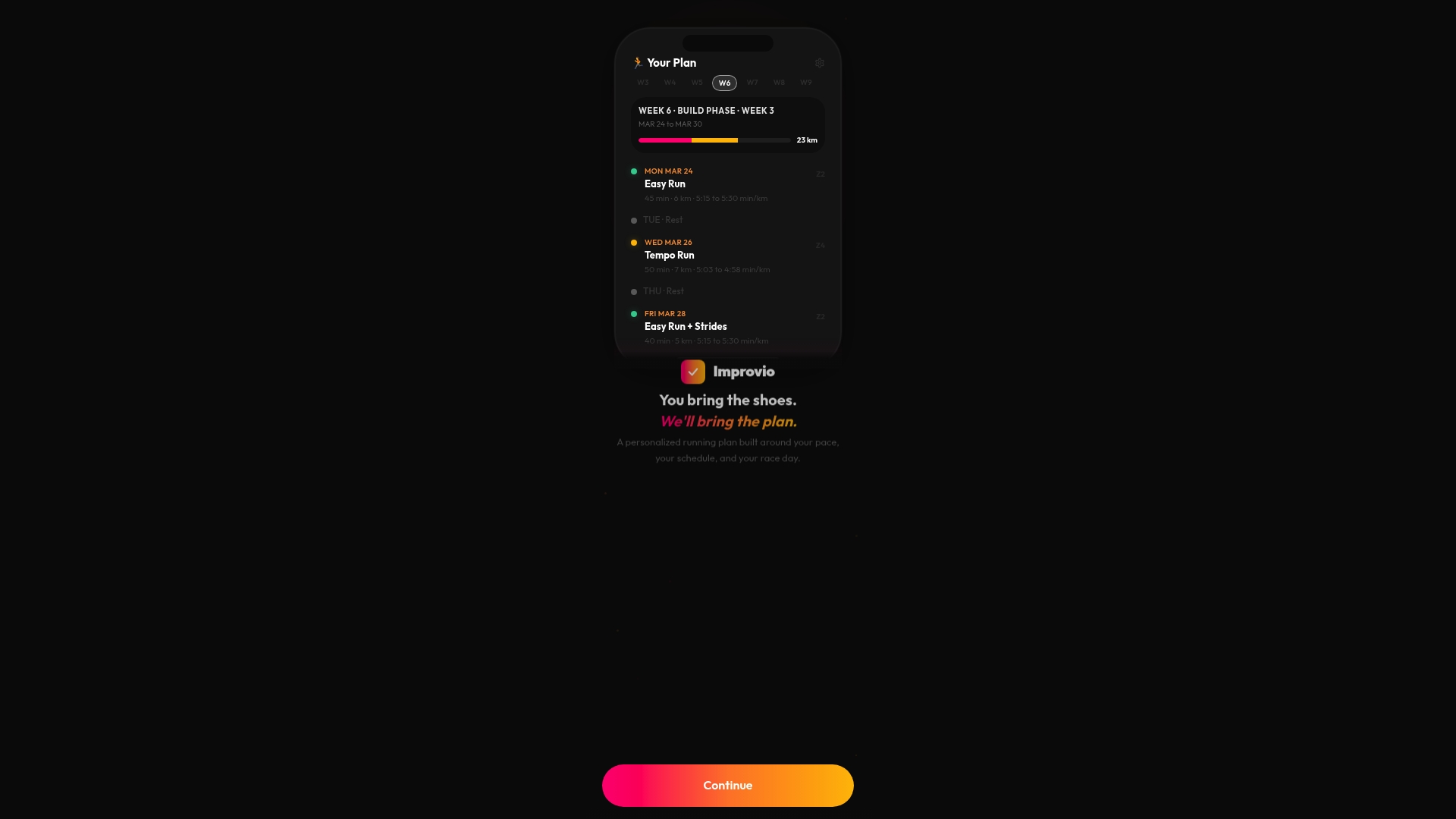
That's exactly what personalized running plans from Improvio are built for. In about 60 seconds, you can set up a custom training schedule based on your pace, your available days, and your race date. No experience needed. No guesswork. Just a clear, structured plan that adapts to you. You bring the shoes. We'll bring the plan. Start free today and take your first real step toward that finish line.
Frequently asked questions
How long should beginners stick with run/walk intervals?
Most beginners follow run/walk intervals for 6-9 weeks, but you should repeat weeks freely if you haven't reached a comfortable level of effort before moving on.
What is the 80/20 rule in running and why does it matter?
The 80/20 rule means 80% of your weekly running stays at an easy, conversational pace. Base building plans emphasize this balance to reduce injury risk while steadily building your endurance.
How do I check if my running form is correct?
Record yourself from the side and look for upright posture, relaxed arms, and midfoot strike. Compare what you see to a beginner form guide and make one small change at a time.
Can I personalize my running plan if I have an injury or health issue?
Absolutely. Repeat weeks, consult your doctor, and adjust your milestones to match your current physical condition. Progress at your own pace and stay safe.
How soon can I prepare for my first race as a beginner?
Most structured programs get beginners race-ready in 9-12 weeks, factoring in gradual progression, base building, and a short taper before race day.