

TL;DR:
- Flexibility improves muscular comfort, but excessive flexibility can reduce running efficiency.
- Dynamic stretching before runs enhances performance, while static stretches aid recovery afterward.
- Combining mobility, strength training, and proper recovery routines prevents injuries and optimizes running.
You've probably heard it a hundred times: "stretch before you run so you don't get hurt." It sounds like simple, solid advice. But the real relationship between flexibility, performance, and injury prevention is more nuanced than that. Some of what you've been told is actually backwards. As a beginner runner preparing for your first race, you deserve accurate guidance, not recycled myths. This article breaks down what flexibility really does for your body, what the research says, and how to build a routine that works for you.
Table of Contents
- Understanding flexibility: What it means for runners
- Does flexibility really boost running performance?
- Flexibility and injury: What stretching can and can't do
- Building an effective flexibility routine for race-ready beginners
- Common flexibility mistakes beginner runners make
- Why flexibility is essential—but only when balanced
- Take your beginner running journey further
- Frequently asked questions
Key Takeaways
| Point | Details |
|---|---|
| Balance is key | Too much flexibility can reduce running efficiency but moderate mobility improves mechanics and reduces injury risk. |
| Dynamic before, static after | Use dynamic stretching before runs for performance and static stretching after for recovery and range of motion. |
| Myths debunked | Stretching before runs doesn't prevent injuries—focus on warm-ups, technique, and strength. |
| Consistency trumps intensity | Daily short flexibility routines are more effective than occasional long sessions for runners. |
Understanding flexibility: What it means for runners
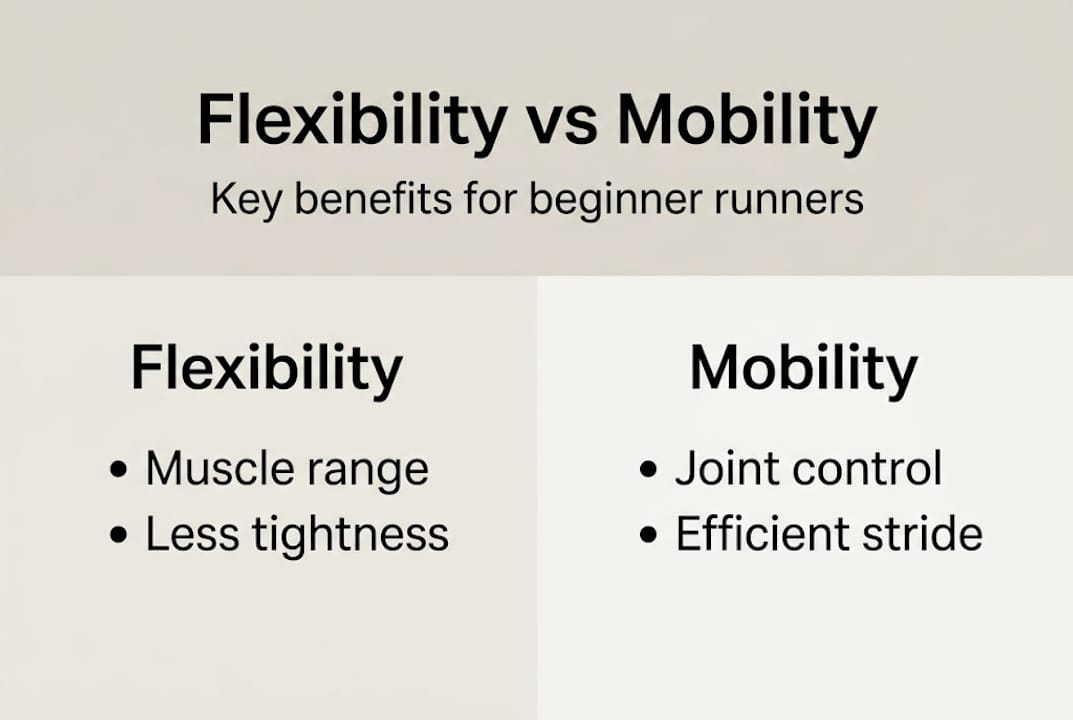
Before you can use flexibility to your advantage, you need to know what it actually means. Flexibility is your muscle's ability to lengthen and stretch. Mobility is your joint's ability to move through its full range of motion. They sound similar, but they play different roles in running.
Think of it this way: flexibility is about your muscles, and mobility is about your joints. Both matter. But for runners, mobility often takes priority. Your hips, ankles, and knees need to move freely with every stride. When they can't, your body compensates. That compensation leads to awkward mechanics, wasted energy, and eventually, discomfort.
Flexibility and mobility improve running mechanics by allowing better range of motion in hips, knees, and ankles, reducing muscle tightness, enhancing shock absorption, and promoting efficient stride patterns. That's a lot of benefits packed into two simple habits.
For beginners, focusing on mobility and injury prevention early sets a strong foundation. It makes your stride smoother and your runs less taxing on your body. It also helps you warm up before running more effectively.
Here's a quick look at how flexibility and mobility differ in their effects:
| Quality | Focus | Running benefit |
|---|---|---|
| Flexibility | Muscle length | Reduces tightness, improves comfort |
| Mobility | Joint range of motion | Improves stride, reduces compensation |
| Both combined | Full body movement | Better efficiency, less fatigue |
Key reasons flexibility and mobility matter for runners:
- Better posture: Loose hips and a mobile thoracic spine keep your form upright.
- Improved stride: Greater range of motion means a longer, more natural stride.
- Less fatigue: Efficient movement uses less energy per step.
- Fewer compensations: Your body doesn't have to "work around" tight muscles.
Start with short mobility work daily. Even five minutes targeting your hips and ankles makes a real difference over weeks.
Does flexibility really boost running performance?
Here's where things get interesting. You might assume that being more flexible automatically makes you a faster, more efficient runner. The research tells a different story.
Running economy is the term coaches use to describe how efficiently your body uses oxygen at a given pace. Better running economy means you can run faster while burning less energy. It's one of the most important factors in race performance.
Counterintuitively, less flexible runners may have superior running economy. Why? Because optimal muscle-tendon stiffness helps your legs act like springs. This is called the stretch-shortening cycle. Stiffer tendons store and release elastic energy more efficiently. When you're excessively flexible, you lose some of that spring, and your muscles have to work harder.
On top of that, stretching has no significant effect on running economy, whether done once before a run or consistently over weeks. That's based on multiple meta-analyses reviewing dozens of studies.
So does that mean you should skip flexibility work entirely? No. There's an important balance here.
| Approach | Effect on running economy | Effect on comfort/mechanics |
|---|---|---|
| Excessive flexibility | Can reduce elastic energy return | May feel comfortable short-term |
| Moderate flexibility | Neutral to slightly positive | Supports good stride and posture |
| Low flexibility | Often linked to better economy | Can cause tightness and strain |
"The goal isn't to become as flexible as a gymnast. It's to move well enough to run efficiently without pain."
Your running form guide matters here too. Good form relies on having just enough range of motion, not maximum flexibility. Learn more about flexibility and running economy to understand the full picture.
Pro Tip: Focus on mobility over maximum flexibility. You want joints that move well, not muscles that are overstretched. Daily hip circles, leg swings, and ankle rolls will serve you better than deep static holds before a run.
Flexibility and injury: What stretching can and can't do
One of the most persistent myths in running is that stretching before a run prevents injuries. It feels logical. Loosen the muscles, reduce the risk. But the evidence says otherwise.
Static stretching does not reduce injury risk in runners. This isn't a fringe opinion. It's a well-established finding backed by years of research. Holding a stretch for 30 to 60 seconds before you run doesn't make your muscles less likely to get hurt. In some cases, it can even temporarily reduce power output.
So what does stretching actually help with? Quite a bit, just not injury prevention in the way most people think.
What stretching is good for:
- Post-run cooldown: Static stretches after a run help muscles return to their resting length and reduce soreness.
- Improving range of motion: Consistent stretching over time increases flexibility and joint mobility.
- Mental recovery: The slow, deliberate pace of stretching after a run helps your body shift into recovery mode.
- Comfort and muscle tension: Stretching relieves that tight, heavy feeling after a hard effort.
What actually reduces injury risk:
- A proper dynamic warm-up before each run
- Strength training targeting glutes, hips, and core
- Gradual increases in weekly mileage
- Proper science of stretching techniques applied at the right time
"Static stretching before a run is like warming up your car by turning on the air conditioning. It's not the right tool for the job."
For practical, race-ready stretching routines for new runners, focus on timing. Save your static holds for after the run.
Building an effective flexibility routine for race-ready beginners
Now you know what works and what doesn't. Here's how to put it into practice. A smart flexibility routine takes less time than you think and pays off fast.

Pre-run dynamic routine (5 to 7 minutes):
According to dynamic stretching research, dynamic stretching before a run improves endurance and power for beginners without any negative effects. Keep it moving, not static.
- Leg swings (front to back): 10 reps each leg. Opens up hip flexors and hamstrings.
- Hip circles: 10 reps each direction. Loosens the hip joint for a fuller stride.
- Ankle rolls: 10 reps each foot. Improves shock absorption and ankle mobility.
- Glute kicks: 20 steps. Activates glutes and warms up the hamstrings.
- Walking lunges: 10 steps. Gets hips, quads, and glutes moving together.
Post-run static routine (5 to 10 minutes):
A base stretching routine targeting hips, hip flexors, hamstrings, and calves is the foundation for beginner runners preparing for their first race. Hold each stretch for 20 to 30 seconds. No bouncing. No pain.
- Standing quad stretch: Balances out the front of the thigh.
- Seated hamstring stretch: Relieves the back of the leg after long efforts.
- Hip flexor lunge stretch: Critical after any run over 20 minutes.
- Calf stretch against a wall: Reduces tightness that builds up with every step.
- Figure-four glute stretch: Takes care of those outer hips that work hard during every run.
You can also add easy running drills on lighter training days. They reinforce mobility and improve mechanics without adding stress. Your beginner running workflow should include flexibility as a regular component, not an afterthought.
Pro Tip: Do your flexibility work every single day, even on rest days. Five minutes of hip and calf stretching at night adds up fast and keeps soreness in check without any extra training load.
Common flexibility mistakes beginner runners make
Even with the best intentions, beginners often fall into the same traps. Avoid these, and your flexibility routine will work harder for you.
Overstretching: Pushing past the point of mild tension into actual pain is never helpful. It can cause micro-tears in muscle fibers and set your training back. Stretch to the point of gentle pull, then stop.
Doing static stretches before a run: You already know this one. Static holds before a run can temporarily reduce your muscle power output. Save them for after.
Skipping the warm-up entirely: Jumping straight into a run with cold muscles is one of the most common mistakes beginners make. Even a three-minute walk and some leg swings make a real difference.
Relying only on stretching for injury prevention: Stretching alone won't keep you healthy. You need strength work too. Excessive stretching can reduce musculotendinous stiffness, which can actually harm running economy if you're not balancing it with strength training.
Being inconsistent: Flexibility takes time to build. Doing a long stretch session once a week and skipping the rest won't move the needle. Short and frequent beats long and rare.
Ignoring strength training: Flexible muscles without strength are vulnerable muscles. Glute bridges, single-leg squats, and calf raises complement your flexibility work and protect your joints.
Following structured running schedules that build in rest, mobility, and strength work helps you avoid most of these mistakes automatically.
Pro Tip: Short, regular flexibility routines beat marathon stretch sessions every time. Ten minutes after every run does more for you than a 45-minute session on Sunday.
Why flexibility is essential—but only when balanced
Here's our honest take: the running world tends to swing between extremes. Either runners ignore flexibility completely, or they spend more time stretching than actually running. Both approaches miss the point.
The best results come from integration. Flexibility, mobility, and strength all need to work together. Flexibility without strength leaves your joints unsupported. Strength without mobility creates movement restrictions that slow you down. Mobility without flexibility training leaves muscle tightness unaddressed.
What surprises a lot of new runners is that race preparation is as much about smart recovery as it is about logging miles. The runs build your fitness, but your flexibility and recovery routines protect that investment. Skip them and the miles come at a higher cost.
We've seen beginners make huge gains simply by adding consistent simple stretching for new runners to their weekly routine. Not because stretching is magic, but because it signals to their body that recovery is part of the process. That mindset shift alone changes how they train.
Balance is not a compromise. It's the strategy.
Take your beginner running journey further
You now have a clear picture of what flexibility does and doesn't do for your running. That knowledge is powerful. But knowing and doing are two different things. Staying consistent with a flexibility routine, a warm-up habit, and a smart training schedule is easier when you have structure built in.
That's where Improvio comes in. We build personalized running training plans in about 60 seconds, tailored to your pace, your schedule, and your race date. Your plan includes built-in guidance on warming up for runs and recovery so nothing gets left out. You bring the shoes. We'll bring the plan. Start free today and run smarter from day one.
Frequently asked questions
Should beginner runners stretch before every run?
Beginners benefit most from dynamic stretching before a run, which preps muscles and joints without reducing power. Save static holds for after your run when your muscles are already warm.
Does being more flexible make you a faster runner?
Not necessarily. Research shows that less flexible runners can have better running economy because stiffer tendons return elastic energy more efficiently. A moderate approach to flexibility works best for most beginners.
Will stretching before running prevent injuries?
Static stretching doesn't reduce injury risk in runners. A dynamic warm-up, gradual mileage increases, and strength work are far more effective for staying healthy.
How often should beginner runners do flexibility routines?
Aim for short sessions of 5 to 10 minutes before and after each run. Consistent short routines targeting hips, hip flexors, hamstrings, and calves build tolerance and keep your body moving well between runs.