

TL;DR:
- Beginners should predominantly run at easy, conversational paces to build a strong aerobic foundation.
- Incorporating tempo and interval runs gradually enhances speed but should be introduced after initial easy mileage.
- The 80/20 rule emphasizes 80% easy runs and 20% moderate efforts for safe, effective progress.
Starting your first training plan feels exciting, until you realize you have no idea how fast to actually run. Should every run feel hard? Should you push until it hurts? Most new runners either go too fast and burn out in week two, or stay confused and quit altogether. The right training paces protect your body, build real fitness, and keep you moving toward your first race. This guide breaks down everything simply, so you can lace up with confidence and a clear plan in hand.
Table of Contents
- How training paces work for beginners
- Main types of training paces for novices
- How much at each pace? The 80/20 rule
- Personalizing your pace: Tips for your first plan
- The beginner's truth: Embrace "too slow" for real results
- Ready to train smarter? Build your plan today
- Frequently asked questions
Key Takeaways
| Point | Details |
|---|---|
| Easy pace is key | Running slower than you think is essential to building endurance and avoiding injury as a beginner. |
| Three main paces | Every beginner should learn the difference between easy, tempo, and interval paces for best results. |
| Follow the 80/20 rule | Spend 80 percent of your week at easy paces and 20 percent at moderate or hard efforts for safe improvements. |
| Personalize your speeds | Use run/walk intervals and talk tests to adjust your training paces for your own comfort and progress. |
| Listen to your body | Slow down when tired or facing harsh weather—consistency is more important than speed. |
How training paces work for beginners
Training pace just means the speed at which you run during a specific workout. Not every run has the same purpose, and your pace should match that purpose. Some runs are meant to build your aerobic base. Others sharpen your speed. Running everything at one speed is like studying for every class the exact same way, regardless of the subject.
The three types of running workouts you need to know as a beginner are easy, tempo, and interval or speed pace. Each one targets a different energy system and produces different results. Easy runs build your base and help you recover. Tempo runs teach your body to sustain a harder effort. Intervals build raw speed and fitness.
Here is when to use each pace:
- Easy pace: Most of your weekly runs, especially in your first month
- Tempo pace: Once per week after you have 4 to 6 weeks of easy running under your belt
- Interval/speed pace: Optional for beginners, introduced after 8 to 12 weeks of consistent training
The beginner running pace guide from Runner's World confirms that the main types of training paces break down like this: Easy/Recovery at a conversational pace and RPE 2 to 4, Tempo at a comfortably hard effort around RPE 5 to 7, and Intervals/Speed at hard efforts reaching RPE 8 to 9.
Understanding running terminology explained like RPE (Rate of Perceived Exertion) gives you a simple, equipment-free way to gauge your effort on any run. RPE runs from 1 (barely moving) to 10 (all-out sprint). Beginners benefit from knowing this scale because it works regardless of terrain, weather, or fitness level.
Pro Tip: When in doubt, slow down. For new runners, running too slow is almost never the wrong choice. Your aerobic base builds at easy effort, and that base is the foundation for everything else.
Main types of training paces for novices
Now that you understand why pacing matters, let's break down how each pace style is different and why you need all three.
Easy/Recovery pace
This is your bread-and-butter pace. Easy pace means you can hold a full conversation without gasping. Think talking to a friend on the phone while jogging. According to pace guidelines for beginners, easy pace lands at RPE 2 to 4, which corresponds to Zone 2 heart rate, roughly 60 to 70% of your maximum heart rate.
For most beginners, that feels like 13 to 15 minutes per mile. That might feel embarrassingly slow. It is not. This pace triggers real aerobic adaptations in your cardiovascular system. Your heart gets stronger. Your muscles learn to use oxygen more efficiently. All of that happens at a pace where you could recite your grocery list mid-run.
Typical easy run session:
- 20 to 40 minutes at conversational pace
- Run/walk intervals if needed (run 2 minutes, walk 1 minute, repeat)
- Focus: completing time, not distance
Tempo pace
Tempo is where things get interesting. It is described as "comfortably hard," meaning you feel the effort, but you can sustain it. You might get out a short phrase or a sentence, but holding a full conversation is off the table. RPE lands around 5 to 6, and for many beginners, this translates to roughly 11 to 13 minutes per mile, depending on fitness.
Typical tempo session:
- Warm up 10 minutes easy
- 10 to 20 minutes at tempo effort
- Cool down 10 minutes easy
Interval/Speed pace
Intervals are hard, short bursts. Think RPE 7 or above, where you might manage a few words at most. For beginner runners, intervals might look like 30 second surges during an easy run, not all-out track workouts. Example paces: 9 to 11 minutes per mile in short efforts. These build your VO2 max and running economy over time.
The role of pacing in beginner running is to teach your body to move efficiently at different intensities, and each type of pace contributes a unique piece of that puzzle.
Here is a quick comparison of all three pace types:
| Pace type | RPE | Talk test | Example pace | Frequency |
|---|---|---|---|---|
| Easy/Recovery | 2 to 4 | Full conversation | 13 to 15 min/mile | 3 to 4x per week |
| Tempo | 5 to 6 | Short phrases | 11 to 13 min/mile | 1x per week |
| Intervals/Speed | 7+ | Few words | 9 to 11 min/mile | Optional, later |
Remember: The talk test is the easiest tool you have. If you cannot say "I am running and feeling good" without losing your breath, you are going too hard. Slow down and come back to easy.
Beginner benchmarks from Runners Connect show that typical training paces range from 12 to 15 minutes per mile, and easy runs should stay 60 to 90 seconds per mile slower than your target race pace. That gives you a concrete anchor to start from.

Learning easy running drills alongside these paces helps you move more efficiently and waste less energy during every workout.
How much at each pace? The 80/20 rule
With the basics covered, let's look at exactly how to balance these three paces in a real training week. The 80/20 rule keeps you safe and makes you faster.
The 80/20 rule is simple: 80% of your weekly running should be at easy pace, and only 20% at moderate to hard effort. This is backed by research and used by coaches across all levels, from first-timers to competitive athletes.
The 80/20 principle for runners explains that 80% low-intensity running at easy paces in Zone 1 to 2, paired with 20% moderate to high intensity, is essential for beginners to build an aerobic base without overtraining.
Here is what a sample beginner week looks like using this rule:
| Day | Workout | Pace type | Duration |
|---|---|---|---|
| Monday | Easy Run | Easy | 20 to 30 min |
| Tuesday | Rest or Walk | Rest | Active recovery |
| Wednesday | Easy Run | Easy | 25 to 35 min |
| Thursday | Rest | Rest | Full rest |
| Friday | Easy Run with Strides | Easy + Speed | 25 min + 4x20 sec |
| Saturday | Long Easy Run | Easy | 30 to 45 min |
| Sunday | Rest | Rest | Full rest |
In this example, only the Friday strides count as harder effort. Everything else is easy. That is exactly the 80/20 balance in action.
Here is why this matters for you specifically as a beginner:
- Your connective tissue needs time to adapt. Bones, tendons, and ligaments strengthen slower than your cardiovascular system. Going hard too early is the leading cause of beginner running injuries.
- Easy runs build your aerobic engine. The biggest gains in fitness come from accumulating easy miles, not from punishing workouts.
- Recovery happens at easy pace. If you run hard every day, your body never fully recovers and your fitness actually stalls.
- The hard days stay hard. When 80% of your runs are easy, your one or two harder efforts feel manageable instead of crushing.
A common mistake new runners make is running every day at a medium-hard effort, what coaches call the "gray zone." This feels like you are working hard enough but it actually delivers the worst of both worlds: not easy enough to recover, not hard enough to produce real speed gains. Avoid it.
Check out weekly running schedules designed specifically for beginners to see how these principles translate into real training weeks you can follow immediately.
Personalizing your pace: Tips for your first plan
Understanding pace types and distribution is key, but choosing YOUR unique starting pace and adapting it is what makes your plan sustainable for real-life success.
Every beginner starts at a different point. Some people walk briskly and build from there. Others can jog 15 minutes without stopping. Your starting easy pace is wherever you can hold a full conversation consistently. Here is how to figure it out:
- Do a run/walk test. Head out for 20 minutes. Run at a pace where you can talk, walk when you cannot, and note how the mix feels. That conversational running pace is your easy pace starting point.
- Use a flat surface first. A treadmill or track makes pace feel more consistent and easier to calibrate, especially in your first few weeks.
- Track how you feel, not just speed. RPE matters more than the number on your watch early on.
- Progress gradually. Expert beginner plans like Hal Higdon's Novice 1 program start with run/walk intervals at easy pace and build slowly over weeks, adding only 10% more time or distance per week.
Your pace will also need to adapt day to day. Not every run happens under perfect conditions.
- Hot weather: Heat adds stress to your body. Run at the slower end of your range on hot days and stay hydrated. A hot day is not a failure day, it is a smart adjustment day.
- Tired days: If you slept poorly or your legs feel heavy, drop to the easiest end of easy pace. Even a slow, short easy run counts as training.
- Rough days: Run/walk is always on the table. No shame, no setback. Getting out the door is the win.
When should you add harder efforts? Wait until you have 6 to 8 weeks of regular easy running completed. After that, add one short tempo effort per week. After 10 to 12 weeks, you can experiment with short interval bursts if you want. Your beginner running plan should layer these efforts in gradually, not all at once.
Pro Tip: Stop comparing your pace to anyone else's. Your easy pace is your easy pace. A 14-minute mile that you can sustain for 30 minutes is far more valuable than a 10-minute mile that leaves you couch-bound for three days. Focus on your runner milestones for your first race and let those be your compass.
Track your small wins. Ran 5 more minutes than last week? That is progress. Survived a hot day run? That is progress. These moments add up into a confident, capable runner ready for race day. Following clear beginner fitness plan steps helps you see the full picture and stay motivated as you move forward.
The beginner's truth: Embrace "too slow" for real results
Here is something most beginner running content glosses over: the pace that feels almost embarrassingly slow is often the most powerful pace you can run.
Most new runners sabotage their own progress by running too fast on easy days. It feels wrong to jog slowly. You think, "If I am not breathing hard, am I even training?" Yes. You absolutely are. In fact, polarized training research shows that beginners improve most through easy-focused training, and the most common error is running easy days too hard, which leads directly to fatigue and fitness plateaus.
Here is the uncomfortable truth: your ego is your biggest obstacle in the first three months. You see someone pass you on the trail. You feel slow. So you speed up, leave your easy zone, drift into that gray zone effort, and come home more tired than you should be. Next run, your legs are heavy. You skip a day. Then two. And slowly, the plan unravels.
Running coaches know this. The runners who follow their easy pace with patience, even when it feels "too slow," are the ones who show up on race day strong, consistent, and injury-free. The pacing for better results is not about running harder, it is about running smarter and respecting what your body needs to adapt.
The runners who embrace slow easy miles are the ones who quietly get faster over time, without fanfare, without grinding through exhausted workouts. They build the aerobic engine piece by piece. By race day, that engine is powerful. Trust the process. Go slow to go far.
Ready to train smarter? Build your plan today
Once you understand how different paces work and why slower training matters, having support makes following through much easier. Here is how you can get started right now.
Improvio was built specifically for beginners like you. You do not need experience. You do not need a coach. You just need your goal, your schedule, and about 60 seconds to get started.
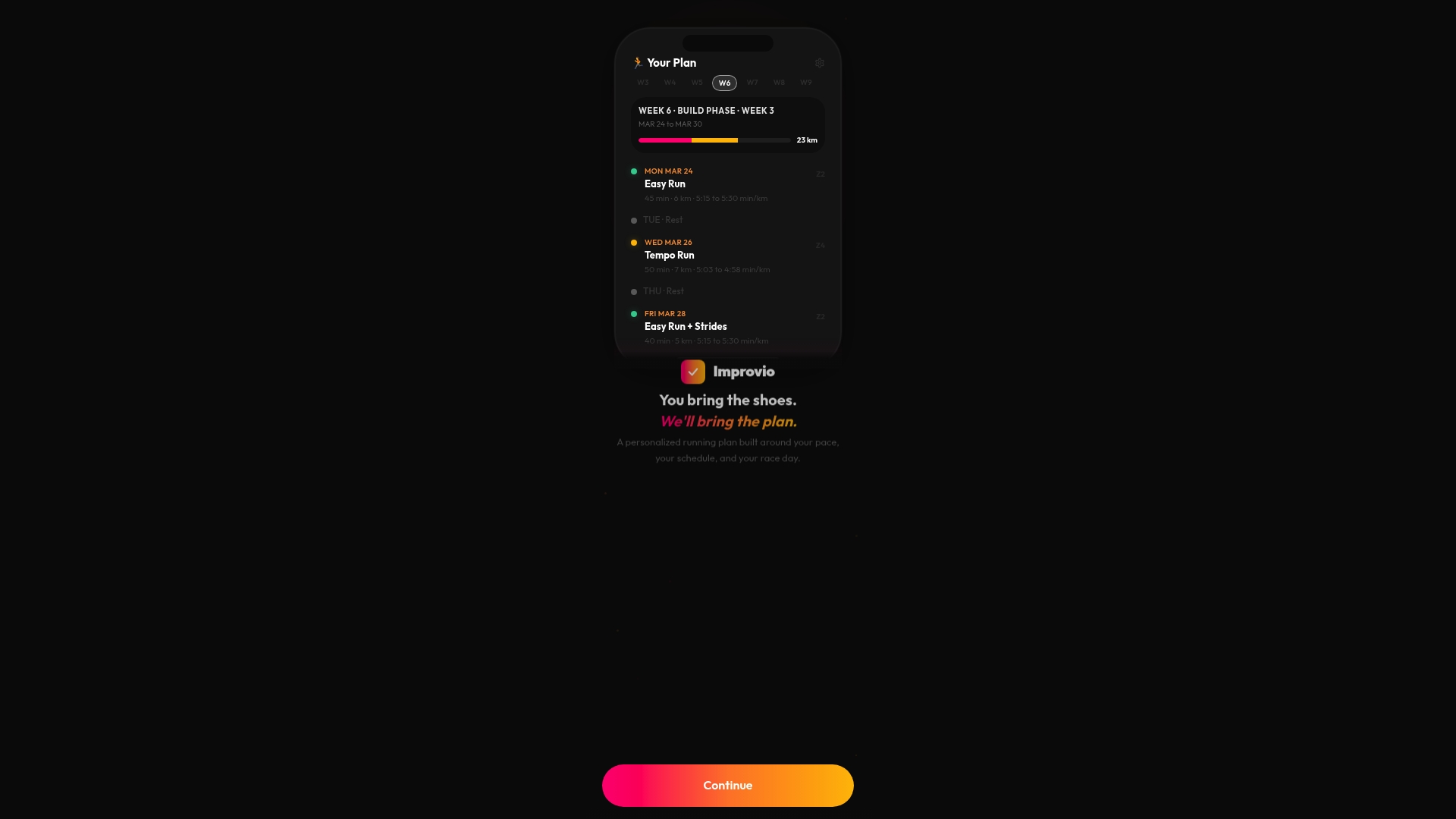
Improvio creates a personalized training plan based on your current pace, your available days, and your race date. Every run is planned for you, including which pace to run, how long to go, and when to rest. The platform takes all the guesswork out so you can focus on the part that matters: actually running. You bring the shoes. We will bring the plan. Start your free personalized running plan today and take your first confident step toward race day.
Frequently asked questions
How do I know what my easy pace should be as a beginner?
Your easy pace is wherever you can hold a full conversation without gasping, typically 12 to 15 min/mile or RPE 2 to 4, but comfort matters more than any specific number.
Why can't I run all my training runs at the same fast pace?
Running hard too often leads to fatigue, injury, and stalled progress. Polarized training evidence consistently shows that most fitness gains come from easy-paced runs, not constant hard efforts.
Is it okay to walk during my runs?
Yes, absolutely. Run/walk intervals are a proven method for beginners to build stamina, personalize effort, and stay injury-free, especially in the early weeks.
How should I adjust my pace if I feel tired or the weather is hot?
Run at the slower end of your range on hot or fatigued days. Your body is under extra stress, and a slower run still builds fitness without risking burnout.
How soon can I add tempo runs or intervals?
Wait until you have 8 to 12 weeks of consistent easy running before adding harder efforts. Adding structured intensity too soon is one of the top reasons beginners get injured or quit early.