

TL;DR:
- Beginners often quit due to confusion, overtraining, or injury, which can be prevented with proper planning.
- Essential gear includes well-fitting shoes, moisture-wicking clothing, and proper warm-up, with personalized shoe fitting recommended.
- Progress should be tracked through effort levels, distance, recovery, and heart rate, emphasizing consistency over speed.
Most beginners quit their running plan within the first few weeks. Not because they lack willpower, but because they don't know exactly what to do, when to do it, or how to avoid the setbacks that slow everything down. Confusion leads to overtraining. Overtraining leads to injury. Injury leads to quitting. It doesn't have to go that way. This guide gives you a clear, step-by-step roadmap built for absolute beginners. You'll learn what gear you actually need, how to structure your first weeks of training, how to stay pain-free, and how to measure real progress. No guesswork. Just a plan that works.
Table of Contents
- What you need to start: Gear, mindset, and the first steps
- Step-by-step: The core beginner plan that works
- Stay pain-free: Injury prevention and recovery shortcuts
- Your proof: Milestones, progress checks, and sticking with it
- Why most beginner plans forget the real secret: personal pacing
- Start your running journey with confidence
- Frequently asked questions
Key Takeaways
| Point | Details |
|---|---|
| Start with essentials | Equip yourself with proper shoes and realistic expectations to prevent early setbacks. |
| Follow gradual steps | Structured run-walk intervals three times a week build fitness safely for beginners. |
| Prevent injuries early | Warming up, strength training, and rest days are non-negotiable for staying pain-free. |
| Track milestones | Use clear progress markers—like distance run or number of sessions—to stay motivated. |
| Adapt your plan | It’s OK to repeat weeks or slow down—personal pacing boosts long-term success. |
What you need to start: Gear, mindset, and the first steps
With your reason for starting clear, let's set you up for a successful first step, literally. You don't need a lot to begin running. But what you do need matters more than most people realize.
Start with the right shoes. 52% of beginners run in footwear that doesn't fit their foot type, and that's one of the leading causes of early injury. Everything else is secondary. Check with your doctor first if you have any existing joint, heart, or breathing concerns. Once you're cleared, you're ready to go.
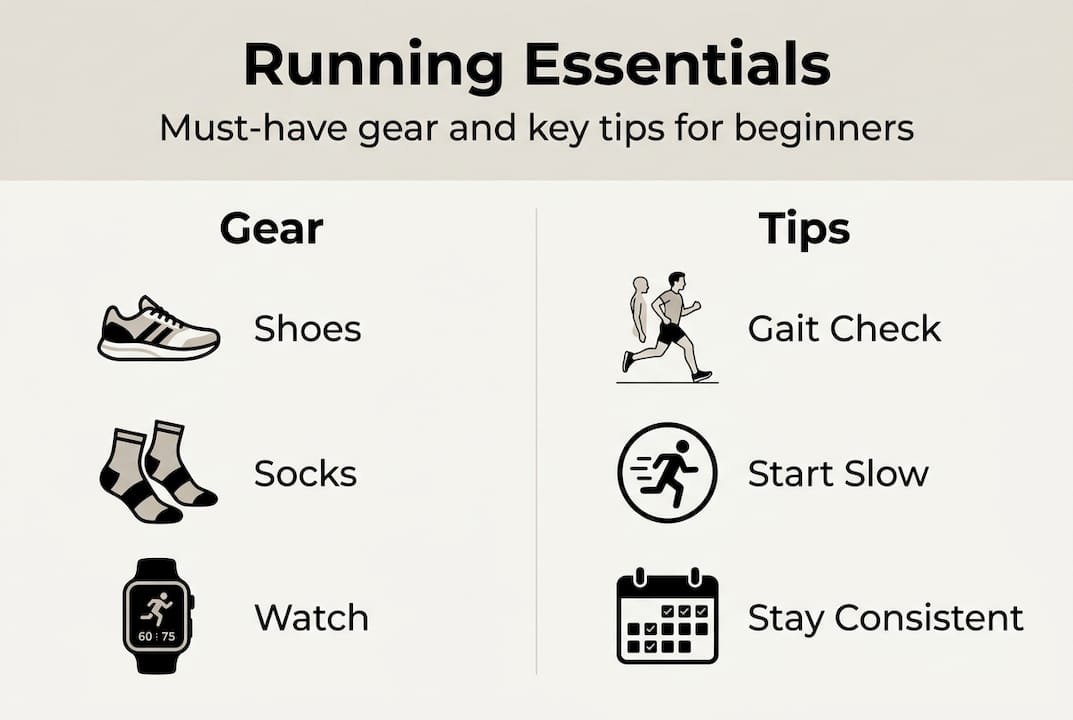
Here's a quick breakdown of what you need versus what's nice to have:
| Gear | Essential | Nice to have |
|---|---|---|
| Running shoes | ✓ | |
| Moisture-wicking socks | ✓ | |
| Comfortable athletic wear | ✓ | |
| Water bottle or hydration belt | ✓ | |
| GPS watch or running app | ✓ | |
| Foam roller | ✓ | |
| Headphones | ✓ |
Pro Tip: Visit a specialty running store and ask for a gait analysis. They'll watch how you move and match you to the right shoe. It takes 15 minutes and can save you months of pain.
Beyond gear, your mindset sets the tone. The biggest mistake beginners make is chasing speed too early. Your first goal isn't to run fast. It's to run consistently. Slow progress is still progress. Check out these starting running basics to build the right foundation from day one.
Here are the most common mental barriers you'll face:
- Fear of looking slow in public (everyone starts somewhere)
- Confusion about how far or how fast to go
- Overambition in week one, leading to soreness and dropout
- Impatience when progress feels invisible
Tackle these early with realistic expectations and solid motivation tips that keep you moving when motivation dips. Consistency beats intensity every single time at this stage.
Step-by-step: The core beginner plan that works
Now that you're ready and equipped, let's walk through the tried-and-true steps of a successful beginner running plan.
The gold standard for new runners is the Couch to 5K program, which runs 8 to 9 weeks, three sessions per week, and builds you up to 30 continuous minutes of running. It's simple, structured, and backed by years of real-world results.
Here's how a typical progression looks:
- Week 1: Alternate 60 seconds of running with 90 seconds of walking for 20 minutes
- Week 2: Run 90 seconds, walk 2 minutes, repeat for 20 minutes
- Week 3: Two sets of running 90 seconds, then 3 minutes, with walking breaks
- Week 4: Longer running intervals, shorter walking breaks
- Week 5: First attempt at a 20-minute continuous run
- Week 6: Mix of intervals and a 25-minute continuous run
- Week 7: Three 25-minute continuous runs
- Week 8: Three 28-minute continuous runs
- Week 9: Three 30-minute continuous runs. You're ready.
Before each session, spend 5 minutes walking briskly to warm up. After each session, walk for 5 minutes and do light stretching. This is non-negotiable for keeping your body healthy.
Not every plan looks the same. Here's how the most popular beginner approaches compare:
| Plan | Method | Best for |
|---|---|---|
| Couch to 5K (NHS) | Run-walk intervals to continuous | Most beginners |
| Galloway Method | Run-walk intervals throughout | Injury-prone runners |
| Nike Run Club | Audio-guided, mix of easy and tempo | Tech-friendly beginners |
As research on run-walk methods shows, both interval and continuous approaches work. The best method is the one you'll actually follow. Explore a full comprehensive running plan to see which structure fits your schedule and goals.
Pro Tip: Use an audio-guided app like the NHS C25K or Nike Run Club. Hearing a coach in your ear keeps you on pace and motivated when you want to quit.
Listen to your body before moving to the next week. If a session felt brutal, repeat it. Moving forward too fast is how most people get hurt. Learn more about beginner workout types to understand how easy runs, tempo efforts, and walk breaks each serve a purpose in your running schedule.
Stay pain-free: Injury prevention and recovery shortcuts
Following those steps, let's make sure pain and injury don't knock you off track.
The numbers are real: 78% of people who quit a beginner running program do so because of injury. Women face a 40% higher injury risk than men in these programs. Most of these injuries are preventable.
Injury prevention isn't complicated. It just requires consistency in the right habits. Here's what actually works:
- Wear proper shoes fitted to your foot type and gait
- Follow the 10% rule: Never increase your weekly mileage by more than 10% at a time
- Warm up every session with 5 minutes of brisk walking. Read more on warm-up guidance to do it right
- Add strength training two days per week, focusing on hips, glutes, and core. Cross-training for hips and core is one of the most effective ways to prevent the knee pain that sidelines so many beginners
- Rest days are training days. Your body repairs and gets stronger when you rest
- Don't run through sharp pain. Discomfort is normal. Sharp or worsening pain is a signal to stop
Knee pain is the most common complaint for new runners. Most cases resolve with rest, ice, and strengthening exercises. Research on knee injury recovery confirms that early intervention and proper load management lead to full recovery in most beginner runners.
Pro Tip: If you have a history of knee, hip, or ankle issues, talk to a physical therapist before starting. One session can give you a personalized prevention plan that saves you weeks of downtime.
Community also plays a role in staying healthy. Runners who train with a group or use a structured app tend to stick with safe progressions longer. Check out beginner injury prevention routines that pair smart training with accountability.
Your proof: Milestones, progress checks, and sticking with it
Having learned how to avoid setbacks, here's how you'll know you're on track and what to do next.
Progress in running isn't always obvious at first. You won't always feel faster. But the signs are there if you know where to look. Here's how to check your improvement:
- Track your effort level. The same run should feel easier over time, even if your pace stays the same
- Log your distance and time. Small gains add up. Even 30 extra seconds of running per session is forward momentum
- Notice your recovery. If you bounce back faster after runs, your fitness is improving
- Check your resting heart rate. A lower resting heart rate over weeks is a reliable sign of cardiovascular improvement
These early milestones matter more than any race time:
- Completing your first full week of training
- Running for 10 minutes without stopping
- Finishing a 20-minute continuous run
- Crossing the finish line of your first race
Here's a simple milestone table to guide your expectations:
| Milestone | Typical timeline | Adjust if... |
|---|---|---|
| First nonstop 10-min run | Week 4 to 5 | Still struggling at week 6 |
| First 20-min continuous run | Week 7 to 8 | Feeling strong, push to week 6 |
| Race-ready fitness | Week 9 | Repeat week 8 if not confident |
Prioritizing consistency over speed is what separates runners who finish their first race from those who don't. Support from a community or app makes a real difference in staying on track.
When life gets in the way, and it will, don't restart from zero. Miss a day? Pick up where you left off. Miss a week? Go back one phase. Weather bad? Run indoors or swap for a walk. Explore milestones for new runners and beginner plan variations to keep your plan flexible and realistic.
Why most beginner plans forget the real secret: personal pacing
Now that you know how to track milestones, let's share one critical factor most plans miss.
Most beginner running plans are built around a fixed schedule. Run this far on this day. Hit this time by this week. That structure is helpful, but it becomes a trap when you treat the schedule as the goal instead of a guide.
The real secret is personal pacing. Not just how fast you run, but how you adapt the entire plan to your body's signals. Adapting to your body rather than following a rigid timetable is what actually drives long-term success.
We've seen it repeatedly. Runners who repeat a week when they need to, who slow down on tired days, and who take an extra rest day without guilt, those are the runners who make it to race day. The ones who push through warning signs to stay "on schedule" are the ones who end up sidelined.
This is why customizing your beginner plan matters more than following a generic template. Your pace, your schedule, your race date. These details change everything.
Pro Tip: The best plan is the one you can stick with. Don't fear repeating a week or dialing back your pace. That's not failure. That's smart training.
Start your running journey with confidence
Motivated to get started? Here's a simple next step.
You've got the knowledge. Now you need a plan that fits your life, not someone else's schedule. That's exactly what Improvio is built for. In about 60 seconds, you can set up a personalized running plan based on your current pace, your available days, and your race date.
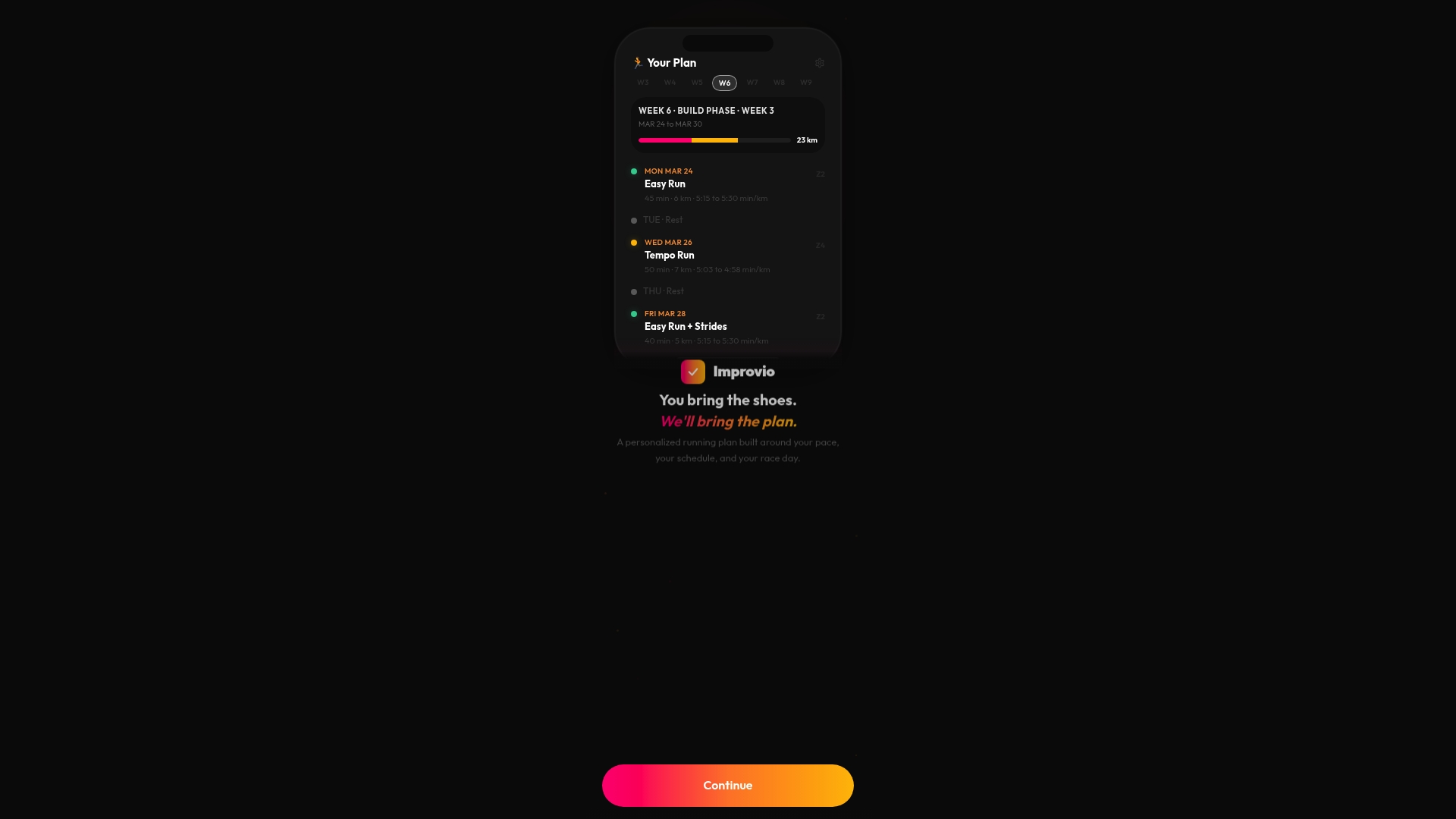
No guesswork. No rigid templates that don't account for your body or your week. Improvio adapts as you progress, so your plan stays realistic and achievable. Track your milestones, get tailored tips, and build confidence with every run. You bring the shoes. We'll bring the plan. Start free today at Improvio and take your first step toward race day.
Frequently asked questions
How many days a week should I run as a beginner?
Three running days per week is the standard recommendation for beginners, giving your body enough time to recover between sessions while building consistent fitness.
Is it okay to repeat a week if I don't feel ready?
Absolutely. Adapting the plan to your body is encouraged and helps you avoid injury or burnout that comes from pushing forward before you're ready.
Do I have to run nonstop by the end of the plan?
No. Run-walk intervals are a completely valid long-term strategy, used by beginners and experienced runners alike to manage effort and reduce injury risk.
What do I do if I experience pain during the plan?
Stop running and rest. If the pain is sharp or doesn't improve within a few days, see a professional. Injury causes high dropout rates, and early intervention is always better than pushing through.