

TL;DR:
- Understanding running terminology helps beginners run safely, confidently, and enjoyably.
- Key terms include pace, cadence, easy and tempo runs, intervals, PR, and race day vocabulary.
- Applying these terms during training and race day reduces confusion and enhances performance.
You open your first training plan and see "6x400m intervals at tempo pace with 90-second recovery." What does any of that mean? If that sentence made your head spin, you are not alone. Running has its own language, and for new runners preparing for their first race, that language can feel like a wall. But here is the good news: once you crack the code, everything clicks. Your workouts make sense. Your race prep feels organized. And you stop second-guessing every instruction. This guide breaks down the most important running terms so you can train smarter, feel more confident, and actually enjoy the process.
Table of Contents
- Why running terminology matters for your first race
- Core running terms explained: What every new runner needs to know
- Training plan lingo decoded: From 'intervals' to tapering
- Beyond the basics: Key race day and community terms
- What most guides miss about learning running terminology
- Take your understanding further with Improvio
- Frequently asked questions
Key Takeaways
| Point | Details |
|---|---|
| Knowing the lingo | Understanding running terms makes training plans clearer and races less intimidating. |
| Core terms demystified | Key concepts like cadence, tempo, and taper set the foundation for successful running. |
| Plan with purpose | Grasping plan terminology ensures you follow workouts correctly and reduce injury risk. |
| Community confidence | Learning common race and group terms helps you connect and feel at home on race day. |
Why running terminology matters for your first race
Running lingo is not just insider talk for experienced athletes. It is a practical tool. When you understand what your training plan is asking you to do, you can actually do it correctly. That matters more than most new runners realize.
Think about it this way. If your plan says "easy run" and you do not know what easy means in running terms, you might push too hard. That leads to fatigue, soreness, and sometimes injury. Understanding the language keeps you in the right zone for each workout. It also makes why running plans matter much clearer. A plan is only useful if you can read it.
Here is why terminology directly supports your training:
- Reduces intimidation. Unfamiliar words make plans feel harder than they are. Once you know the terms, the plan becomes a clear roadmap.
- Improves safety. Knowing the difference between an easy run and a tempo run helps you control effort and avoid overtraining.
- Boosts motivation. Runners who understand what they are doing and why tend to stay more consistent. They feel like they belong.
- Supports better decisions. When you hear a coach or training partner use a term, you can respond and adjust instead of guessing.
One area where terminology really matters is cadence. Higher cadence shortens stride and lowers the impact on your joints. Cadence is not fixed at one number. It tends to increase by roughly 10 steps per minute across your full speed range. Knowing this helps you run more efficiently without overthinking your form.
"The first step to running well is understanding what you are being asked to do. Clarity in language is clarity in training."
For new runners, beginner runner milestones are much easier to hit when you know what each workout is building toward. And if you are brand new to all of this, new to running tips from experienced runners can help you feel less alone in the process.
Pro Tip: When you see a term you do not recognize in your plan, do not skip it. Look it up right away. Skipping unknown instructions is one of the most common mistakes new runners make.
Core running terms explained: What every new runner needs to know
Let us start with the words you will see most often. These terms show up in training plans, race guides, and running communities. Knowing them gives you a strong foundation.
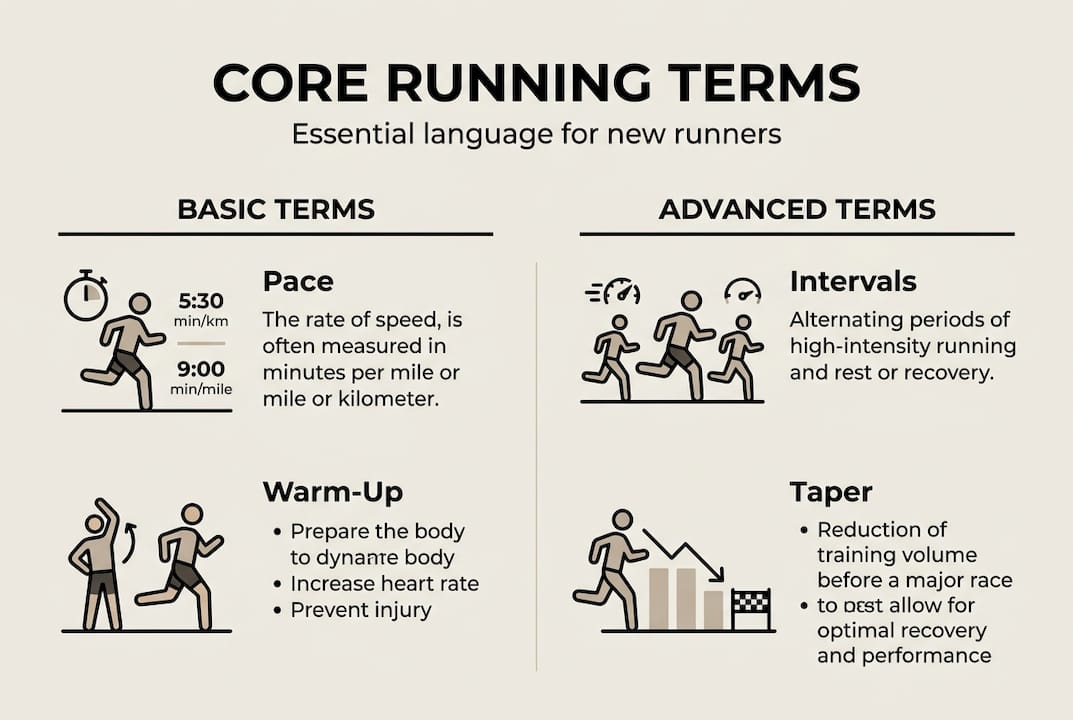
- Pace: How long it takes you to run one mile or one kilometer. For example, a 10-minute pace means you run one mile in 10 minutes.
- Cadence: The number of steps you take per minute. A higher cadence often means better running form.
- Easy run: A comfortable, conversational run. You should be able to speak in full sentences.
- Tempo run: A steady, challenging effort. Harder than easy but not a sprint. Builds speed and endurance.
- Intervals: Short, fast efforts followed by rest or slow jogging. Great for building fitness quickly.
- Recovery: The rest or slow movement between hard efforts. Just as important as the work itself.
- PR or PB: Personal Record or Personal Best. Your fastest time for a given distance.
- Chip time: Your actual race time, measured from when you cross the start line to when you cross the finish.
- Warm-up: Easy movement before your main workout to prepare your body.
- Cool-down: Easy movement after your workout to help your body recover.
As explained in the types of running workouts guide, each workout type has a specific purpose. Mixing them up in the right way is what builds fitness over time.
| Term | What it means | Why it matters |
|---|---|---|
| Pace | Time per mile or km | Helps you run at the right effort |
| Cadence | Steps per minute | Improves form and reduces injury risk |
| Tempo run | Steady hard effort | Builds speed and endurance |
| Intervals | Fast efforts with rest | Increases fitness fast |
| Tapering | Reducing training before a race | Lets your body recover and peak |
| Chip time | Your personal race clock | Gives you an accurate finish time |
When you are starting your training, focus on the top five terms first. Pace, easy run, warm-up, cool-down, and recovery will cover most of what you see early on. The rest will make sense as you progress. You can also explore marathon training basics for more context on how these terms fit into longer race prep.

Training plan lingo decoded: From 'intervals' to tapering
Now that you know the core terms, let us look at how they appear in real training plans. Plans use specific language to describe workouts, and reading them correctly makes a big difference.
Here is a comparison of common plan terms and what they actually mean for you as a new runner:
| Plan term | What it means for you |
|---|---|
| Intervals | Run fast for a set distance, then rest, repeat |
| Repeats | Same as intervals, just another word for it |
| Ladders | Intervals that increase then decrease in distance |
| Tempo run | Run at a comfortably hard pace for a set time |
| Long run | Your weekly longest run, done at easy pace |
| Tapering | Cutting back mileage the week or two before your race |
| Cross-training | Non-running exercise like cycling or swimming |
Knowing why training plans matter helps you trust the structure. Each term represents a specific training stimulus. When you follow the plan as written, your body adapts in the right way.
Here is how to interpret a typical workout description step by step:
- Read the distance or time first. That tells you how long the effort is.
- Find the pace or effort cue. Words like "easy," "tempo," or "hard" tell you how fast to go.
- Check for rest instructions. "90-second recovery" means jog or walk for 90 seconds between efforts.
- Count the repetitions. "6x400m" means six rounds of 400 meters each.
- Note any warm-up or cool-down instructions. These are often listed at the start and end of the workout.
For more detail on making a training plan that fits your schedule and goals, structure matters from day one. And if you want to see how experienced runners approach their build-up, how to train for a marathon offers a useful real-world view.
Pro Tip: The most common mistake new runners make is running their easy runs too fast. If you can not hold a conversation, slow down. Easy means easy.
As noted in running plans for new runners, the terminology in your plan is not random. Every word is a cue for how to train that day.
Beyond the basics: Key race day and community terms
Understanding your training plan is crucial, but runners also need to decode the language used on race day and in the running community. These terms come up fast, and knowing them in advance helps you feel calm and prepared.
Here are the key race day and community terms you need to know:
- Corral: A designated starting area grouped by expected finish time. Faster runners start at the front.
- Pacer: A runner who runs at a set pace to help others hit their goal time. Look for signs with finish times.
- DNF: Did Not Finish. It happens to everyone at some point. It is not failure, it is data.
- Negative split: Running the second half of your race faster than the first. A smart race strategy.
- Bandit: Someone who runs a race without registering. Not encouraged, as it affects safety and resources.
- Chip timing: Your race time starts when you cross the start mat, not when the gun fires. Your time is yours.
- Bib: The numbered paper you pin to your shirt. It identifies you and tracks your chip time.
As covered in beginner milestones, knowing what to expect on race day reduces anxiety significantly. New runners who feel familiar with the environment and the language tend to perform better and enjoy the experience more.
"When new runners understand the vocabulary of the sport, they stop feeling like outsiders and start feeling like part of the community."
Race day can feel overwhelming. There are crowds, announcements, and a lot of moving parts. But if you know what a corral is, you will find your spot. If you know what a pacer does, you can use one as a guide. These small pieces of knowledge add up to a much calmer start line. For safety guidance specific to race environments, runner safety explained is worth a read.
If you hear a term you do not recognize, just ask. Running communities are welcoming. No one expects you to know everything on your first race. The running structure benefits extend beyond fitness. They build your confidence and your sense of belonging in the sport.
What most guides miss about learning running terminology
Most terminology guides hand you a list of definitions and call it done. That is helpful, but it is not the whole picture. Memorizing what "tempo run" means is not the same as knowing how it feels in your legs at mile three.
The real learning happens when you apply terms during actual runs. Try this: before your next workout, pick two terms from this guide and focus on them. Notice your cadence. Feel the difference between easy effort and tempo effort. That hands-on experience is what makes the language stick.
Typical guides also miss how terms connect to your daily routine and your running group. When your training partner says "let us do a negative split today," you want to respond with confidence, not confusion. Language builds connection.
Embrace the moments when you do not know a term. That confusion is a signal that you are growing. Follow a step-by-step running plan that uses these terms in context, and you will internalize them naturally. You do not need to memorize a dictionary. You just need to keep showing up.
Take your understanding further with Improvio
Now that you understand running terminology, the next step is putting it into practice with a plan built around you.
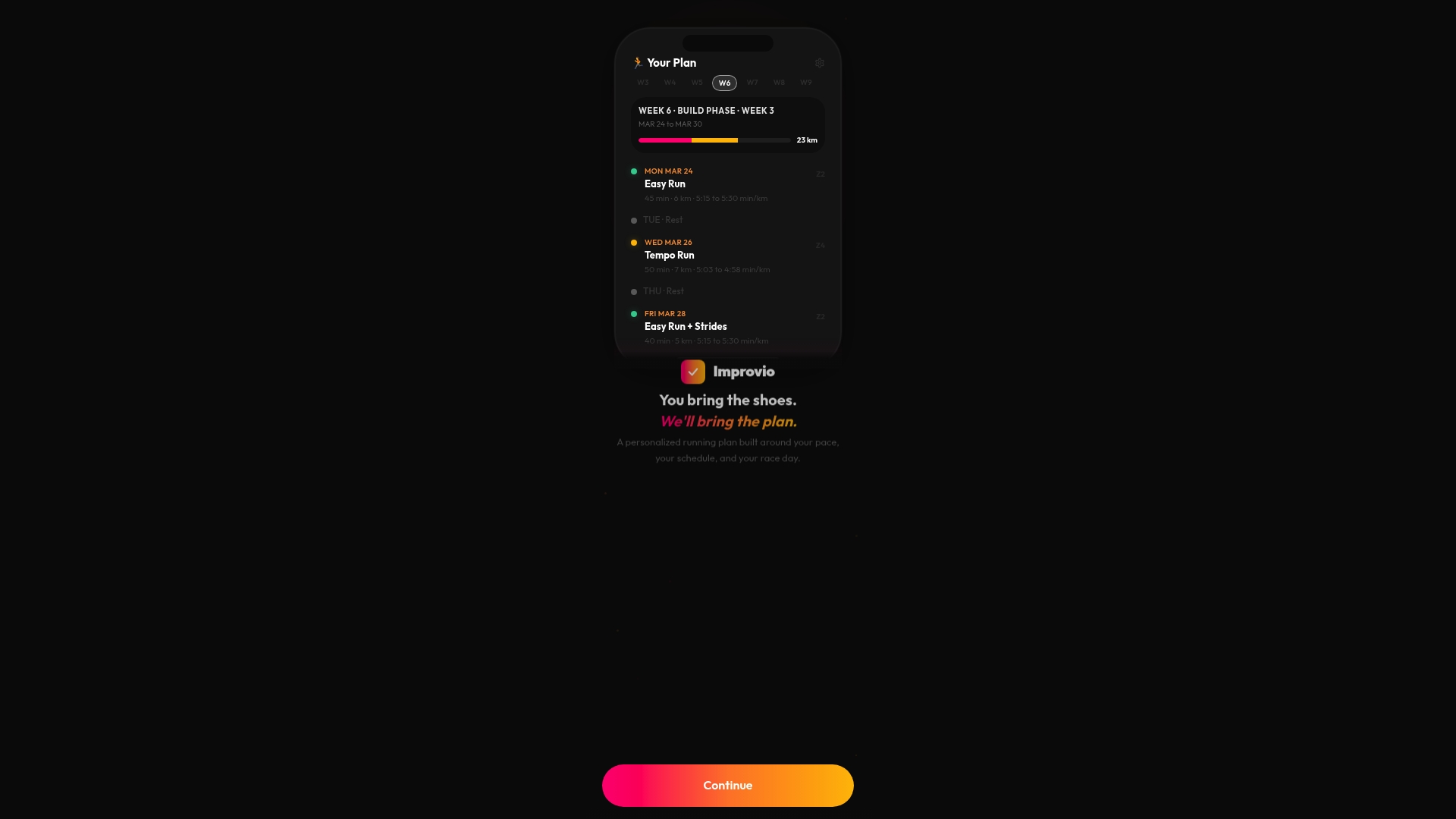
Improvio creates personalized training plans for absolute beginners. Every workout in your plan uses the exact terms you just learned, so you always know what you are doing and why. Your plan is built around your pace, your schedule, and your race date. Setup takes about 60 seconds and your first plan is free. You bring the motivation. We bring the structure. Start with the simple start steps and turn your new knowledge into real progress.
Frequently asked questions
What does 'cadence' mean in running?
Cadence is the number of steps you take per minute. Higher cadence reduces impact on your joints and can improve your overall running efficiency.
Why is tapering important before a race?
Tapering means reducing your training volume in the final week or two before race day. As outlined in running plans for beginners, it allows your body to recover fully so you can perform at your best.
What is a negative split?
A negative split means you run the second half of your race faster than the first half. It is a smart pacing strategy that helps you finish strong.
How do I interpret 'tempo run' in my plan?
A tempo run is a steady, comfortably hard effort that builds both speed and endurance. As detailed in running workout types, it sits between easy and all-out effort on the intensity scale.
What do I do if I don't understand a term?
Ask a coach, search a reliable running guide, or post in a running community forum. Every experienced runner was once a beginner who did not know the lingo either.