

You lace up your shoes, you follow your schedule, and you push a little harder every week. More miles, more effort, faster progress. That logic makes sense on paper. But for new runners, it can quietly backfire. Overtraining is one of the most common reasons beginners stall, get hurt, or lose motivation before race day. Key symptoms include elevated resting heart rate, frequent illnesses, slow-healing injuries, performance drops, and loss of motivation. This guide breaks down what overtraining is, how to spot it early, and exactly what to do about it.
Table of Contents
- What is overtraining in running?
- Key symptoms of overtraining every runner should know
- Why overtraining happens: The science behind the struggle
- How to prevent overtraining as a new runner
- Recovering from overtraining: Step-by-step guide for new runners
- How your training plan keeps you safe from overtraining
- Take the next step toward smarter, safer training
- Frequently asked questions
Key Takeaways
| Point | Details |
|---|---|
| Spot warning signs | Recognizing physical and mental clues early helps prevent serious setbacks. |
| Balance training and rest | Gradual progression and scheduled recovery days minimize overtraining risks. |
| Monitor your body | Tracking your heart rate and mood gives an early indication of trouble. |
| Plan for recovery | Prompt rest and a phased, structured return are essential for long-term progress. |
| Structured plans help | Following a training plan with built-in rest keeps new runners on a safe path. |
What is overtraining in running?
Overtraining happens when you push your body harder than it can recover from. It is not just feeling tired after a long run. It is a pattern where your body never fully bounces back between sessions, and the damage starts to stack up.
Normal fatigue fades within a day or two. Overtraining does not. Your legs stay heavy, your pace drops, and even easy runs feel like a grind. For new runners, this often happens when mileage or intensity jumps too fast, too soon. Your enthusiasm is real, but your body needs time to adapt.
Here is what makes overtraining different from regular tiredness:
- Fatigue that lasts more than 48 hours after a run
- Performance getting worse despite consistent training
- Mood changes like irritability or feeling emotionally flat
- Trouble sleeping even when you are physically exhausted
- Getting sick more often than usual
As the Mayo Clinic notes, elevated resting heart rate, disturbed sleep, and loss of motivation are common signs of overtraining. If you are seeing two or more of these at once, it is time to pay attention.
"Overtraining is not a badge of honor. It is a signal your body is asking for help."
If you are just getting started, check out this beginner running workflow to build a solid foundation before ramping up intensity.
Key symptoms of overtraining every runner should know
Once you know what overtraining is, the next step is learning to recognize it fast. The earlier you catch it, the quicker you recover.
Physical warning signs:
- Resting heart rate elevated by +10 bpm or more above your normal baseline
- Persistent muscle soreness that does not ease with rest
- Recurring minor injuries like shin splints or knee pain
- Frequent colds or infections
- Poor sleep quality despite feeling exhausted
Performance warning signs:
- Your easy runs feel harder than they should
- Your pace slows even at the same effort level
- You struggle to finish workouts you used to complete easily
- Pain lasting more than 5 to 10 minutes into a run is a red flag
Mood and mental signs:
- Irritability, anxiety, or feeling emotionally drained
- Low motivation to run or train at all
- Psychological signs like irritability and emotional flatness often show up before physical symptoms do
| Symptom | Normal tiredness | Overtraining |
|---|---|---|
| Fatigue duration | 1 to 2 days | More than 3 to 5 days |
| Performance | Stable or improving | Declining |
| Mood | Normal | Irritable or flat |
| Sleep | Restful | Disrupted |
| Motivation | Present | Low or absent |
Pro Tip: Keep a simple daily log. Write down your resting heart rate each morning, your energy level (1 to 10), and how your run felt. Patterns show up fast when you track them. Pair this habit with a solid running checklist guide to stay on top of your prep.
Why overtraining happens: The science behind the struggle
Your body gets stronger during recovery, not during the run itself. When you run, you create small amounts of stress and damage in your muscles. Rest is when your body repairs that damage and comes back stronger. Overtraining happens when you do not give it enough time to do that.

For beginners, the gap between training load and recovery capacity is often the problem. You feel good, so you add more miles. You hit a new distance, so you push the pace. Before long, your body is running a recovery deficit it cannot close.
Here is what happens physiologically when training load exceeds recovery:
| Marker | Healthy runner | Overtrained runner |
|---|---|---|
| VO2max | Stable or rising | Decreased |
| Heart rate variability (HRV) | High | Reduced |
| Nocturnal heart rate | Normal | Elevated |
| Peak blood lactate | Normal | Reduced |
Empirical benchmarks include decreased VO2max, peak blood lactate, reduced HRV, and elevated nocturnal heart rate in overtrained runners compared to healthy controls.
"Up to two-thirds of elite runners experience overtraining syndrome at least once in their career. For beginners without structured guidance, the risk is just as real."
Stress outside of running matters too. Work pressure, poor nutrition, and lack of sleep all reduce your body's ability to recover. Running on top of an already stressed system speeds up the path to overtraining. Explore these training routine ideas to see how a balanced weekly structure protects your recovery.
How to prevent overtraining as a new runner
Prevention is simpler than recovery. A few consistent habits make a big difference.
- Increase mileage slowly. Add no more than 10% to your weekly distance each week. This gives your muscles, joints, and tendons time to adapt.
- Schedule rest days. At least one full rest day per week is non-negotiable. Every third or fourth week, pull back your total mileage by 20 to 30% for an easy recovery week.
- Track your resting heart rate. Check it every morning before you get up. A spike of 7 to 10 bpm above your normal baseline is a signal to ease off. Tracking resting heart rate and listening to your body's signals can prevent overtraining before it takes hold.
- Rate your energy daily. On a scale of 1 to 10, how do you feel before each run? Consistently scoring below 5 means your body needs more recovery time.
- Mix your effort levels. Not every run should be hard. Easy runs at a conversational pace make up the bulk of a smart training week.
- Follow a structured plan. A good plan builds in progression and rest automatically. Understanding the importance of training plans is one of the best things you can do before your first race. When you are ready to build one, start with making a training plan that fits your schedule and goals.
Pro Tip: Rest days are not wasted days. Your body gets stronger on rest days, not on run days. Treat recovery like a workout you cannot skip.
Recovering from overtraining: Step-by-step guide for new runners
If you are already showing signs of overtraining, do not panic. Recovery is possible. But it requires patience.
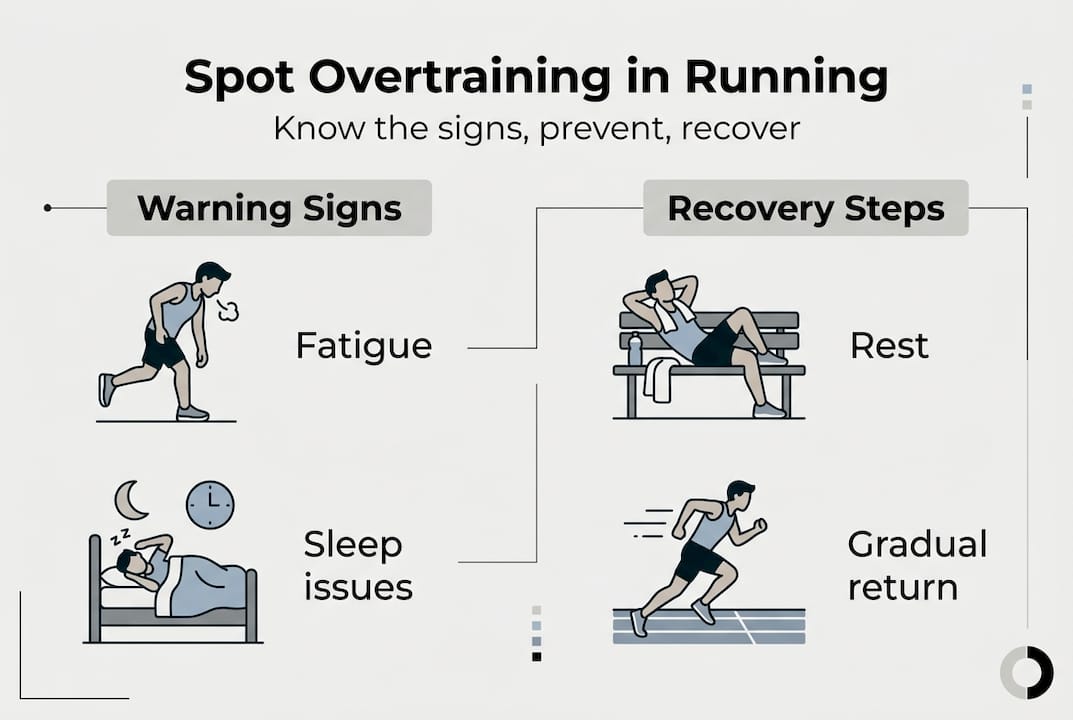
Recovery time can range from 1 to 2 weeks for mild cases to many months for severe Overtraining Syndrome (OTS). The key is not to rush back.
Here is a step-by-step recovery approach:
- Stop running completely. For mild cases, take 1 to 2 full weeks off. For more severe symptoms, rest until all signs resolve.
- Monitor your resting heart rate daily. When it returns to your normal baseline for several days in a row, that is a good sign your body is recovering.
- Phase 1: Gentle movement. Start with walking, light stretching, or easy swimming. Keep effort very low.
- Phase 2: Low-intensity runs. Once symptoms are gone, reintroduce short, easy runs at a very comfortable pace. Think 20 to 30 minutes at most.
- Phase 3: Gradual rebuild. Slowly increase duration and frequency over several weeks, following the 10% rule again from the start.
"Full recovery from OTS can take weeks to years. Do not rush the process. Returning too soon is the most common reason runners relapse."
Real recovery timelines vary. Mild cases resolve in 2 to 4 weeks. Moderate cases can take 3 to 6 months. Severe OTS has been documented taking up to 15 months or longer. Use a step-by-step running plan to guide your return safely. And do not overlook the mental side of recovery. Mental training for recovery can help you stay focused and patient during the process.
How your training plan keeps you safe from overtraining
A structured training plan is your best defense against overtraining. It does the thinking for you so you do not have to guess when to push and when to rest.
Here is what a good plan does for you:
- Builds in gradual progression so mileage increases are automatic and safe
- Schedules rest days and easy weeks so recovery is part of the plan, not an afterthought
- Balances hard and easy efforts across the week to prevent cumulative fatigue
- Adapts to your pace and schedule so you are not following a plan built for someone else
- Gives you a clear path to race day without guessing what comes next
Phased returns and structured plans are key to safe training after overtraining. Whether you are starting fresh or rebuilding after a setback, a plan that fits your life makes all the difference. Learn more about how a training plan for race success can keep you on track, and why following a beginner plan is one of the smartest moves a new runner can make.
Take the next step toward smarter, safer training
You now know what overtraining looks like, why it happens, and how to stop it before it stops you. The next step is putting that knowledge into a plan that actually works for your schedule, your pace, and your race date.
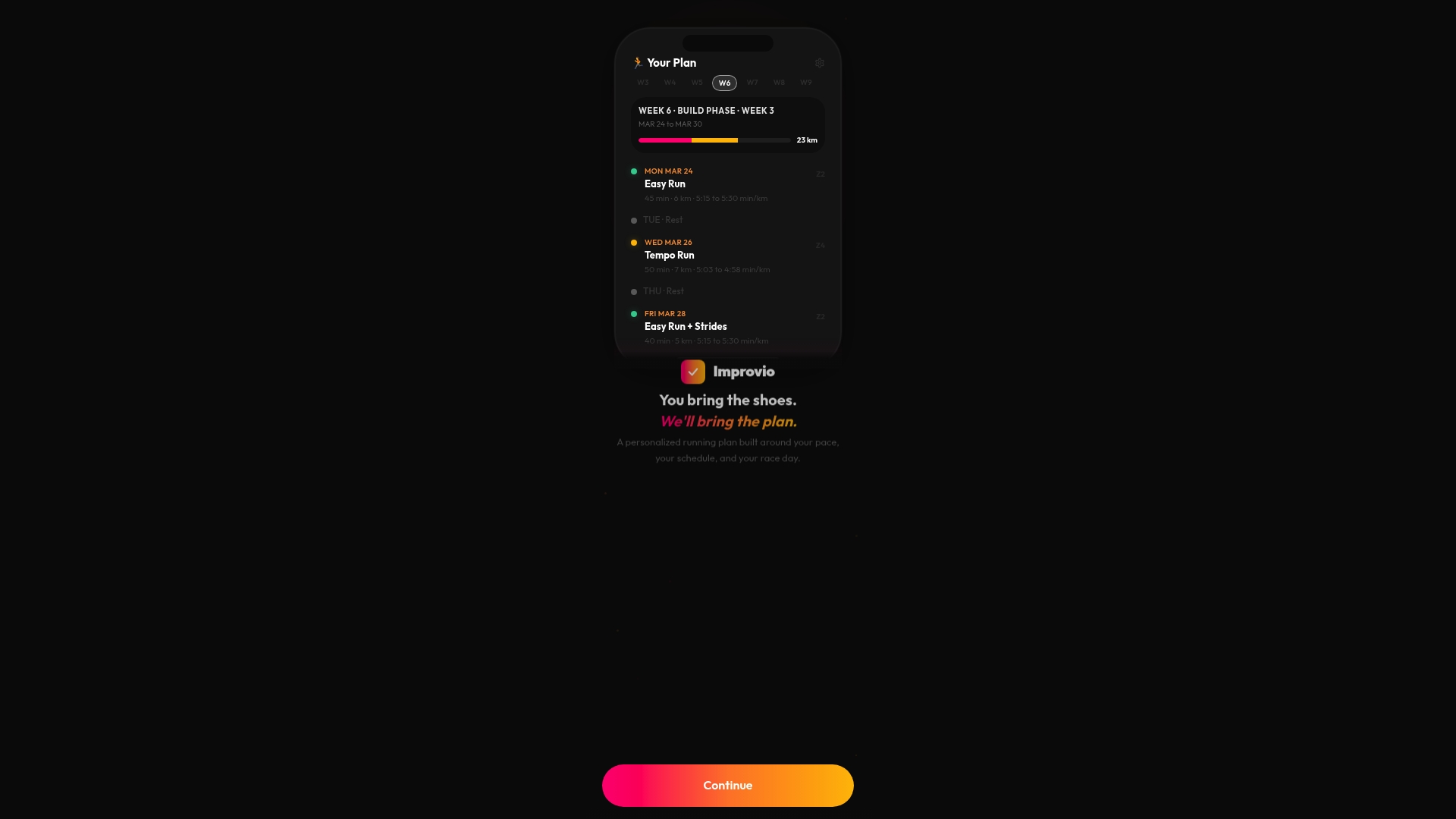
That is exactly what Improvio is built for. In about 60 seconds, you get a personalized training plan designed around your goals, not someone else's. No guesswork, no generic schedules, no overtraining traps. Just a clear, structured path to your first finish line. Start with the running workflow guide to see how it all fits together, then build your free plan today. You bring the shoes. We will bring the plan.
Frequently asked questions
How do I know if I'm overtraining as a new runner?
Look for persistent fatigue, elevated heart rate, irritability, sleep issues, and declining performance lasting more than a week. If two or more of these show up together, take it seriously.
Can I still run if I think I'm overtrained?
No. Take a full break until all symptoms resolve, then follow a gradual return. Rest is required for recovery, ranging from 1 to 2 weeks for mild cases to several months for severe ones.
What's the fastest way to recover from overtraining?
Complete rest first, then a phased return starting with walking and easy movement. Phased return is critical after rest. Monitor your heart rate and symptoms throughout the process.
Is overtraining permanent?
No, but severe cases can take months or longer to fully resolve. Full recovery can take weeks to years depending on how serious the overtraining was and how quickly you addressed it.
Do I need to see a doctor for overtraining?
If symptoms persist despite rest or you notice heart irregularities, see a physician. Consult a doctor for persistent symptoms, heart issues, or recurring injuries that do not improve with rest.