

TL;DR:
- Using run-walk intervals makes running achievable and gradually builds endurance.
- A schedule of three days of running weekly promotes consistency and injury prevention.
- Focusing on slow, conversational pace and proper form ensures sustainable, injury-free running.
7 Simple Ways to Stay Consistent With Your Running Routine
Sticking with a running routine is the hardest part of training for your first race. You start strong, miss a day, and suddenly the plan feels impossible to follow. Sound familiar? You're not alone. Most new runners struggle with consistency far more than fitness itself. The good news: small, expert-backed strategies make a real difference. This article walks you through actionable, beginner-friendly habits that will help you stay on track, feel good about your progress, and actually cross that finish line.
Table of Contents
- Start with a run-walk program
- Build a beginner-friendly running schedule
- Master running pace and form for consistency
- Warm up, cool down, and listen to your body
- Stay motivated and measure your progress
- What most beginner running advice gets wrong about consistency
- Ready to build your consistent running habit?
- Frequently asked questions
Key Takeaways
| Point | Details |
|---|---|
| Start with run-walk intervals | Begin with short running and walking intervals to build confidence and consistency gradually. |
| Follow a realistic schedule | Schedule three weekly sessions and treat them like appointments for steady progress. |
| Prioritize comfort and form | Run at a pace that lets you talk and pay attention to good posture for a safer, more enjoyable run. |
| Warm up, cool down, and rest | Add warm-ups and cool-downs to each session, and listen to your body to avoid injuries. |
| Use motivation strategies | Track progress and use rewards or support from others to stay motivated through inevitable dips. |
Start with a run-walk program
If sticking with running feels overwhelming, here's how to make the process approachable and rewarding right from the start.

The run-walk method is exactly what it sounds like: you alternate between running and walking during your workout. Instead of forcing yourself to run nonstop from day one, you break the effort into manageable chunks. This makes each session feel achievable rather than exhausting. And when running feels achievable, you actually show up for the next session.
The structure matters. A well-designed run-walk interval program starts with short running bursts, like 1 minute of running followed by 2 minutes of walking, and gradually shifts the balance over several weeks. By week 8, most beginners can run 30 minutes continuously, which is all you need to finish a 5K race. That kind of clear, visible progression keeps motivation high.
Here's a sample 8-week progression you can follow:
- Week 1: 1 min run, 2 min walk (repeat 6 times)
- Week 2: 2 min run, 2 min walk (repeat 5 times)
- Week 3: 3 min run, 2 min walk (repeat 4 times)
- Week 4: 5 min run, 2 min walk (repeat 3 times)
- Week 5: 8 min run, 1 min walk (repeat 3 times)
- Week 6: 12 min run, 1 min walk (repeat 2 times)
- Week 7: 20 min run, 1 min walk, 10 min run
- Week 8: 30 min continuous run
This progression works because your body needs time to adapt. Tendons, joints, and muscles all strengthen more slowly than your cardiovascular fitness. Rushing the process is how new runners get hurt. Following a gradual plan means you keep going.
| Week | Run interval | Walk interval | Total run time |
|---|---|---|---|
| 1 | 1 min | 2 min | ~6 min |
| 4 | 5 min | 2 min | ~15 min |
| 8 | 30 min | None | 30 min |
Pro Tip: Keep a simple running log. Write down the date, what you did, and how you felt. Even a quick note in your phone works. Seeing your progress adds up to a powerful motivator over weeks.
For more guidance on building endurance as a beginner, a structured approach makes all the difference. You can also review simple running start steps to make sure your first sessions set you up for success.
Build a beginner-friendly running schedule
Once you have interval runs set, the next step is building a schedule you can realistically follow every week.
Three days a week is the sweet spot for most beginners. Research shows that 3x per week training allows beginners to reach a continuous 5K in about 8 weeks, with average first finish times between 30 and 40 minutes. You get enough practice to improve, but enough rest to recover.
Here is what a solid beginner week looks like:
- Monday: Rest or light walk
- Tuesday: 🏃 Run-walk session
- Wednesday: Rest or easy stretching
- Thursday: 🏃 Run-walk session
- Friday: Rest or light cross-training
- Saturday: 🏃 Longer run-walk session
- Sunday: Full rest
The key is to treat your running days like appointments. Put them in your calendar. Protect them. Life will get in the way sometimes, and that is completely normal. Missing one session does not ruin your plan. What matters is that you come back the next day and keep going. A single skipped run is just a skipped run, not a failed week.
Your running days should also have consistent spacing. Back-to-back running days increase injury risk for beginners. A rest day between sessions gives your legs time to recover and come back stronger.
Check out this beginner running workflow to see how other new runners structure their weeks. You can also use this runner milestones guide to stay motivated as you hit each new landmark.
Pro Tip: Lay out your running clothes and shoes the night before. Lowering the barrier to getting out the door matters more than you think. When everything is ready, you are far more likely to follow through.
Master running pace and form for consistency
With a schedule in place, you can boost consistency and comfort by dialing in your running speed and form.
Pace is the number one thing most new runners get wrong. They start too fast, feel miserable within the first two minutes, and decide running is not for them. But the problem was not running. It was the speed.
Conversational pace means running slowly enough to hold a real conversation. You should be able to say a full sentence without gasping. If you cannot, slow down. Ignore your GPS pace for the first several weeks. It doesn't matter how fast you go. What matters is that you finish the session feeling like you could do it again.
Here is a quick comparison to help you understand the difference:
| Approach | What it looks like | Result |
|---|---|---|
| Speed-focused | Running too fast, heavy breathing, stopping early | Burnout, frustration, skipped sessions |
| Comfort-focused | Slow and steady, able to talk, finishing strong | Consistency, enjoyment, long-term habit |
Form also plays a huge role in how running feels. Good form reduces effort and prevents injury. Here are the basics:
- Keep your posture upright, not hunched forward
- Bend your arms at roughly 90 degrees and swing them forward and back, not across your body
- Land with your foot under your hips, not out in front of you
- Keep your shoulders relaxed, away from your ears
- Look about 10 to 20 feet ahead, not down at your feet
A 5-minute warm-up walk before each run prepares your muscles and makes those first few minutes feel much easier. The first 5 to 6 minutes of every run tend to feel hard regardless of fitness level. That is totally normal, and it gets better once your body warms up.
For a deeper look at technique, check out this beginner running form guide. Understanding why warm up and cool down matter will also help you run smarter, not just harder.
Warm up, cool down, and listen to your body
Consistency also means protecting your body. Starting and ending runs the right way keeps you on track for weeks, not just days.
Here is a simple routine to use before and after every run:
- Start with a 5-minute brisk walk. This warms up your muscles, gets blood flowing, and signals your body that exercise is coming. A proper warm-up walk includes upright posture, arm swing, and a pace just fast enough to feel your heart rate pick up slightly.
- Begin your run-walk intervals as planned for that day.
- Slow down gradually in the last 2 to 3 minutes of your session instead of stopping abruptly.
- Finish with 5 minutes of slow walking. Let your heart rate come down naturally.
- Stretch gently. Focus on calves, hamstrings, hip flexors, and quads. Hold each stretch for 20 to 30 seconds without bouncing.
Listening to your body is equally important. There is a real difference between normal running discomfort and actual injury warning signs. Muscle soreness 24 to 48 hours after a run is normal and expected. Sharp pain during a run, joint pain that gets worse as you run, or pain that doesn't go away with rest are all signals to stop and take a break.
"Missing one run is always better than risking an injury that sidelines you for weeks. Rest is part of the training plan, not a break from it."
Never push through sharp or joint pain just to hit a goal. The goal is to reach race day healthy. Take extra rest when your body asks for it. The training will still be there when you come back.
For more detail on protecting yourself before each session, explore this guide on warm up before running.
Stay motivated and measure your progress
Now that you're protecting your body and using smart routines, you can lock in long-term consistency with the right motivation and progress tracking.
Motivation naturally rises and falls. That is true for every runner, at every level. Expecting the dips prepares you for them. The goal is not to feel motivated every single day. The goal is to have strategies that carry you through the days when you don't.
Here are the most effective tools for staying consistent:
- Join a local running group or online community. Showing up for others makes it easier to show up for yourself. Accountability is one of the most powerful consistency tools available.
- Set a small, specific goal. Sign up for a 5K race with a real date. A race on the calendar makes training feel purposeful and gives you a concrete finish line to aim for.
- Use a running buddy. Someone to meet at the trail or park makes skipping a session much harder. You are less likely to cancel on a friend than on yourself.
- Reward yourself for small wins. Buy new running socks after two consistent weeks. Enjoy a favorite meal after completing a tough session. Rewards reinforce the habit.
- Track your progress visually. A running journal, a basic spreadsheet, or a running app all work well. Seeing a streak of completed sessions builds momentum.
Tracking non-speed milestones matters just as much as tracking times. Did you run three times this week? That is a win. Did you complete your longest session yet? Celebrate it. Did you get out the door on a day when you really didn't want to? That might be your biggest win of all.
Pro Tip: Celebrate consistency streaks, not just speed improvements. A streak of 10 completed sessions is worth more than a fast mile time when you're starting out. Consistency is the real skill you are building.
For more ideas, check out these running motivation strategies and these beginner runner motivation tips designed specifically for people working toward their first race.
What most beginner running advice gets wrong about consistency
Most beginner running guides focus on the physical side: pace, schedule, form, warm-up. All of that matters. But here is what most advice skips over entirely: the mental side of consistency is harder than the physical side, and it deserves just as much attention.
Strict plans fail not because runners are lazy. They fail because real life does not respect training schedules. Work gets busy. Weather turns bad. Sleep suffers. A rigid plan that expects you to never miss a session sets you up to feel like a failure the moment life interferes.
Flexibility is not weakness. It is strategy. When you miss a run, the most important skill is getting back out there without guilt or drama. Mastering your running workflow means learning to adapt, not just follow instructions.
Self-compassion is also underrated. Talking to yourself the way you would talk to a friend makes a measurable difference in sticking with any habit. You would not tell a friend they failed because they skipped one run. Do not say it to yourself either.
Quitting and restarting is not failure. It is the actual process. The runners who reach race day are not the ones who never stumbled. They are the ones who kept starting again.
Ready to build your consistent running habit?
If you want extra structure and support, there's an easier way to stay on track.
Everything in this article gives you a solid foundation. But applying it consistently is a lot easier when you have a plan built around your pace, your schedule, and your race date.
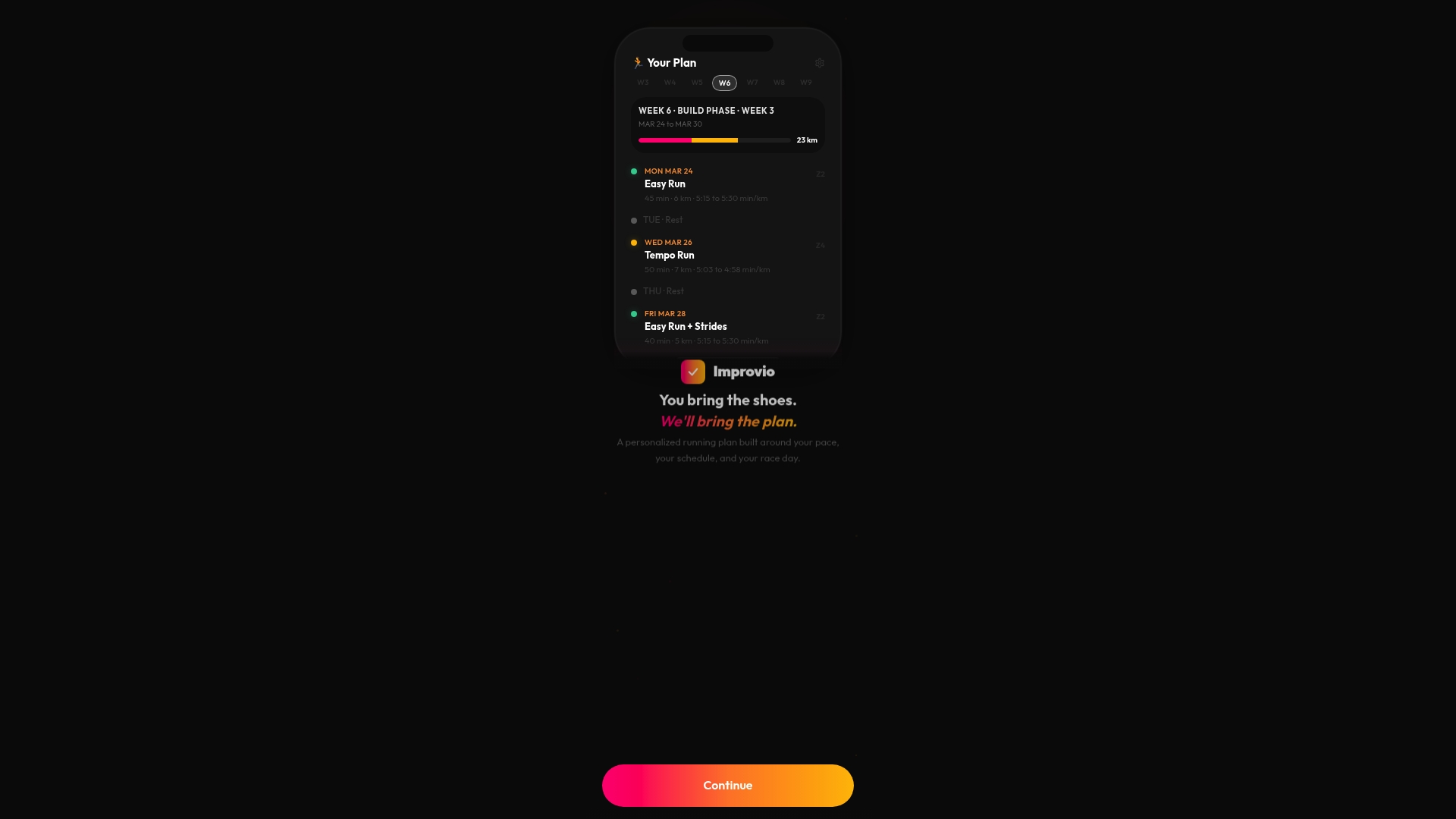
Improvio's personalized running plans do exactly that. In about 60 seconds, you get a custom training schedule tailored to where you are right now and where you want to be on race day. No guesswork. No generic plans that don't fit your life. Just a clear, day-by-day plan designed for you. You bring the shoes. We'll bring the plan.
Frequently asked questions
How many days a week should a beginner run for consistency?
Most beginners build consistency best with three running days per week, allowing full rest days between each session to recover and avoid overuse injuries.
What is the run-walk method and does it really work?
The run-walk method alternates short running intervals with walking breaks, and research shows beginners can reach a continuous 5K in about 8 weeks using this approach three times per week.
How slow should my pace be when starting out?
Start at a conversational pace where you can speak in full sentences without gasping. Speed is irrelevant in the beginning. Comfort and consistency are what matter most.
Do I really need to warm up and cool down for short runs?
Yes. Even a 5-minute warm-up walk before a short run prepares your muscles and reduces injury risk. A short cool-down walk after your run helps your heart rate return to normal safely.