

TL;DR:
- Structured training plans promote gradual adaptation and reduce injury risk for beginners.
- Consistency and progressive overload are key to sustainable running improvement.
- Personalizing plans with rest, strength work, and realistic goals ensures long-term success.
Most new runners assume that lacing up and logging miles is enough. Run more, get faster. Simple, right? Not quite. Without structure, you're likely spinning your wheels, wondering why progress stalls or why your knees ache after week two. The truth is, structured progression adapts your body gradually and cuts injury risk significantly. A well-built training plan isn't just a schedule. It's your roadmap from the couch to the finish line, built around how your body actually responds to stress and recovery.
Table of Contents
- Why do beginners struggle to improve?
- How do training plans create sustainable progress?
- What makes a good beginner training plan?
- The science of periodization: Why structure beats guesswork
- Why most runners overcomplicate training—and how to avoid it
- Start your journey with a personalized training plan
- Frequently asked questions
Key Takeaways
| Point | Details |
|---|---|
| Structure beats guesswork | Following a plan keeps you consistent, helps progress safely, and lowers your injury risk. |
| Gradual progress wins | Steady increases in running and rest allow your whole body to adapt and perform better. |
| Personalization matters | Matching plans to your fitness and schedule raises your success odds and keeps running enjoyable. |
| Recovery is essential | Built-in rest and variety help prevent burnout and keep you motivated for the long term. |
| Science backs simplicity | Evidence shows simple, structured plans are safest and most effective for new runners. |
Why do beginners struggle to improve?
You're motivated. You've got the shoes. You head out three days in a row, push hard, and then... something hurts. Or you lose steam. Or you just stop seeing results. Sound familiar? You're not alone, and it's not a willpower problem.
Most beginners hit a wall because of three core mistakes:
- Inconsistency: Running hard one week, skipping the next. Your body never gets a chance to adapt.
- Overtraining: Going too fast, too soon. Your muscles might handle it, but your tendons and bones need more time.
- Skipping rest: Recovery is where fitness actually builds. Without it, you just break down.
These new runner setbacks are incredibly common. And the data backs that up. Up to 64% dropout and 48% injury rates plague unstructured beginner running programs. That means nearly half of new runners get hurt, and nearly two thirds quit before reaching their goal.
"Most beginners don't fail because they lack effort. They fail because they lack a system."
Think about it this way. You wouldn't start a new job without any training or onboarding. Running is the same. Your body needs a clear, progressive introduction to the demands you're placing on it.
Tracking beginner race milestones also matters more than most new runners realize. When you have no benchmarks, it's easy to feel like nothing is working, even when it is. Frustration builds. Motivation fades. And then you're back on the couch.
The fix isn't running more. It's running smarter. And that starts with having a plan that tells you exactly what to do, when to do it, and when to rest.
How do training plans create sustainable progress?
A good training plan meets you exactly where you are. It doesn't assume you can run 30 minutes straight on day one. It builds from walk/run intervals up to longer, steadier efforts over weeks. That's not babying you. That's science.
Your body adapts to running stress in layers. Muscles respond first, usually within days. But your cardiovascular system, tendons, and bones take weeks to catch up. Structured progression allows all these systems to adapt together, reducing the chance that one part breaks down before the others are ready.

Here's a sample 4-week beginner progression to show you what that looks like:
| Week | Run days | Workout type | Total weekly time |
|---|---|---|---|
| 1 | 3 | Walk/run intervals (1 min run, 2 min walk) | ~60 min |
| 2 | 3 | Walk/run intervals (2 min run, 1 min walk) | ~75 min |
| 3 | 3-4 | Easy runs (15-20 min continuous) | ~90 min |
| 4 | 3-4 | Easy runs + 1 rest/stretch day | ~100 min |
Notice the gradual increase. That's intentional. Gradual cardiovascular adaptation builds aerobic capacity and muscular endurance while keeping injury prevention research principles front and center.
Key training variables every plan should manage:
- Frequency: How many days per week you run
- Duration: How long each session lasts
- Intensity: How hard you push (easy, moderate, or hard effort)
- Recovery: Scheduled rest days and lighter weeks
Check out this beginner running plan guide for more detail on how these variables work together.
Pro Tip: If a workout feels unusually hard or your legs feel heavy for two days in a row, take an extra rest day. Your body is telling you something. Listen to it.
What makes a good beginner training plan?
Not all plans are created equal. A solid beginner plan has specific features that protect you and keep you moving forward. Here's what to look for:
Unstructured running vs. structured training plan:
| Feature | Unstructured running | Structured training plan |
|---|---|---|
| Progression | Random | Gradual and intentional |
| Rest days | Often skipped | Built in |
| Injury risk | High | Reduced |
| Motivation | Fades quickly | Supported by milestones |
| Race readiness | Unpredictable | Targeted and measurable |
Plans with progressive overload and built-in rest reduce overuse injuries and burnout, especially for beginners. That's not just common sense. That's what the beginner program research consistently shows.
Here's how to personalize a beginner plan in five steps:
- Set your race date. Work backward from your goal event to map out your training weeks.
- Assess your current fitness. Can you walk 30 minutes comfortably? That's your starting point.
- Block your available days. Pick 3-4 days per week you can realistically commit to.
- Add strength work. Two short sessions per week protect joints and improve form.
- Schedule rest. At least one full rest day and one easy/active recovery day per week.
An easy training schedule that you actually follow beats a perfect plan you abandon in week two. Consistency wins every time.
Pro Tip: If you have a previous knee or hip issue, swap one run per week for a low-impact cross-training session like cycling or swimming. Protect the weak link.
The biggest pitfall? Doing too much too soon because you feel good. Good plans protect you from your own enthusiasm, especially in the early weeks. That's why it pays to follow a training plan rather than improvise as you go.
The science of periodization: Why structure beats guesswork
Periodization sounds technical. But the concept is simple. It means organizing your training into phases so your body gets the right stress at the right time, followed by the right recovery.
For beginners, a basic periodized plan has four phases:
- Base phase: Build your aerobic engine with easy, consistent runs
- Buildup phase: Gradually increase mileage and introduce slightly harder efforts
- Peak phase: Your longest and most challenging training weeks before the race
- Recovery phase: Taper down before race day so your body is fresh and ready
Key principles that make periodization work:
- The 80/20 rule: 80% easy runs, 20% hard prevents overtraining and keeps you progressing without burning out
- The 10% rule: Never increase your weekly mileage by more than 10% from one week to the next
- Strength work: Two sessions per week reduces injury risk and improves running economy
- Recovery weeks: Every third or fourth week, pull back mileage by 20-30% to let your body absorb the training
Stat callout: Interval training shows effect sizes of 0.43 to 0.77 for performance gains in new runners. That's a significant boost from adding just one structured hard effort per week.
You don't need to understand every detail of periodization to benefit from it. You just need a plan that has it built in. That's why the importance of running plans goes beyond just telling you what to do each day. And structured running schedules that apply these principles give you a real edge over guessing your way through training.
Even the simplest plan, if it respects these principles, will outperform the most motivated runner who wings it every week.
Why most runners overcomplicate training—and how to avoid it
Here's something coaches see over and over: beginners spend more time researching gear, apps, and advanced workouts than they do actually running. And when they do run, they go too hard because easy pace feels embarrassingly slow.
The uncomfortable truth? The runners who improve fastest are usually the ones doing the most boring things consistently. Easy runs. Rest days. A little strength work. Repeat.
You don't need a heart rate monitor on day one. You don't need a tempo run in week two. You need to show up, run easy, and recover well. That's it.
"The best plan is the simplest one you'll actually follow. Consistency beats complexity every single time."
Ignore the noise. Skip the intimidating jargon. Find the step-by-step guide that matches where you are right now, not where you think you should be. Build the habit first. The performance will follow.
Start your journey with a personalized training plan
You now know why structure matters, how plans work, and what to look for. The next step is actually starting. That's where most people get stuck.
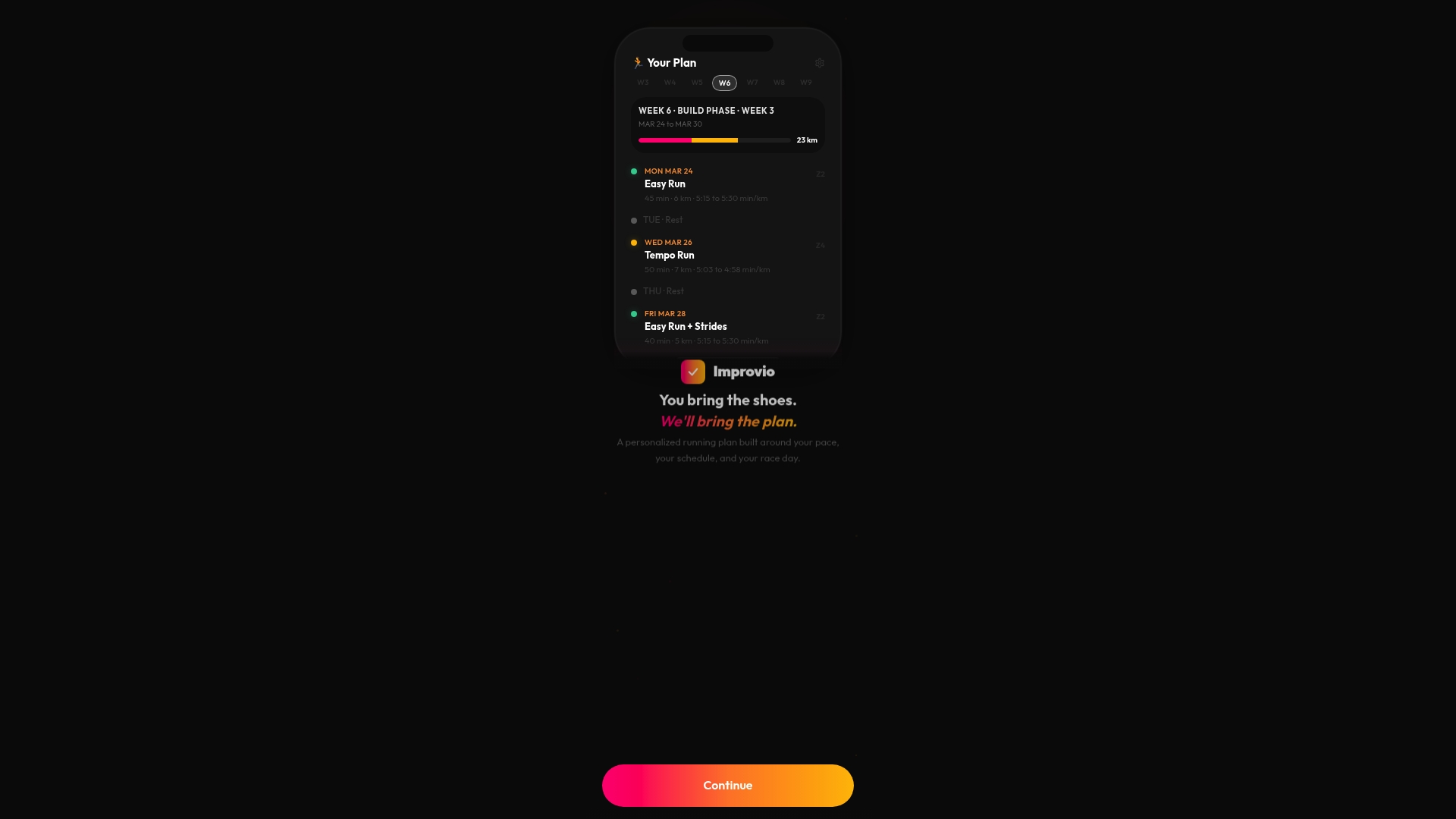
Improvio makes it simple. In about 60 seconds, you get a personalized running plan built around your pace, your schedule, and your race date. No experience needed. No guesswork. Just a clear, day-by-day plan that keeps you moving forward safely. It's free to start, and it's designed specifically for beginners like you. If you're ready to stop guessing and start progressing, check out our training plan guide and take that first structured step today. You bring the shoes. We'll bring the plan.
Frequently asked questions
What is the main benefit of a training plan for beginners?
A training plan gives you structure, gradual progression, and built-in recovery. Structured progression builds aerobic capacity and strength while keeping injury risk low.
How often should beginners run each week?
Most beginner plans recommend 3 to 4 run days per week. 3-4 runs plus strength training twice a week gives your body the best chance to adapt without breaking down.
Can following a training plan prevent injuries?
Yes. Conservative increases and strength work in structured plans significantly reduce overuse injuries compared to unstructured running.
Is a Couch to 5K plan the best starting point for all beginners?
Couch to 5K is a solid starting point, but it's not perfect for everyone. High dropout and injury rates show that personalized plans with ongoing support tend to produce better results.
How long does it take for beginners to see improvement?
You'll likely notice fitness gains in 4 to 6 weeks. Bone remodeling takes 4 weeks to 3 months, which is why gradual increases matter so much in the early stages.