

TL;DR:
- Runner's fatigue is a specific physical and mental warning signal indicating your limits.
- It results from neural, fuel, electrolyte, and muscle activity changes during running.
- Managing fatigue involves structured training, proper nutrition, rest, and listening to your body signals.
You lace up your shoes, head out the door, and a mile in your legs feel like concrete. Your brain tells you to slow down. You think you're just tired, maybe even out of shape. But what you're experiencing is almost certainly runner's fatigue, and it's a lot more specific than simple tiredness. Runner's fatigue is a real, well-studied physical and mental state that affects new and experienced runners alike. Understanding what it is, why it happens, and how to manage it will completely change how you approach your first race training.
Table of Contents
- What is runner's fatigue?
- The science: What causes runner's fatigue?
- How does runner's fatigue feel and affect you?
- How to manage and prevent runner's fatigue
- A smarter way to think about fatigue as a beginner
- Next steps: Put what you've learned into practice
- Frequently asked questions
Key Takeaways
| Point | Details |
|---|---|
| Fatigue is complex | It involves both your brain and muscles working together and is more than simple tiredness. |
| Recognizing fatigue helps progress | Knowing the signs lets you train smarter and prevent injuries or setbacks. |
| Prevention comes from routine | Structured plans, proper rest, and nutrition are your best defenses against runner’s fatigue. |
| Listen and adapt | Fatigue is a useful signal—adjust your training instead of ignoring it for long-term success. |
What is runner's fatigue?
Runner's fatigue is not just feeling worn out after a long run. It's a specific combination of physical and mental signals that tell your body it's working near or past its current limit. For beginner runners, this can feel confusing and even discouraging. But knowing what's actually going on makes it a lot easier to train through it.
At the core, fatigue works on two levels:
- Central fatigue comes from your brain and nervous system. Your brain starts sending weaker signals to your muscles, almost like a phone losing its connection. You feel mentally foggy and your effort feels much harder than it should.
- Peripheral fatigue happens inside your muscles. Your fuel runs low, waste products build up, and your muscle fibers physically struggle to keep contracting.
According to exercise fatigue research, mechanisms include central fatigue from reduced neural drive due to serotonin accumulation, and peripheral fatigue from glycogen depletion reaching 75 to 90%, along with lactate and hydrogen ion accumulation that lowers muscle pH.
For beginners, the most noticeable signs are:
- Heavy or sluggish legs that feel like they're moving through water
- A pace that slows even when you feel like you're working just as hard
- Loss of focus or motivation mid-run
- Shuffling steps or poor posture as your form starts to break down
Runner's fatigue is your body communicating with you, not failing you. Learning its language is one of the best skills you can develop as a new runner.
The good news? Every runner deals with this. It doesn't mean you're weak or unprepared. It means your body is adapting to a new stress. Starting with beginner running workouts that match your current fitness level is a smart way to manage how much fatigue you accumulate in the first place.
The science: What causes runner's fatigue?
With the basics covered, let's explore what exactly is happening inside your body when you feel runner's fatigue.
Many beginners blame lactic acid for the burning sensation in their legs. But lactic acid is only part of the story, and it's actually been misunderstood for decades. Research on fatigue causes shows that acidosis and lactate are not the sole cause of fatigue. In fast-twitch muscle fibers, acidosis can reduce force output by 12 to 22%, but it also has a protective effect on muscle action potentials. So it's more complicated than "lactic acid bad."
Here's a clear breakdown of the main fatigue drivers:
| Fatigue driver | Where it happens | What it does to you |
|---|---|---|
| Neural signal reduction | Brain and nervous system | Makes effort feel harder, slows reactions |
| Glycogen depletion | Muscles | Reduces fuel for sustained effort |
| Electrolyte loss | Whole body | Causes cramps and weakness |
| Calcium handling disruption | Muscle cells | Weakens muscle contractions |
| pH drop from hydrogen ions | Muscle tissue | Reduces force output |
Key stat: Your muscle glycogen, which is your primary running fuel, can drop by 75 to 90% during longer runs, even before you feel completely drained.
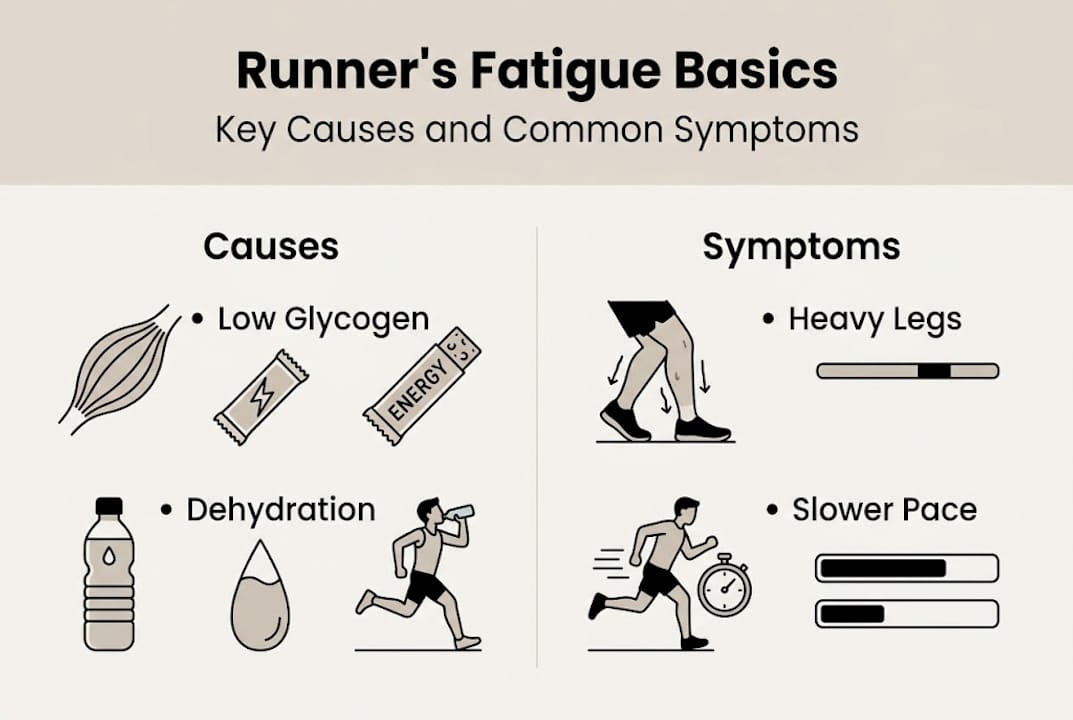
Hydration and electrolytes also play a bigger role than most beginners realize. Sodium, potassium, and magnesium all support nerve and muscle function. When you sweat, you lose them. Even mild dehydration can speed up how fast central fatigue sets in.
Pro Tip: Eating a small carbohydrate-rich snack 30 to 60 minutes before your run helps keep your glycogen stores topped up, so fatigue hits later rather than sooner.
One key insight: fatigue is actually protective. Your body triggers these signals to prevent you from causing real damage. A well-structured approach, like the training plans for beginners built around gradual progression, helps you train close enough to your limit to improve, without crossing into injury territory.
How does runner's fatigue feel and affect you?
Understanding the biology is a huge step, but what does fatigue actually feel like out on the road or in training?
For beginners, runner's fatigue often shows up in a specific sequence:
- Your legs get heavy. This is usually the first sign. Each stride takes more effort than it should.
- Your pace drops without trying. You feel like you're running the same effort, but your speed is lower.
- Your form starts to change. You may shuffle more, lean forward, or shift to a midfoot strike without realizing it.
- Mental fog sets in. Staying focused on your run gets harder. Small distractions become big ones.
- Motivation drops sharply. Even short distances start to feel impossible.
Studies on fatigue interplay confirm that neural decline, metabolic stress, and biomechanical changes all interact under fatigue, with some runners compensating better than others, creating different injury risks.
This biomechanical shift matters a lot. When you're fatigued, your running economy (how efficiently your body uses energy) drops. Your muscles work harder to produce the same output. Over time, this increases your injury risk if you ignore the signals.

Pro Tip: Take a short video of yourself running fresh at the start of a run, then again near the end. Comparing your form will show you exactly how fatigue changes your movement.
Here's the most important distinction to keep in mind: fatigue is reversible with rest. You feel it during or after a run, you sleep well, eat well, and it's gone in a day or two. That's normal. But if heavy legs, soreness, or mental exhaustion persist after rest days, that could signal overtraining or an early injury. Recognizing your personal overtraining signs early keeps you on track and off the injury list.
How to manage and prevent runner's fatigue
Now that you know what fatigue feels like, the next step is developing strategies to work with, rather than against, it.
The single most effective strategy is also the simplest: follow a structured training plan. Runners who increase their weekly mileage too fast, often more than 10% per week, are far more likely to hit severe fatigue and get injured. A smart plan builds stress gradually, so your body has time to adapt.
Here's a quick comparison of two common approaches:
| Approach | What it looks like | Risk level |
|---|---|---|
| Unstructured training | Run whenever, however far, no rest days | High fatigue, high injury risk |
| Structured plan | Gradual mileage increase, rest days built in | Manageable fatigue, lower injury risk |
Beyond structure, there are several daily habits that directly reduce how much fatigue you accumulate:
- Sleep 7 to 9 hours. This is when your muscles actually repair and your glycogen stores refill.
- Eat enough carbohydrates. Carbs are your primary running fuel. Don't cut them out.
- Stay hydrated before, during, and after runs. Even a 2% drop in body water can meaningfully reduce performance.
- Add cross-training. Swimming, cycling, or yoga builds fitness without adding running-specific stress.
- Recover actively. Easy walks or light stretching on rest days support blood flow without adding fatigue.
When it comes to mental training for runners, the goal is not to push through every tough moment blindly. It's to recognize the difference between productive discomfort, which builds fitness, and warning signs that call for rest.
Running motivation tips also help on the days when fatigue feels more mental than physical. A simple goal, a running partner, or even a new playlist can carry you through a tough session. To create a running plan that accounts for all of this, you need one built around your specific schedule, not a generic template.
A smarter way to think about fatigue as a beginner
Most articles tell you to push through fatigue. We disagree, at least partially.
New runners often swing between two extremes: they either fear fatigue and stop at the first sign of discomfort, or they ignore it completely and run themselves into the ground. Neither works. Both lead to frustration and missed race goals.
The smarter move is to treat fatigue as feedback. Your body is telling you something specific. Heavy legs after three straight days of running? That's a rest day request. Mental fog mid-run on an easy pace? Check your sleep and nutrition first before blaming your fitness.
Building a weekly running routine that includes intentional rest and varied effort levels teaches you to read these signals over time. That skill is worth more than any single workout. Runners who learn to listen to fatigue early in their training hit fewer setbacks and cross more finish lines. Fatigue is not your enemy. It's the feedback loop that makes you better.
Next steps: Put what you've learned into practice
You now understand what runner's fatigue is, why it happens, and how to manage it. That knowledge alone puts you ahead of most beginners who just run harder and wonder why they feel worse.
The next step is putting a real structure around your training. The Improvio app builds personalized running plans in about 60 seconds, based on your current pace, your weekly schedule, and your race date. No guesswork, no generic programs. You also get a clear beginner running workflow that takes you from your first easy run all the way to race day, with recovery built right in. You bring the motivation. We'll bring the plan.
Frequently asked questions
What does runner's fatigue feel like for a beginner?
Runner's fatigue feels like heavy legs, mental fog, and a noticeable drop in pace or running smoothness. According to fatigue research, neural decline, metabolic stress, and biomechanical changes all combine to create these symptoms.
What causes fatigue when running?
Fatigue is caused by both central and peripheral factors, including glycogen depletion and neural changes, electrolyte loss, and a drop in muscle pH from hydrogen ion accumulation.
How can a beginner runner avoid or reduce runner's fatigue?
Follow a gradual, structured training plan, prioritize sleep and carbohydrate intake, and stay well hydrated. Structured planning and nutrition can meaningfully reduce the risk and severity of runner's fatigue.
Is it safe to run through fatigue?
Mild fatigue is a normal part of training and generally safe. But running through severe fatigue increases injury risk, especially when form breaks down, so rest when symptoms persist after recovery days.