

TL;DR:
- Effective time management fosters consistency, motivation, and performance in beginner runners.
- Structured training schedules around specific goals reduce injury risk and improve race readiness.
- Personalized planning tools help runners integrate training into busy lives for better race outcomes.
You want to train. You know race day is coming. But somehow the week fills up, workouts get skipped, and you end up scrambling to catch up. Sound familiar? This is the most common struggle for new runners, and it has nothing to do with fitness level or natural ability. It has everything to do with time management. When you organize your training with intention and structure, you build the consistency that actually gets you to the finish line. This guide breaks down why managing your time matters, what the research says, and how you can start applying these strategies right now.
Table of Contents
- Why time management is the foundation of successful training
- How structured training schedules help you reach your race goals
- The risks of ignoring time management in running training
- Smart strategies to personalize time management for your training
- The overlooked truth: Why time management beats talent for new runners
- Take the next step: Time management tools for runners
- Frequently asked questions
Key Takeaways
| Point | Details |
|---|---|
| Daily goals drive progress | Setting daily training goals helps new runners stay motivated and achieve consistent improvement. |
| Structured plans build confidence | A clear schedule lets you track progress, adapt to setbacks, and approach race day prepared. |
| Avoid injury with planned rest | Time management ensures proper recovery periods and reduces the risk of overtraining injuries. |
| Talent isn't everything | Organizing your time and training habits leads to better outcomes than relying on natural ability alone. |
Why time management is the foundation of successful training
Most new runners assume the hardest part of training is the running itself. But the truth is, showing up consistently is harder than any tempo run. Without a plan, good intentions fade fast. You might squeeze in a run here and there, but sporadic effort does not build fitness. Consistent, structured training does.
Think of your training plan as a road map. Without it, you are guessing at every turn. With it, you know exactly where you are going and how long it will take to get there. A solid runner schedule guide helps you see how routine and rhythm directly impact your readiness on race day.
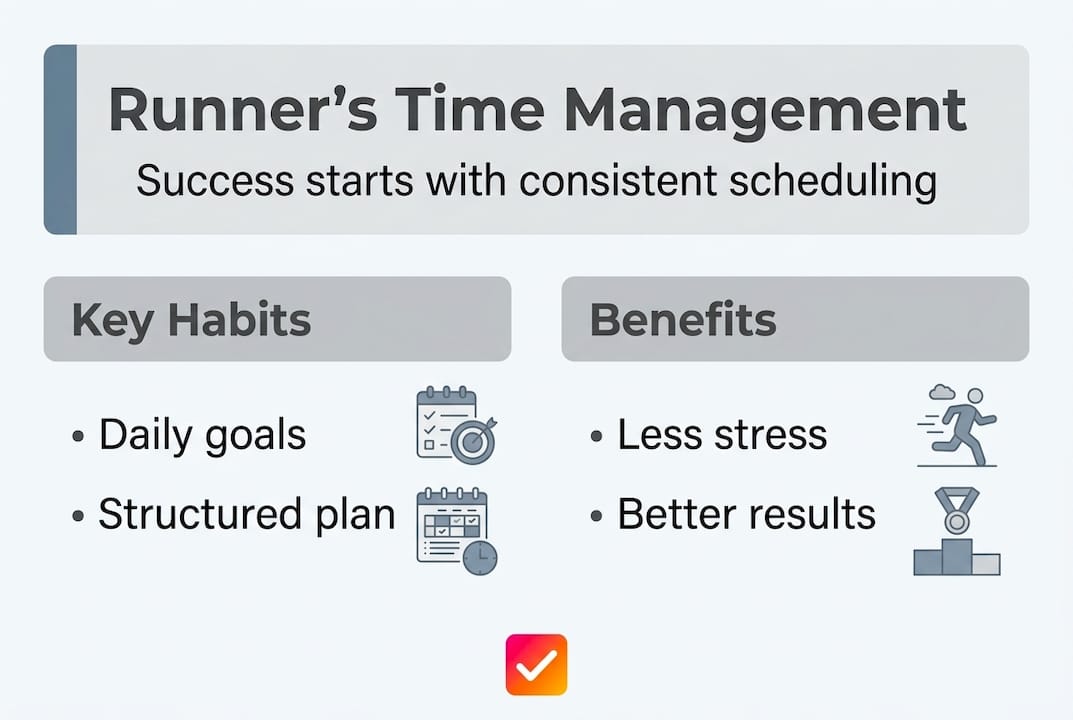
Research backs this up. Daily goals increased physical activity, while weekly goals alone did not produce the same results. The science is clear: "Daily goals and daily plus weekly goals were effective at increasing physical activity, while weekly goals alone were not." Setting a daily intention to run makes you far more likely to actually lace up your shoes.
"Daily goals and daily plus weekly goals were effective at increasing physical activity, while weekly goals alone were not." — Goal-Execution Issue in Exercise: Timing Impacts Efficacy
Here is what effective time management does for new runners:
- Builds motivation. When you schedule a run and complete it, you feel accomplished. That feeling compounds over weeks.
- Creates accountability. A written schedule holds you to a commitment, even on days when you do not feel like it.
- Improves performance. Consistent training builds aerobic capacity, leg strength, and mental toughness steadily over time.
- Prevents overwhelm. Breaking your race prep into daily and weekly tasks makes the goal feel manageable.
- Supports recovery. A schedule includes rest days, which are just as important as your run days.
Daily vs. weekly goal setting for runners
| Goal Type | Effect on Training | Best Used For |
|---|---|---|
| Daily goals only | High consistency, strong daily habit | Short-term momentum and motivation |
| Weekly goals only | Low consistency, easy to procrastinate | Big-picture planning, not execution |
| Daily plus weekly goals | Highest consistency and progress | Full race preparation and long-term success |
Pro Tip: Break your weekly mileage target into daily micro-goals. Instead of "run 15 miles this week," try "run 3 miles today." That one shift keeps your training momentum strong every single day.
Learning setting winning goals is one of the first skills that separates runners who finish their first race from those who never make it to the start line.
How structured training schedules help you reach your race goals
Understanding goal timing is powerful. But knowing how to build a structured schedule around those goals is where real progress happens. Every race has a clock. Your training plan should work backward from race day to today, filling in the weeks with purposeful workouts that build your fitness steadily.

Vague intentions are not enough. Research confirms that runners benefit when they convert training goals into appropriately timed, actionable targets rather than vague intentions. "Run more" is not a plan. "Run an Easy Run for 20 minutes on Tuesday and Thursday, with a longer run on Saturday" is.
Here is how a structured week compares to random training:
| Training Style | Weekly Consistency | Injury Risk | Race Readiness at 8 Weeks |
|---|---|---|---|
| Structured plan | High (5 of 5 sessions) | Low | Strong |
| Random training | Low (2 of 5 sessions) | Moderate to high | Weak |
| No plan | Very low (0 to 1 sessions) | High | Not ready |
The difference is dramatic. Runners on a structured plan complete more sessions, recover properly, and arrive at race day confident. Runners without a plan often overtrain one week and do nothing the next, leaving their fitness inconsistent.
Steps to convert your race goal into a structured schedule
- Identify your race date. Count backward from race day to today. How many weeks do you have?
- Assess your current fitness. Can you run a mile without stopping? That is your starting point.
- Map out your weekly workout types. Include Easy Runs, one longer run per week, and at least two rest days.
- Assign specific days. Monday rest, Tuesday Easy Run, Wednesday cross-train, Thursday Easy Run, Saturday long run, Sunday rest.
- Add progression. Increase your long run distance by no more than 10% each week to build safely.
- Schedule it. Put every workout in your phone calendar with a reminder. Treat it like a meeting you cannot cancel.
Learning making a training plan from the ground up gives you the framework to build a schedule that actually works around your life.
Pro Tip: Set a phone reminder 30 minutes before each scheduled workout. That heads-up gives you time to change clothes, gather your gear, and mentally shift into training mode before the moment arrives.
A beginner running plan removes the guesswork entirely. You get a structured schedule built around your pace and race date, so you are always training with purpose.
The risks of ignoring time management in running training
Skipping your training schedule once feels harmless. Skip it twice and it becomes a habit. Skip it regularly and you risk arriving at race day undertrained, burned out, or injured. Poor time management does not just cost you progress. It can actually set you back.
The most common setbacks new runners face without structure include:
- Overtraining on random days. When you finally do run, you push too hard to make up for lost time. That spikes injury risk fast.
- Missing essential rest days. Recovery is where your body actually gets stronger. Skip rest and your muscles break down without rebuilding.
- Inconsistent mileage. Running 10 miles one week and 2 the next confuses your body and stalls fitness gains.
- Mental burnout. Without a clear plan, training feels chaotic. That chaos drains motivation quickly.
- Missed race goal benchmarks. Every week of skipped training is a week of progress you cannot recover before race day.
Research is direct on this point: converting intentions into actionable, timed targets is what separates runners who succeed from those who stall.
"Runners benefit when they convert training goals into appropriately timed, actionable targets rather than vague intentions." — Goal-Execution Issue in Exercise: Timing Impacts Efficacy
Your body needs predictable stress and predictable recovery to adapt. That is how fitness is built. Without a schedule, you are applying stress randomly. The result is inconsistency at best and injury at worst. A good injury prevention guide can show you exactly how to structure rest and activity to keep you healthy all the way to race day.
The runners who show up to race day healthy and confident are not always the most naturally gifted athletes. They are the ones who followed their schedule. They understood that missing a Tuesday run is not just one missed workout. It disrupts the week's overall load and recovery balance. Every session in a structured plan has a reason. Understanding that makes skipping feel a lot less tempting.
You can see how dramatically a structured plan changes outcomes by looking at training plan transformation stories from real beginners who went from scattered workouts to confident finishers.
Smart strategies to personalize time management for your training
Every runner's schedule looks different. You might work early mornings, have kids to pick up, or travel for work. The key is building a training routine that fits your real life, not an imaginary perfect schedule. Flexibility built into a plan is what makes it sustainable.
Research confirms that daily structured goals drive physical activity more reliably than weekly-only intentions. So the strategy is simple: create a daily plan, but build in wiggle room for when life happens.
Steps to personalize your running schedule
- Audit your week. Write down all fixed commitments: work, family, errands. See where gaps naturally exist.
- Identify your best training windows. Are you sharper in the morning or evening? Do not fight your natural rhythm.
- Assign workouts to open slots. Match workout intensity to your energy levels. Save your longer runs for days with more time and lower stress.
- Set a weekly mileage goal. Then divide it into daily targets that feel achievable, not overwhelming.
- Track every session. Log your runs in an app or notebook. Seeing your progress builds motivation to keep going.
- Review and adjust weekly. At the end of each week, check what worked. Move workouts that consistently get skipped to better time slots.
Tools and apps to help you stay organized
- 🏃 Improvio: Builds a personalized training plan based on your pace, schedule, and race date in under 60 seconds.
- 📅 Google Calendar: Schedule every workout as an event with reminders.
- 📝 Training journal: A simple notebook works. Write your plan, log your runs, and track your mood and energy.
- ⏱️ Strava or Garmin Connect: Track your pace, distance, and heart rate to monitor progress over time.
- 🔔 Phone alarm system: Set multiple reminders before each workout so nothing sneaks up on you.
Understanding why training plans matter before your first race helps you commit to the process with confidence, not guesswork.
Pro Tip: When life throws off your schedule, do not scrap the week. Just shift. Move your missed run to the next available day. Keep your core training intact, even if the timing shifts slightly. Flexibility is not failure. It is smart running.
The structured plan benefits for beginners go beyond fitness. Structure reduces anxiety, builds confidence, and gives you something concrete to follow every single week leading up to your race.
The overlooked truth: Why time management beats talent for new runners
Here is something most training advice skips: natural running talent is far less important than most beginners believe. The runners who consistently cross finish lines are not born with special legs. They are the ones who showed up on schedule, week after week, even when motivation was low.
We have seen this pattern repeatedly. A beginner with no running background follows a structured daily plan and finishes their 5K feeling strong. Meanwhile, someone with natural athletic ability trains casually, skips sessions, and either does not make it to race day or struggles through it.
The data supports this. Organized, daily goal-setting increases physical activity. Raw intentions do not. Managing your time is the mechanism that converts "I want to run a race" into "I ran a race."
"Consistent practice trumps raw talent." The runner who manages their time beats the naturally gifted runner who trains randomly every single time.
This is genuinely good news for you. You cannot change your genetics. But you can absolutely build a disciplined schedule. That is entirely within your control, starting today. The running plans matter insight here is not just motivational. It is measurable. Runners on structured plans improve their pace, endurance, and race outcomes at a far higher rate than those winging it.
Pro Tip: Stop trying to be perfect and start building a habit. A 20-minute run you actually complete is worth ten 60-minute runs you planned but skipped. Habit always wins over heroics.
Take the next step: Time management tools for runners
You have the strategies. Now it is time to put them into action.
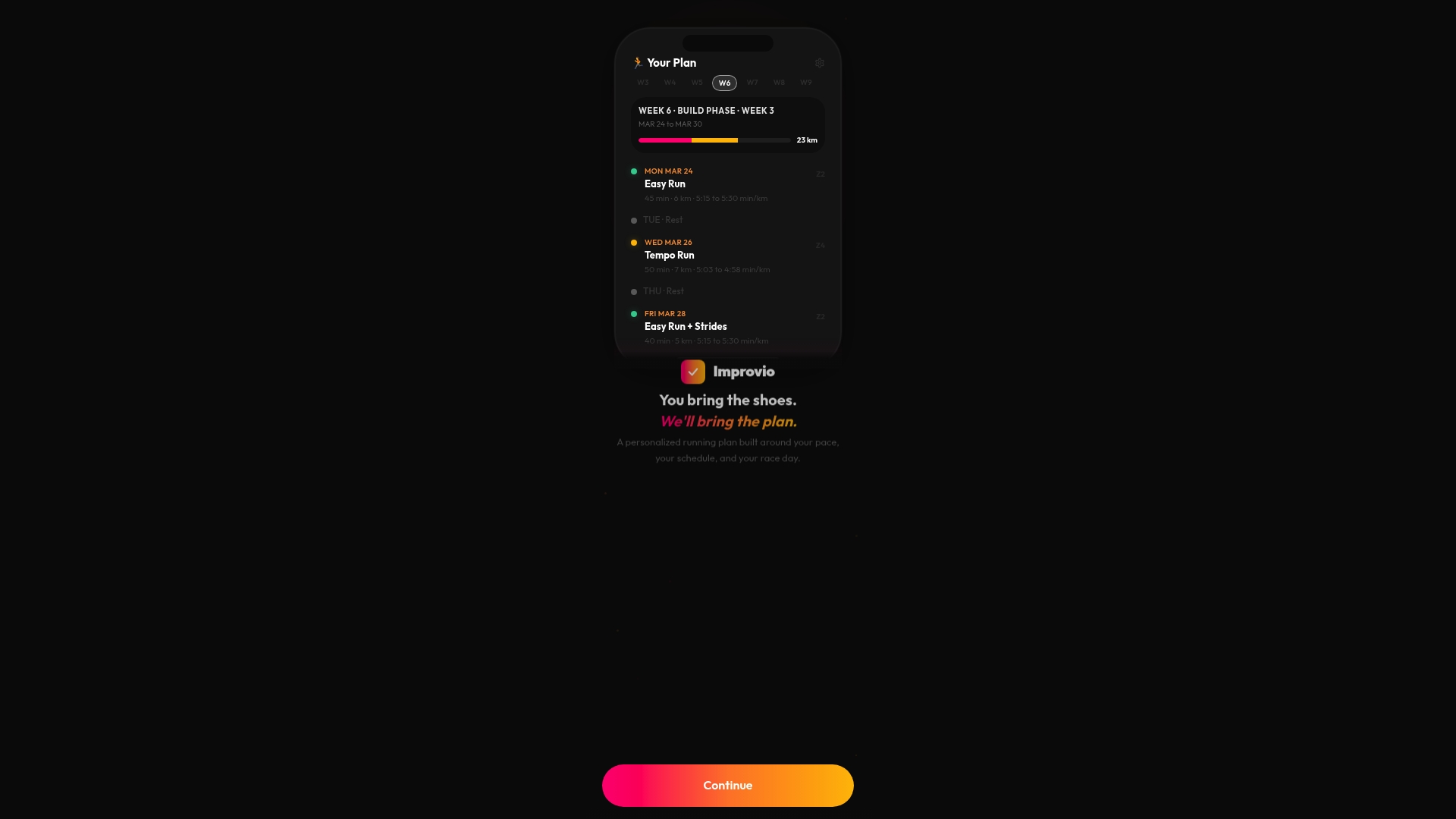
Improvio makes it simple. In about 60 seconds, you get a personalized running plan built around your pace, available schedule, and race date. No guesswork, no complicated spreadsheets. Just a clear, daily training plan that tells you exactly what to run, when to run it, and how to build toward your goal. You bring the shoes. We will bring the plan. Whether you are 8 weeks out from your first 5K or preparing for a longer race, Improvio gives you the structure to train smart, stay consistent, and arrive at race day ready. Start your free plan today and take time management from a challenge into your biggest competitive advantage.
Frequently asked questions
How does time management improve race performance for beginners?
By making training consistent and goal-oriented, time management helps new runners build endurance, avoid burnout, and arrive ready for race day. Research shows that daily goals increase physical activity more reliably than weekly goals alone, directly improving training outcomes.
What is the best way to track running sessions for time management?
Use a training plan, calendar, or dedicated app to schedule and monitor your workouts, adjusting as needed to stay consistent. Apps like Improvio automatically organize your sessions around your actual schedule.
Why are daily goals more effective than weekly goals alone?
Research shows that daily and daily-plus-weekly goals increase physical activity better than weekly-only goals, making training progress more reliable and consistent for new runners.
Can poor time management lead to injuries?
Yes, inconsistent training and missed rest periods raise the risk of injuries for new runners. Converting your goals into appropriately timed targets protects your body by balancing training stress with proper recovery.