

TL;DR:
- Short, 20 to 30-minute run-walk sessions build endurance safely and fit busy schedules.
- Gradual increases in session duration over weeks prevent injuries and promote consistency.
- Focusing on duration and habit formation leads to successful first 5Ks and lifelong running enjoyment.
You don't need to run for an hour to see results. That's the truth most new runners miss. Beginner sessions can start with just 20 to 30 minutes, using run-walk intervals to safely build endurance without burning out. Getting the duration right from day one is what separates runners who stick with it from those who quit after two weeks. This article breaks down exactly how long you should run, why it matters, and how to make it work around your real schedule.
Table of Contents
- Why duration matters for beginner runners
- How duration shapes progress: From 20-minute sessions to your first 5K
- Interval training: Using duration to maximize results and minimize risk
- Avoiding injury: How smart duration choices protect new runners
- Fitting training duration into busy lives: Real strategies for consistency
- Why beginners should embrace short sessions—and ignore 'go long' myths
- Ready to put the right duration into action?
- Frequently asked questions
Key Takeaways
| Point | Details |
|---|---|
| Start short, be consistent | Even 20-minute sessions establish a strong beginner foundation and are easier to stick with. |
| Gradually increase duration | Bumping up your run time by no more than 10% weekly helps progress and reduces injury risk. |
| Intervals boost safety | Using run-walk intervals lets beginners get fitter while minimizing strain and injury. |
| Make it fit your life | Tailor your running duration to your schedule—the habit matters most for long-term gains. |
Why duration matters for beginner runners
Now that you know longer isn't always better, let's explore why duration is such a powerful foundation for safe and successful beginner training.
Most new runners assume more time on their feet equals faster progress. That assumption leads to exhaustion, soreness, and giving up. The reality is that consistent short sessions build your aerobic base (the foundation of your cardio fitness) far more effectively than occasional long runs. Your body adapts to running stress gradually. Give it too much too soon, and it pushes back hard.
20 to 30 minute sessions, done 3 to 4 times per week, help new runners build endurance and fit running into busy lives. That's not a lot of time. It's roughly the length of a TV episode. And it's enough to genuinely change your fitness.
Here's why duration is the right thing to focus on at the start:
- Habit formation: Short sessions are easier to commit to. When running feels manageable, you show up more often, and consistency is everything.
- Reduced injury risk: Your muscles, joints, and tendons take longer to adapt than your cardiovascular system. Keeping sessions moderate protects those tissues.
- Fits real life: You're busy. A 25-minute run is something you can actually schedule. A 90-minute long run is not.
- Better motivation: Finishing a session feeling good beats dragging yourself home after overdoing it.
Understanding the importance of running plans is closely tied to managing session duration. A good plan keeps you in the right time range each week so you never accidentally do too much.
"The goal isn't to run far. The goal is to run again tomorrow." That mindset shift, from chasing distance to building a habit, changes everything for beginners.
Here's a simple breakdown of what beginner session duration looks like in the first few weeks:
| Week | Session length | Frequency | Goal |
|---|---|---|---|
| 1-2 | 20 minutes | 3x per week | Build the habit |
| 3-4 | 25 minutes | 3x per week | Extend time on feet |
| 5-6 | 28-30 minutes | 3-4x per week | Increase endurance base |
| 7-8 | 30-35 minutes | 4x per week | Approach continuous running |
Smart running time management keeps your sessions productive without eating your entire week.

How duration shapes progress: From 20-minute sessions to your first 5K
Understanding why duration matters, let's see exactly how it looks in real-world progress, from your very first run to finishing your first 5K race.
The path from "I can barely run a block" to crossing a 5K finish line is more predictable than most people think. Research backs this up. Beginners reach continuous 30-minute runs in just 1 to 2 months, and a full 5K in 8 to 12 weeks, when following a structured plan. That timeline is achievable for almost anyone who starts with appropriate session durations and follows a progression.
Here's what that structured path typically looks like, step by step:
- Weeks 1 to 2: Start with 20-minute sessions using a 1-minute run, 2-minute walk format. Your lungs and legs adapt together.
- Weeks 3 to 4: Extend run intervals to 2 to 3 minutes. Sessions stay at 25 minutes total. You'll feel the effort getting easier.
- Weeks 5 to 6: Push run intervals to 5 minutes with 1-minute walk breaks. Total session time hits 28 to 30 minutes.
- Weeks 7 to 8: Run 8 to 10 minutes continuously with short walk breaks. You're nearly there.
- Weeks 9 to 12: Run 20 to 30 minutes continuously. Your first 5K is within reach.
The key insight here is that session duration grows gradually, not all at once. You're not jumping from 20 minutes to an hour. Every week adds a small, manageable piece.
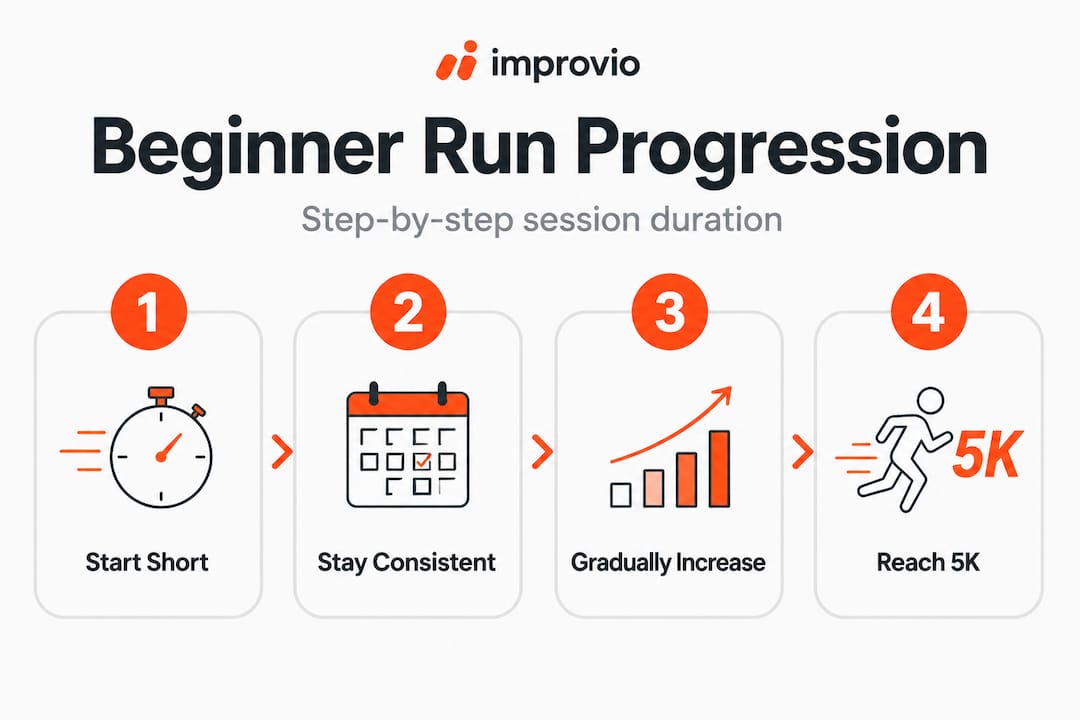
Pro Tip: Don't measure your progress in kilometers or miles early on. Measure it in minutes. "I ran for 8 straight minutes today" is a genuine win, and it will keep you motivated better than tracking pace.
Compare how structured vs. unstructured progression affects beginner results:
| Approach | Average time to 5K | Injury rate | Dropout rate |
|---|---|---|---|
| Structured plan with duration goals | 8-12 weeks | Low | Low |
| Running "whenever, however long" | 16+ weeks (if at all) | High | High |
| Long run focus from week 1 | Variable | Very high | Very high |
Following a beginner running plan that respects duration progression puts you squarely in the first row of that table. A solid 10-week beginner running guide maps out exactly how to move from interval training to continuous running without guesswork.
Interval training: Using duration to maximize results and minimize risk
As you increase session duration, the structure of your workouts, especially intervals, plays a critical role in both results and safety.
Intervals are alternating periods of running and walking within a single session. For beginners, this method is not a shortcut or a compromise. It is the most effective way to build endurance without breaking down your body in the process.
Run-walk intervals, such as 1 minute running followed by 2 minutes walking, within 20 to 30 minute sessions, safely build endurance and fit busy schedules. The walk breaks are not failures. They are part of the plan.
Here's why intervals work so well for new runners:
- They keep your heart rate in a productive zone without pushing into dangerous territory.
- They reduce cumulative impact on joints and tendons, which are the body parts most vulnerable to overuse injuries.
- They make sessions feel achievable. Knowing a walk break is coming in 60 seconds keeps you mentally in the game.
- They allow faster recovery, meaning you can run again in 48 hours instead of needing several days off.
- They mimic natural effort variation, which is actually how experienced runners train on easy days too.
Exploring beginner interval workouts will show you the full range of structures you can use as your fitness improves.
Statistic to know: Overuse injuries account for roughly 70 to 80% of all running injuries in new runners. Interval training, by controlling how long you run at once, is one of the most direct ways to cut that number down for yourself.
Pro Tip: Use a simple timer on your phone or a basic running watch to track your intervals. You don't need fancy gear. Just set a repeating 1-minute alert and alternate between running and walking. Simple, effective, and easy to adjust as you improve.
As your fitness builds, your intervals evolve. A 1-minute run becomes 3 minutes, then 5, then 10. The session length stays roughly the same, around 25 to 30 minutes, but the ratio of running to walking shifts dramatically in your favor. That's real, measurable progress.
Avoiding injury: How smart duration choices protect new runners
While intervals and gradual progression boost your results, avoiding injuries is what keeps you running, and enjoying it, long term.
Injuries are the number one reason beginners quit running. And the leading cause of those injuries is almost always the same: doing too much, too fast, too soon. Your enthusiasm is an asset. But your tendons, ligaments, and bone density need weeks to catch up to your motivation.
Research is clear on this point. Previous injury increases risk for new injuries (OR 2.31), and rapid increases of more than 10% per session raise injury rates significantly. If you've been hurt before, even in a different sport, you need to be especially careful about how fast you ramp up your running duration.
Here are the most important injury prevention habits tied to duration management:
- Follow the 10% rule. Never increase your total weekly running time by more than 10% from one week to the next. If you ran 90 minutes total this week, don't exceed 99 minutes next week.
- Build rest days into your plan. Running 5 or 6 days per week too early is a fast track to injury. Three to four days is the sweet spot for most beginners.
- Listen to your body during each session. Sharp or persistent pain is not normal soreness. It's a signal to stop, rest, and reassess.
- Keep easy runs truly easy. If you can't hold a conversation while running, you're going too hard. Slow down and protect your recovery.
- Don't run through fatigue. Tired muscles lose form, and poor form causes injury.
"The best training session is the one that lets you train again tomorrow." Smart duration choices are how you make that happen consistently.
Detailed tips for injury prevention give you a complete framework for staying healthy throughout your entire training cycle. Pairing those tips with the right weekly beginner schedules ensures your plan already has built-in recovery time.
Fitting training duration into busy lives: Real strategies for consistency
Even with the best intentions, fitting runs into real life can be tough. Here are strategies that actually work for busy beginners.
The most common excuse for not running is not laziness. It's time. Between work, family, and everything else, carving out 45 minutes for a workout feels impossible. But here's the thing: you don't need 45 minutes. Even 10-minute runs support habit formation and health benefits, especially for people with packed schedules.
That means three 10-minute sessions across a day can deliver real results. Morning, lunch, evening. Done.
Here's how to make running fit no matter how busy you are:
- Schedule it like a meeting. Put your runs in your calendar with specific times. Treat them as non-negotiable appointments.
- Lay out your gear the night before. Reducing friction makes it harder to skip. Shoes by the door, clothes already out.
- Use lunch breaks. A 20-minute run during your lunch hour is entirely doable. Pack your gear the night before.
- Split sessions when needed. Two 15-minute runs in a day count. Your body doesn't know the difference between one session and two.
- Aim for consistency over perfection. Missing one session is not a failure. Missing a week is when you lose momentum. Show up most of the time and you'll make progress.
- Use a simple, pre-built plan. Decision fatigue is real. When your plan tells you exactly what to do and for how long, you just show up and execute.
Pro Tip: If time is genuinely tight, replace one longer session with two shorter ones during the same week. A 25-minute run split into two 12-minute sessions still counts toward your weekly total. Progress doesn't require perfection, it requires showing up.
An easy running schedule removes all the guesswork about when and how long to run each week. And a clear guide on step-by-step endurance building shows you exactly how those sessions stack up over time.
Why beginners should embrace short sessions—and ignore 'go long' myths
Here's the honest perspective: the "go long" mentality is one of the most damaging myths in beginner running culture. Somewhere along the way, distance became a badge of honor. People share 10-mile runs on social media. Race posters emphasize half marathons and marathons. New runners absorb this messaging and assume they need to do the same, right now, from week one.
They don't. And chasing that model too early is exactly why so many people get injured and quit within the first month.
The runners who reach their first race, who actually cross a finish line, are not the ones who went longest in week two. They're the ones who ran three times a week for eight straight weeks. Consistency, not heroism, wins. Short sessions done repeatedly build the aerobic base, the mental habit, and the physical resilience that long runs require.
We've seen this pattern play out over and over. A runner starts strong with ambitious long runs, gets shin splints by week three, and stops entirely. Another runner starts with 20-minute intervals, feels a little silly going so easy, but sticks with it. By week ten, they're running their first 5K. The second runner won. Not because they had more talent, but because they respected the process.
Short sessions also protect something harder to measure: your enjoyment of running. When you finish a session feeling strong instead of wrecked, you want to do it again. That positive reinforcement is what turns a new runner into a consistent runner.
Tracking your beginner race milestones matters too. Celebrating small wins, like your first 10-minute continuous run, builds the momentum that carries you to bigger ones. Ignore the myth that short means weak. Short means smart.
Ready to put the right duration into action?
You now have a clear picture of how session duration drives real results for beginner runners. The next step is putting it into practice with a plan built around your schedule, your pace, and your race date.
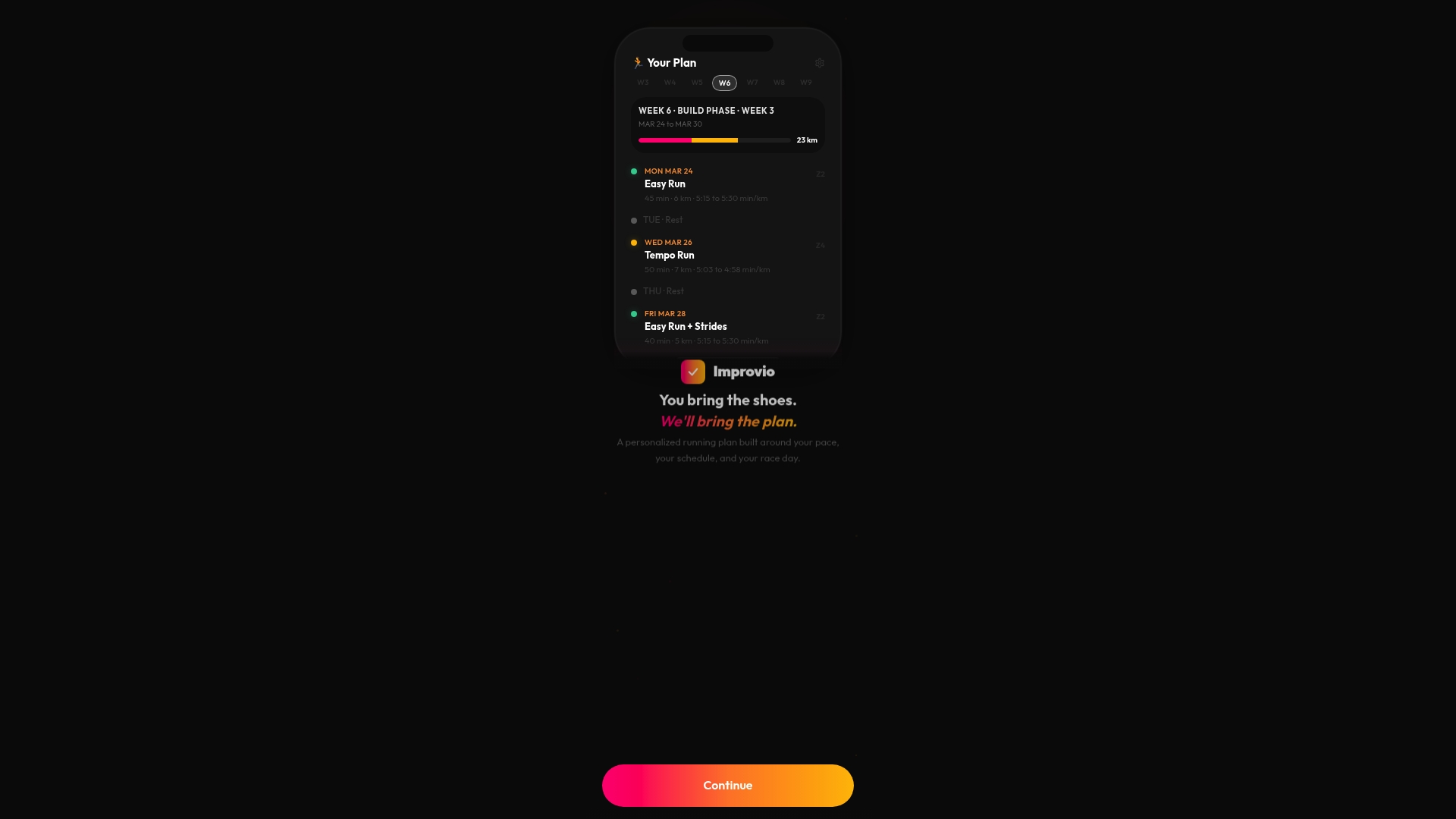
That's exactly what Improvio is built for. In about 60 seconds, you can get a personalized running plan that maps out your sessions week by week, tells you exactly how long to run each day, and adjusts as you progress. No guesswork. No overly ambitious long runs from day one. Just a smart, structured plan that fits your life and gets you to the finish line. You bring the shoes. We'll bring the plan.
Frequently asked questions
How long should a beginner runner's first session be?
Start with 20 to 30 minutes, using run-walk intervals, for the safest and most effective introduction to running. This gives your body enough stimulus to adapt without overwhelming it.
How quickly can I progress to a continuous 30-minute run?
Most beginners reach this milestone in 1 to 2 months of regular, structured training. Following a plan with gradual progression is the fastest way to get there safely.
Is 10 minutes of running enough to be effective?
Yes, 10-minute sessions are enough to maintain your running habit and deliver real health benefits, especially when life gets busy. Consistency with short sessions beats occasional long ones every time.
How much can I safely increase my running duration per week?
Keep your weekly increases at 10% or less. Rapid spikes above 10% per session significantly elevate injury risk for new runners. Slow and steady progression is the safest path.
What if I have a history of injury?
Previous injury raises your risk for new injuries by more than double, so start with shorter durations and progress even more cautiously than a typical beginner. Consider checking in with a physical therapist before beginning your plan.